
RAYPCB · ENGINEERING GUIDE
IPC-4101: Laminate Specification and Purchase Callouts
IPC-4101 is a material specification for base materials used in rigid and multilayer printed boards. It helps define what laminate or prepreg is being purchased; it does not, by itself, accept a completed PCB. A useful IPC-4101 callout identifies the applicable revision and specification sheet, then connects that requirement to the actual material grade and construction.
This guide focuses on that purchase and engineering handoff. If you need an overview of material families, start with the PCB material directory. If a drawing already contains an IPC reference but the supplier proposes a different grade, use the evidence worksheet below to make the unresolved questions visible before accepting the substitution.
Start with the material being supplied
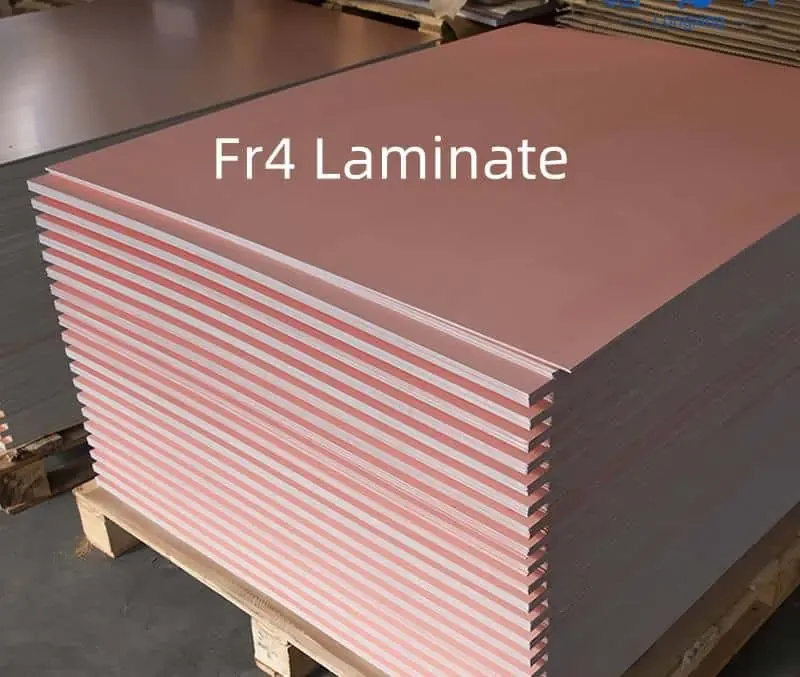
Identify whether the order concerns copper-clad laminate, unclad laminate or bonding material. Those forms enter manufacturing at different points. A cured core holds its existing thickness while a prepreg is processed into a bond layer whose finished condition depends on the stackup and lamination process. Calling both items FR-4 does not establish an interchangeable purchasing requirement.
Record the supplier grade and full suffix, supplied thickness, copper foil where applicable, resin or glass construction information and packaging identity. Keep the supplier document revision with the callout. This allows a receiving inspection or later failure review to identify what was actually ordered rather than reconstructing the choice from a generic material family.
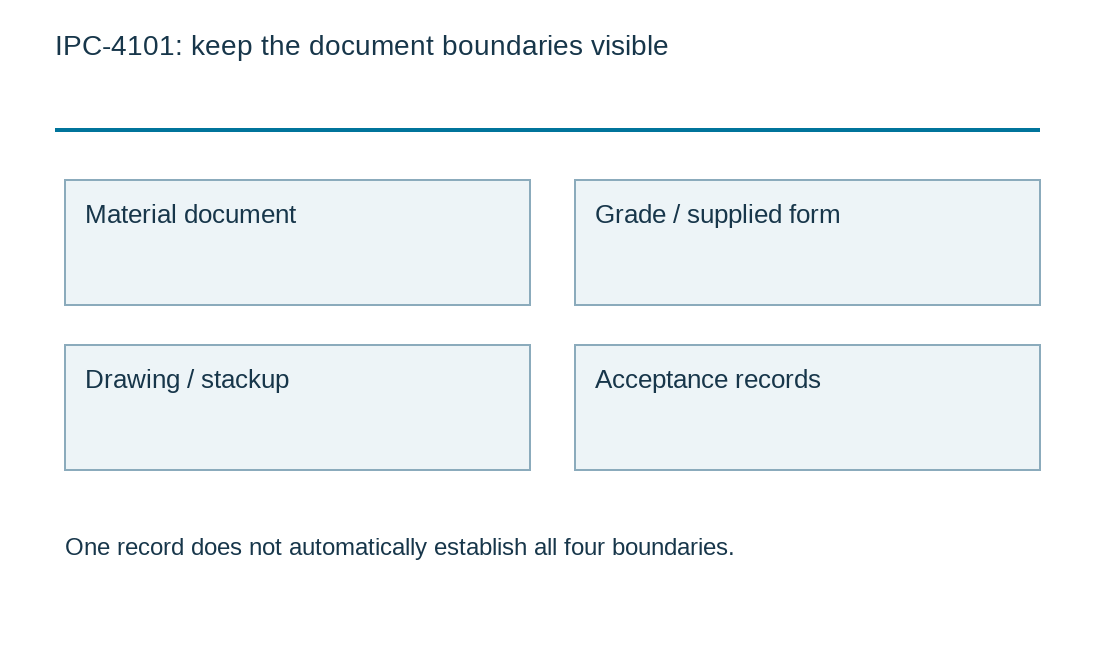
Four different requirement boundaries
| Boundary | What it controls | What it does not establish |
|---|---|---|
| Material specification | Named laminate or bonding-material requirements | Finished board acceptance by itself |
| Supplier datasheet | Product characterization and declared limits | Universal equivalence to another grade |
| Fabrication drawing | Project geometry and construction | Independent material qualification |
| Acceptance record | Evidence for a specified deliverable | Blanket future-lot or product approval |
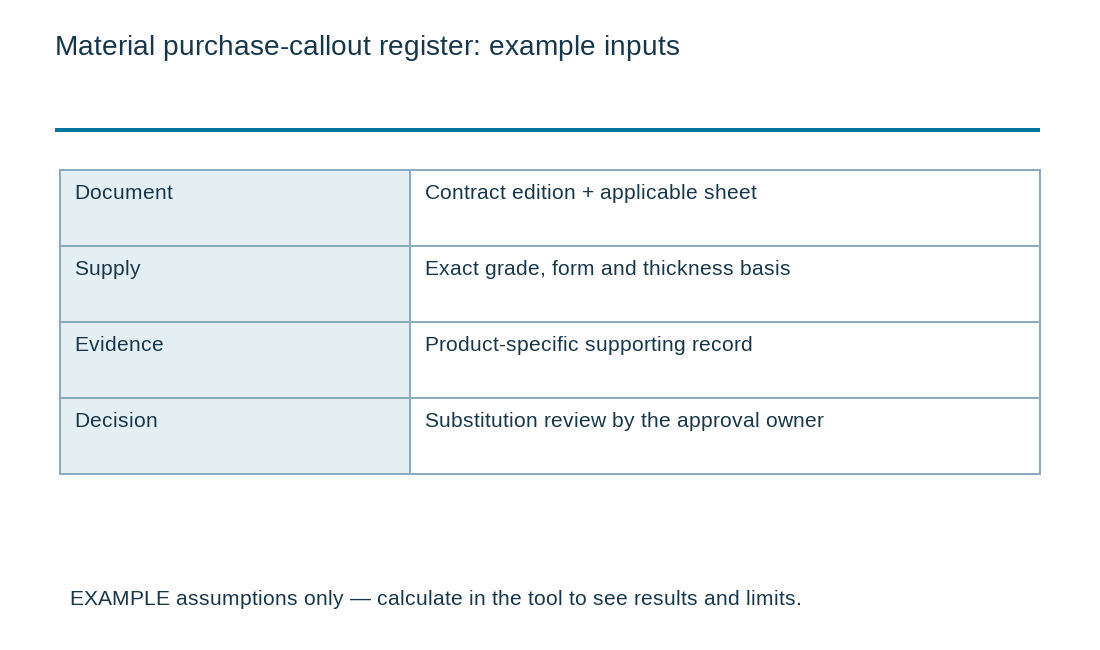
Material purchase-callout register
Material purchase-callout register
Use the current inputs and keep the assumptions
Start with the example only to inspect the units and the calculation boundary. Replace every assumption with a value tied to your own document or measurement. An empty numeric field is not zero. The review-reference field is a local label; avoid entering customer names, confidential part numbers or other private information into a public worksheet.
After calculating, read the notes alongside the numerical result. Changing any input invalidates the displayed result and disables its download until you calculate again. For a comparison, keep the units, geometry, material condition and measurement boundary consistent. A long decimal result does not imply equally precise input data. The downloadable record stays on your device and can be attached manually to an inquiry. It is not automatically transferred into the Contact form.
If an input is unknown, identify the person or document needed to resolve it. Do not fill a gap with a favorable generic value simply to obtain a result. You can request a material or fabrication review without using the tool. The arithmetic illustrates a relationship; it does not accept a construction, certify a material, establish current pricing or replace a supplier process specification.
| Input | What to establish before using it |
|---|---|
| Review reference | Nonconfidential revision label. |
| Requirements and evidence · CSV | Status is Open, Recorded or Not applicable. Recorded needs a source reference; exclusions need a reason. |
Read the revision and slash sheet together
The public IPC revision table lists IPC-4101 E with Amendment 1, dated April 2022. A project may deliberately name another contractual edition. Confirm which edition governs before changing a legacy drawing to the newest listed document. A revision change can affect requirements and evidence; it is not merely a filename update.
A slash-sheet designation narrows the material specification within the standard. It is not a universal supplier part number. Do not select a sheet solely because a reseller describes its Tg as similar to another material. Obtain the controlled specification and compare the actual requirements with the supplier's declared grade and form. The public table of contents is useful for scope but does not replace the complete document.
| Review item | What to establish |
|---|---|
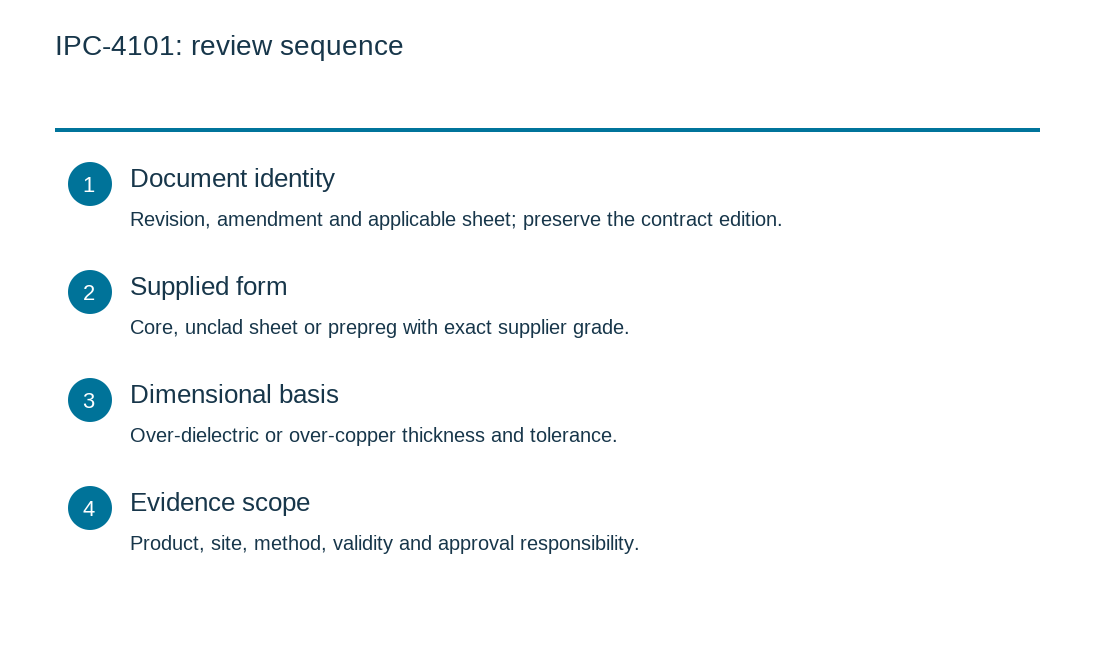
| Document identity | Revision, amendment and applicable sheet; preserve the contract edition. |
| Supplied form | Core, unclad sheet or prepreg with exact supplier grade. |
| Dimensional basis | Over-dielectric or over-copper thickness and tolerance. |
| Evidence scope | Product, site, method, validity and approval responsibility. |
Define thickness without counting copper twice
A thickness callout should state whether it is measured over dielectric or over copper. For example, a hypothetical 0.20 mm cured dielectric with 18 µm copper on both sides has a simple over-copper sum of 0.236 mm before tolerances. That is not the same requirement as a 0.20 mm copper-clad sheet measured over its outer surfaces.
Carry the measurement basis into the stackup and purchase list. For an etched inner layer, copper clearance regions and local surface features also matter. Use the PCB core thickness worksheet when reconciling dimensions, then ask the fabricator to confirm the supplied and finished construction. A numerical sum alone cannot establish a finished-board tolerance.
Separate a typical datasheet value from acceptance
Material datasheets often contain typical properties, test descriptions and product-positioning information. A typical value helps an engineer understand a grade, but it is not automatically the minimum or maximum supplied-lot limit. Identify which requirements are controlled by the specification, which are supplier guarantees and which are characterization only.
The evidence record should preserve the method, conditioning, direction and unit. A thermal property measured in one direction or by one technique should not silently replace a differently defined requirement. The datasheet reading guide explains how to retain those footnotes. When a value is missing, mark it open and request the appropriate evidence instead of copying a number from a similar grade.
Review qualification claims at their actual scope
A qualified product listing, a supplier declaration and an individual test report answer different questions. Check the named manufacturer, site, product, material form, revision, validity and applicable scope. A listing for a laminate does not certify every fabricator that uses it, nor does it automatically validate every board construction made from it.
For a repeat program, define what records are required with each delivery and what changes need approval. Supplier site, resin formulation, reinforcement, foil treatment or grade suffix can matter even when the broad material name is unchanged. Keep the change-notification requirement proportional to the project instead of assuming that a one-time datasheet comparison controls all future lots.
Keep design, material and finished-board requirements separate
The material specification supports one part of the manufacturing contract. A rigid-board design document addresses a different task, and a finished-board performance specification addresses another. A drawing that says only IPC-4101 leaves many decisions about holes, copper, dimensions, inspection and acceptance unresolved.
Use IPC-2222B design handoff for the relationship between sectional rigid-board design and fabrication information. Where high-frequency material requirements lead to an IPC-4103 reference, use the scope comparison rather than treating the two document numbers as competing quality grades. The correct set of requirements follows the product and construction, not the highest-looking standard number.
Worked example: a proposed material substitution
Suppose a drawing identifies a grade, an IPC revision and sheet, a dielectric thickness basis and a controlled-impedance stackup. Purchasing receives a proposed substitute described only as high-Tg FR-4. The right next step is not to approve it from the headline Tg. First obtain its full identity and compare the requirements that affect this board.
Review thickness availability, electrical data at the relevant conditions, thermal behavior, copper treatment and the fabricator's process compatibility. Revisit impedance geometry if the design input changes. Record which requirements remain equivalent and which need analysis, testing or customer approval. This is an illustrative workflow, not a claim that a particular substitution has been qualified by RAYPCB.
Build the inquiry around an answerable question
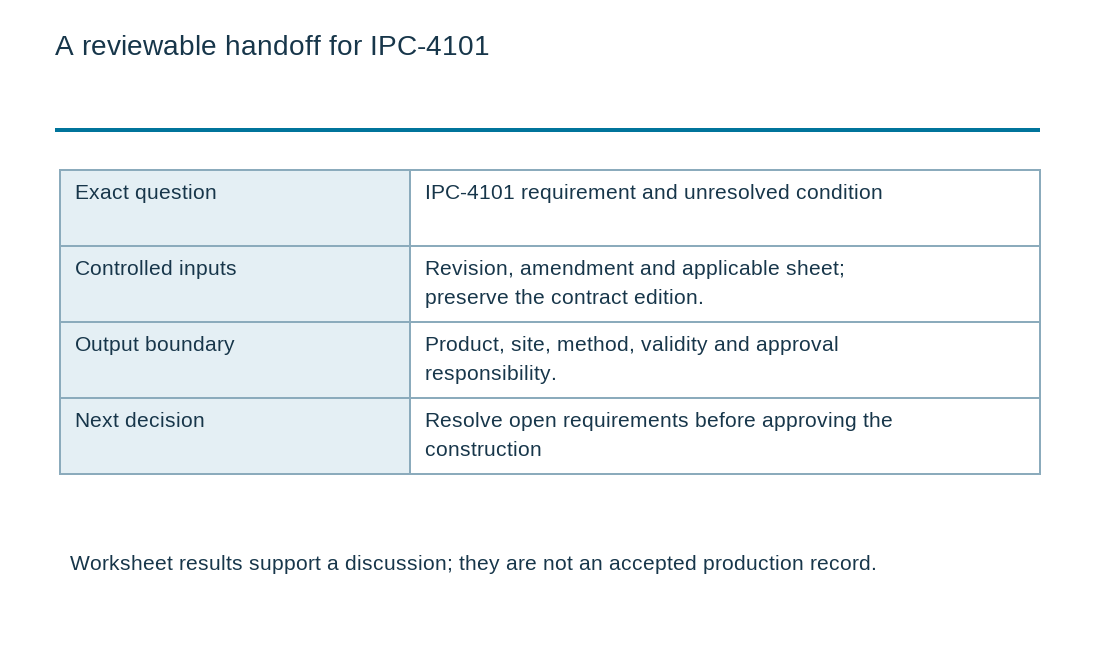
Send the material callout, stackup, fabrication drawing, quantity and the exact uncertainty. Examples include whether a proposed grade meets the named material requirements, whether the thickness basis is understood, or whether a documented alternative needs geometry changes. Include the required evidence deliverables and the approval owner.
The worksheet accepts a structured evidence register and highlights open records. It cannot read the full licensed standard, authenticate a certificate or approve a lot. Download the local summary only if it helps the discussion. You can request a review directly, and any final quotation should identify the agreed material and unresolved exceptions rather than relying on a generic compliance phrase.
Turn a material question into a reviewable purchase requirement
A useful material callout connects the required function to a named document, a measurable condition and an approval owner. Keep the exact grade and supplied form with the thickness basis, copper treatment, test method and substitution rule. This prevents a purchasing shorthand from silently replacing a more precise engineering requirement.
Distinguish typical characterization from a guaranteed supply limit. A typical result may help compare options, but it is not automatically the acceptance value for an incoming lot. If a supplier proposes an alternative, compare the properties that affect this design and the manufacturing evidence needed to use it. Record the decision with a drawing or material-list revision instead of leaving it only in an email thread.
For an inquiry, provide the construction, required quantity, application conditions and any nonnegotiable specification references. Ask which requirements need additional evidence or lead time. A clear open question usually produces a more useful response than a broad request for the best laminate.
Standards, source context and limits
Use the edition, amendment and material-document revision named in the purchase agreement. A standards title, marketing label or supplier product family does not establish that a particular lot meets a requirement. Public summaries are useful for scope; the controlled specification and applicable test method govern acceptance.
The examples on this page are illustrative engineering scenarios. They are not RAYPCB production records or guaranteed material values. Source links identify the organizations responsible for the referenced information. Confirm applicability to the exact grade, construction and test condition before carrying a number into a drawing or qualification report.
For fabrication scope and the agreed construction requirements, see PCB manufacturing.