
RAYPCB · ENGINEERING & PROCUREMENT
PCB Assembly Order Checklist: From Approved Quote to Build Release
A PCB assembly order should connect an approved quotation to the exact files, materials, test requirements and delivery conditions that will be built. Sending a purchase order does not resolve an ambiguous BOM or release an unapproved substitute. This checklist focuses on the stage after quotation, helping procurement, engineering and quality teams close the handoff before assembly begins.
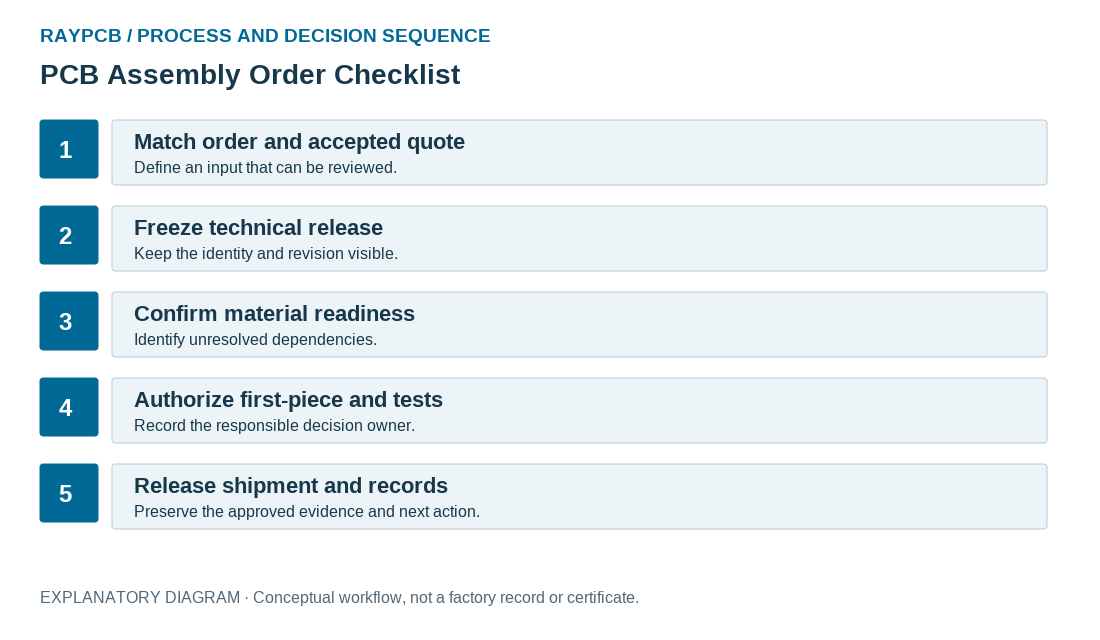
Your task: Match order and accepted quote. Use the assembly order release review to record the next decision.

Tie the order to a specific quotation and revision
Reference the accepted quotation and its date or identifier. State the ordered quantity, product revision, population option and required deliverable. Check whether the quotation assumed a different quantity, construction or test scope.
Attach or reference one controlled file manifest. Do not rely on same as last time when several versions have been discussed. If the purchase order contains terms that differ from the offer, resolve them explicitly before release.
The PCBA quote requirements guide covers preparing the request. This page starts once the commercial and technical offer is being converted into an executable order.
Close engineering queries before they become instructions
Review every open question about fabrication, materials, component identity, orientation, special operations and testing. Assign an authorized owner to each. Record the approved answer in the controlled build package or a clearly referenced instruction.
If a query changes design intent, the responsible engineer should approve it. A purchasing response intended only to keep the schedule moving may not be adequate technical authorization.
Some issues can be accepted temporarily for a defined lot; others require a hold. State scope, quantity, expiry and release authority for any temporary acceptance. Avoid leaving a vague email waiver that later appears to authorize every repeat order.
Confirm material readiness and purchasing authority
Separate parts received and accepted from parts merely ordered or quoted. For customer-supplied material, reconcile the kit against the released BOM and required quantities. For supplier purchases, confirm approved alternatives and any commitments requiring consent.
Define ownership and disposition of excess components. Identify noncancelable or special-order items before authorizing them. If a build quantity changes, revisit reservations and allowances rather than assuming all purchasing assumptions remain valid.
Use component kitting for physical readiness and inventory management for reserved and returned stock. A kit-complete label should correspond to actual reconciled evidence.
Release programs, firmware and test instructions
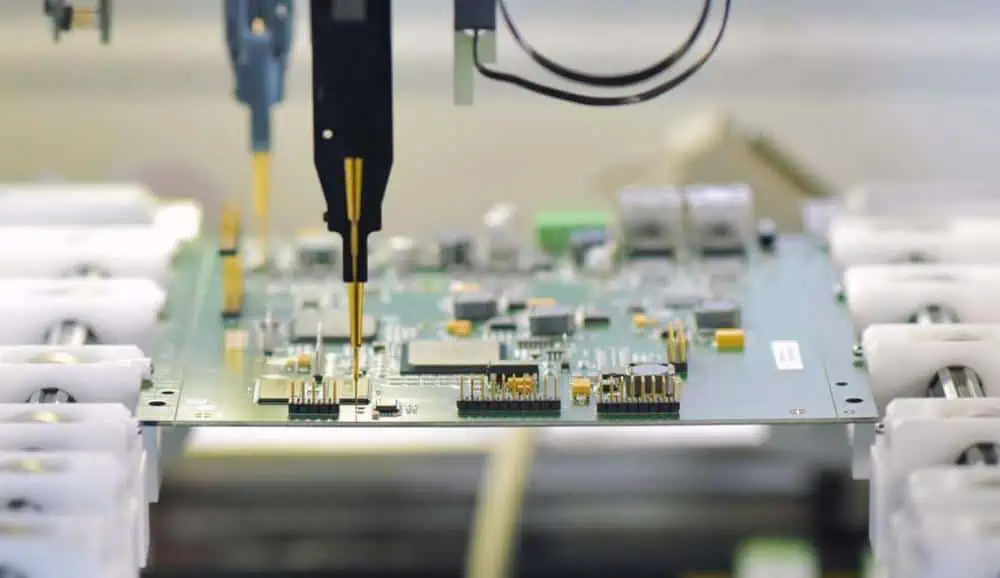
Specify the software image, programming procedure and verification required when programming is in scope. Identify configuration or serial-number requirements. Handle credentials and secure provisioning through an appropriate agreed process rather than putting secrets into a general order note.
Functional tests need an approved method, fixture, limits and failure disposition. Confirm who supplies and maintains them. Inspection requirements should also identify applicable process and acceptance documents.
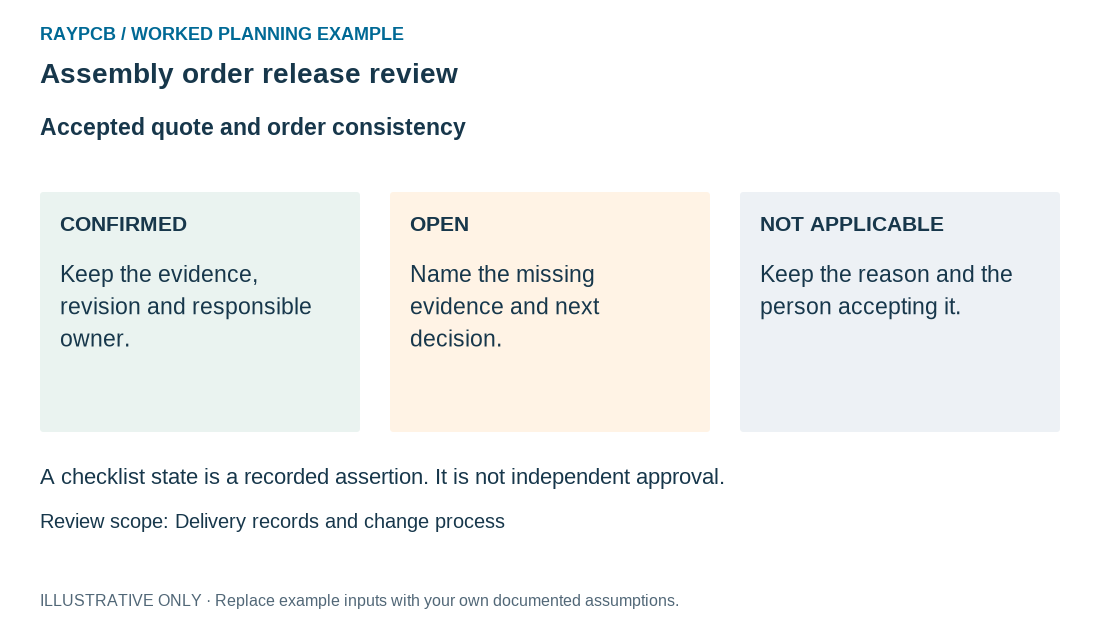
The worksheet summarizes unresolved release categories. It does not authorize production or replace an order acknowledgement.
Assembly order release review
Assembly order release review
How to use and interpret this worksheet
Choose a narrow review boundary before filling in the worksheet. Use one product revision, one proposed build or one supplier decision. If several configurations differ, keep separate records or explain precisely which evidence applies to each. A short reference is enough; the tool does not need drawings, customer names, confidential part lists or passwords.
For every item, distinguish confirmed evidence from an unresolved assumption. Confirmed means that the responsible person has reviewed the relevant information, not merely that a document exists somewhere. Open means the decision or evidence is still missing. Not applicable requires a rationale because it is an applicability decision, not a shortcut to completion.
Record a concrete next action with an owner and a target decision point. For example, replace ask engineering with obtain the approved revision from the design owner before material release. The useful output is an actionable handoff, not a readiness percentage. No weighted score is used, because the consequence of one mandatory gap may exceed that of several completed items.
Load example only to learn the controls. Example mode remains clearly labeled even if you edit its values. Clear the form before entering your own review. Changing an input invalidates the old result and disables its download until you generate a new record. Download the current text if it helps your discussion; it is not automatically added to an enquiry.
Keep supporting approvals and measured results in the controlled project system. This worksheet stores nothing between visits and does not verify files, supplier statements or legal applicability. A completed record can support a review meeting, but the authorized team remains responsible for the release decision.
An order can be commercially approved while still technically on hold. Keep those states separate so nobody interprets payment or purchase-order receipt as permission to bypass an unresolved engineering issue.
Keep a decision record with the review
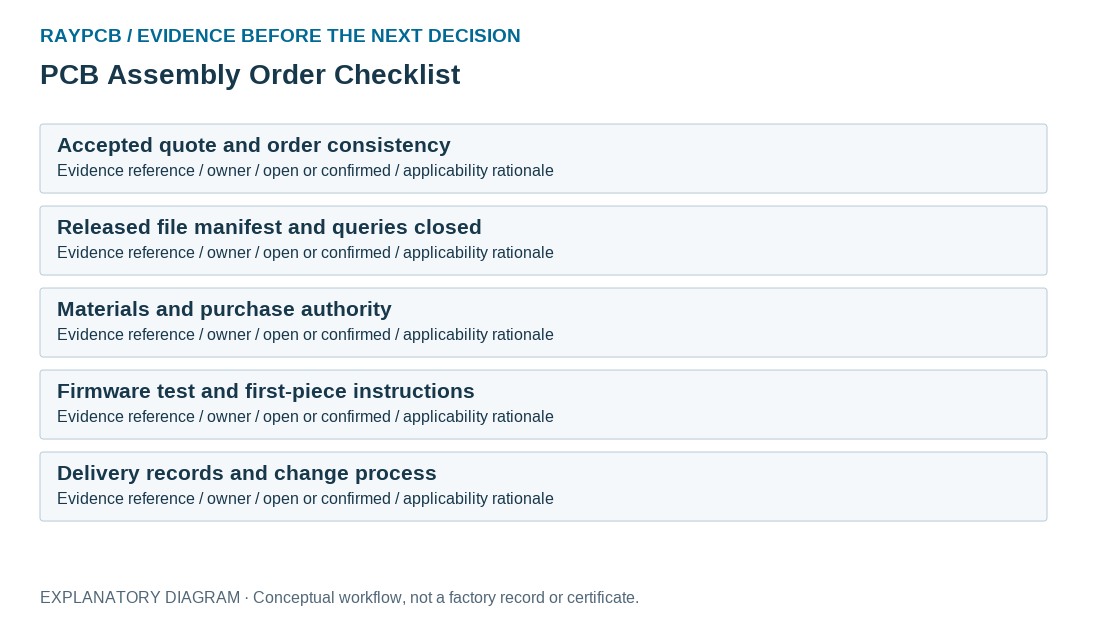
Use this record to connect the discussion to supporting information. Record the source, revision and reviewer for each item. Confirmed means the responsible person has reviewed the evidence; it does not mean this website has verified it. Keep confidential documents in your approved project system.
| Review topic | Record to retain | When it remains open |
|---|---|---|
| Accepted quote and order consistency | Identify the controlled scope and the person authorized to approve it. Keep the current reference together with the intended decision. | Clarify the boundary before treating the review as a release instruction. |
| Released file manifest and queries closed | Reference the actual file, data source or agreed requirement, including its revision or date and the person who reviewed it. | Request the missing evidence and identify which downstream decision depends on it. |
| Materials and purchase authority | Record the conditions and assumptions that make the evidence applicable. Separate a proposed value from an approved requirement. | Keep the assumption visible and define whether the next activity may proceed under a bounded exception. |
| Firmware test and first-piece instructions | Identify responsibility for the next operation and the evidence expected afterward. Distinguish preparation from a completed result. | Assign a named role and an agreed decision point; do not turn an unanswered question into an approval. |
| Delivery records and change process | Record the final disposition, affected quantity or revision and the authority accepting it. Preserve the reason for any exception. | Retain the item in the action list and review its consequence before committing work or materials. |
Review the record again when the product, supplier proposal or supporting data changes. A result from an earlier revision is historical evidence, not automatic approval for the current one. If an item is not applicable, retain the reason and the person who made that decision.
Agree first-piece and lot release responsibilities
If a first-piece review is required, define the sample, evidence, reviewer and response process. Identify what triggers a new review after a change. A photograph alone may not address the functional or internal conditions that matter.
State whether the supplier can proceed with the rest of the lot before customer review and under what conditions. Do not leave that decision to an assumption during a tight schedule.
A hypothetical controller order may require confirmation of connector orientation, fitted options and firmware before the remaining units run. The correct review scope follows the specific risks, not a fixed universal first-article template.
Confirm delivery, packaging and accompanying records
State the delivery destination and required arrival or ship date clearly. Confirm the schedule start condition and distinguish production interval from transit. Provide packaging, labeling and documentation requirements that affect release.
Specify whether partial shipments are permitted and how quantities and revisions will be identified. Agree any records to accompany the lot, such as inspection summaries or traceability documents, rather than assuming every available record is automatically included.
For schedule uncertainty, use manufacturing lead-time risk planning. A worksheet date is not a supplier commitment until the relevant assumptions and capacity are confirmed.
Handle changes after release as controlled events
When a file, part or instruction changes, identify affected work in progress, materials and completed units. Ask for the impact on cost, timing and verification. Do not replace a file in a shared folder and assume every participant notices.
Keep the old baseline for traceability and the new baseline clearly marked for use. Define disposition of partially built units and any rework instructions. Changes should not erase the records needed to understand earlier deliveries.
Use the IPC standards framework for the scope of process and acceptance documents. The agreed order must still identify the applicable revisions, class and special requirements rather than relying on a generic compliant label.
Questions before releasing assembly
Does an accepted quote release the files? It establishes the commercial offer, but the order should identify the approved technical package and remaining conditions.
Can parts be changed after purchase? Changes need review of technical suitability, material commitments, schedule and affected units.
What should RAYPCB receive? Send the approved quotation reference, order quantity, controlled file manifest, material status and release responsibilities. PCB assembly is the board-level route. The checklist is optional and no order, payment or production booking is performed by the tool.