
RAYPCB · ENGINEERING GUIDE
Isola FR402 PCB: Legacy Material and Drawing Review
An Isola FR402 PCB inquiry often begins with an older drawing rather than a new material selection. The first useful task is to recover the controlled specification and determine what must remain unchanged. A familiar FR-4 description alone is not enough to replace the material in an established design.
This page keeps the FR402 URL focused on legacy specification review. The Isola material overview owns the broader current-family comparison; a proposed alternative remains a documented engineering change.
Establish what the available document proves
An official Isola FR402 prepreg safety document establishes the product name and supplied form. A safety document is not a technical performance table. It cannot supply missing GHz design values, a qualified press cycle or current orderability simply because it names the material.
Obtain the original technical sheet and revision used by the drawing. Keep the part number, glass style, resin content and cladding information where available. This guide does not publish a reconstructed FR402 specification by borrowing values from FR406 or another high-Tg material.
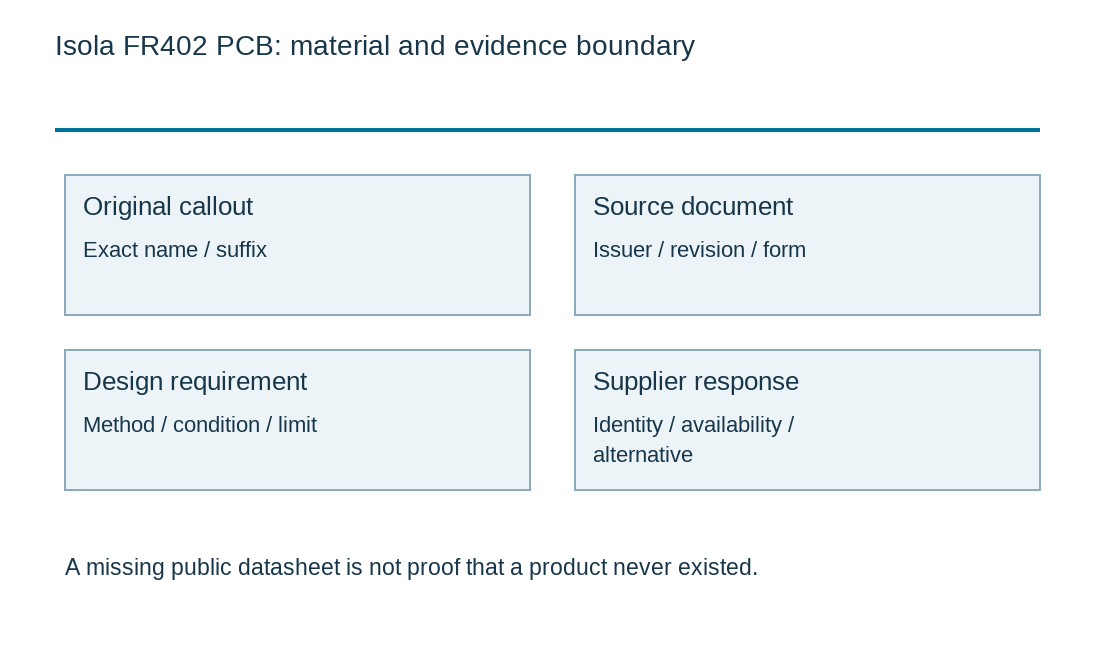
Evidence and construction decision
| Item | Source or model boundary | Action for the design review |
|---|---|---|
| Available evidence | FR402 safety document | Supports identity, not a complete performance table. |
| Missing evidence | Controlled TDS for the original callout | Ask for source revision before substitution. |
| Lifecycle | Not established by this review | Do not infer discontinued status from a missing search result. |
Recover the original design requirement before selecting an alternative
Identify which requirements actually drove the original choice. They may include insulation, soldering exposure, hole construction, mechanical fit or a controlled customer material list. An older part can have modest electrical needs but strict configuration-control obligations.
Record the evidence that supported the original build: approved stackup, qualification report, supplier certificate or customer acceptance. A successful historical board does not prove that every modern replacement is equivalent. Conversely, the age of a drawing is not evidence that its material must be discarded.
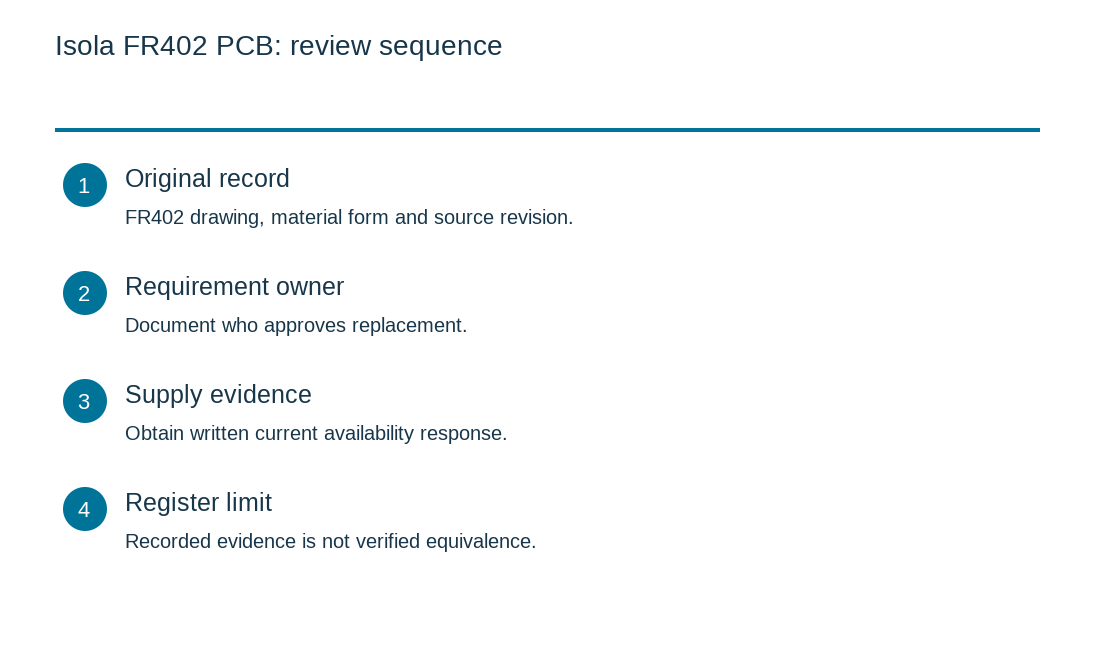
| Review item | What to establish |
|---|---|
| Original record | FR402 drawing, material form and source revision. |
| Requirement owner | Document who approves replacement. |
| Supply evidence | Obtain written current availability response. |
| Register limit | Recorded evidence is not verified equivalence. |
Isola FR402 PCB requirement register
Isola FR402 PCB requirement register
Use the current inputs and keep the assumptions
Start with the example only to inspect the units and the calculation boundary. Replace every assumption with a value tied to your own document or measurement. An empty numeric field is not zero. The review-reference field is a local label; avoid entering customer names, confidential part numbers or other private information into a public worksheet.
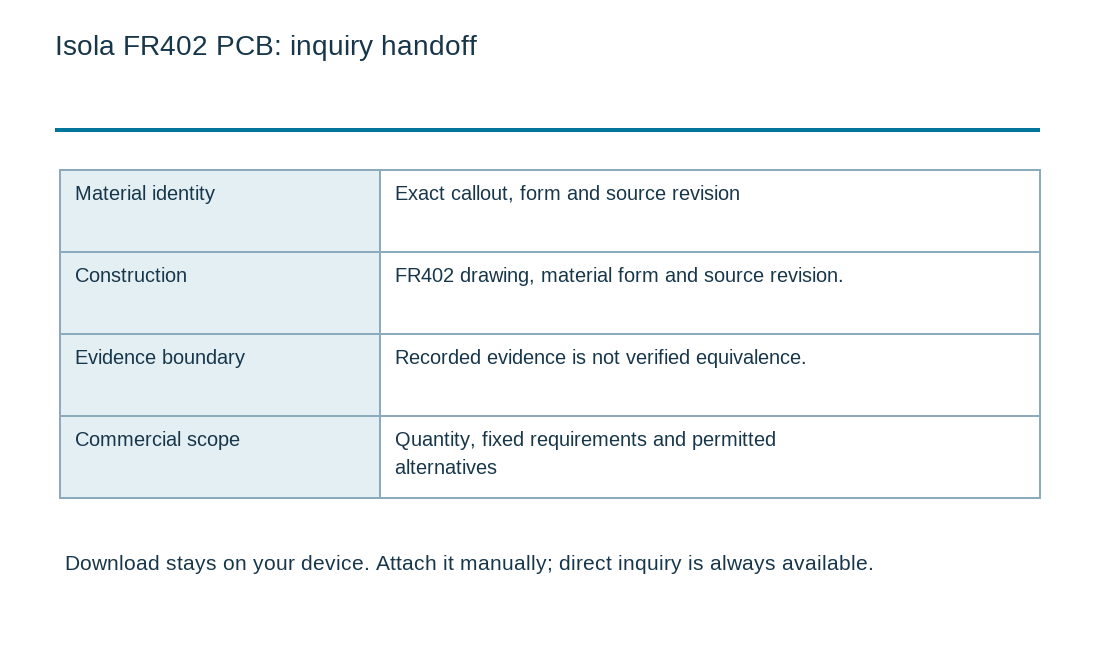
After calculating, read the notes alongside the numerical result. Changing any input invalidates the displayed result and disables its download until you calculate again. For a comparison, keep the units, geometry, material condition and measurement boundary consistent. A long decimal result does not imply equally precise input data. The downloadable record stays on your device and can be attached manually to an inquiry. It is not automatically transferred into the Contact form.
If an input is unknown, identify the person or document needed to resolve it. Do not fill a gap with a favorable generic value simply to obtain a result. You can request a material or fabrication review without using the tool. The arithmetic illustrates a relationship; it does not accept a construction, certify a material, establish current pricing or replace a supplier process specification.
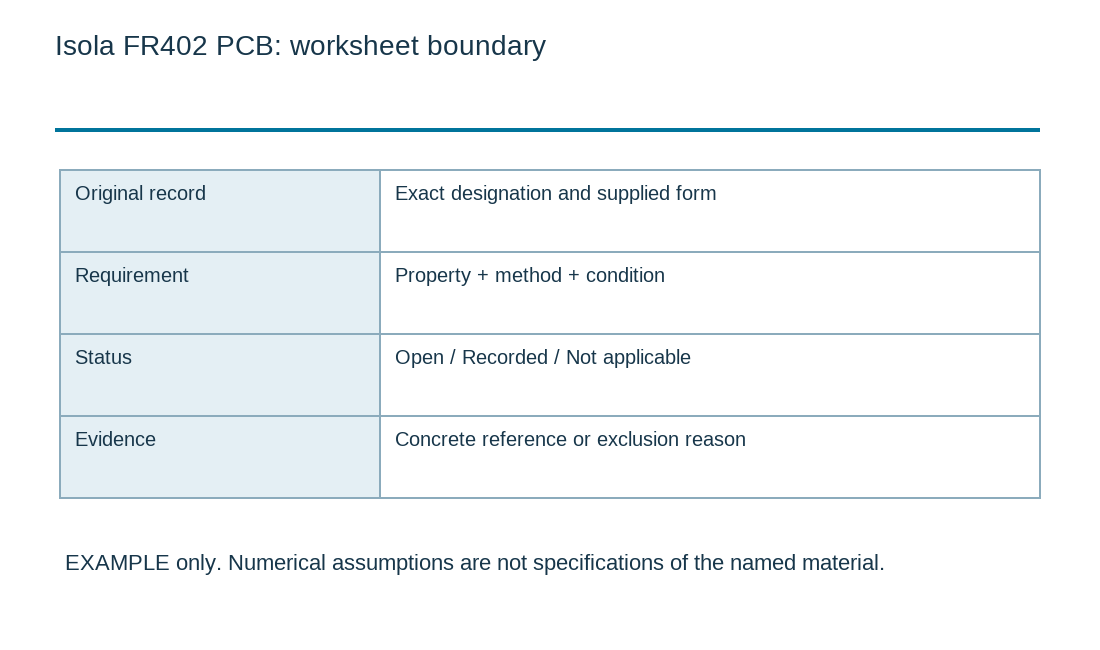
| Input | What to establish before using it |
|---|---|
| Review reference | Nonconfidential revision label. |
| Requirements and evidence · CSV | Status is Open, Recorded or Not applicable. Recorded needs a source reference; exclusions need a reason. |
Optional cost comparison from your own allowances
Use a quotation or a clearly labeled internal assumption for each input. Keep the quantity, construction and inspection scope the same when comparing alternatives. This uncalibrated planning model adds entered values; it contains no current market rates and does not issue a RAYPCB quotation. You can contact the team without completing it.
Optional project allowance comparison
Use the requirement register to separate facts and gaps
The local tool accepts rows for a requirement, status and evidence reference. A recorded item needs a concrete source; a not-applicable item needs a reason. This makes the handoff reviewable without turning a count of completed rows into an engineering approval score.
For example, material identity may be documented while current supply remains open. Electrical test coverage may be agreed while the assembly profile is still missing. Keep these as separate rows so the manufacturer can answer the actual unanswered questions rather than rereading a vague request for equivalent FR-4.
Compare candidate constructions on the same basis
DE104 is another specific legacy callout, not a generic replacement label. IS 420 provides a different thermal-material route whose suitability must follow the requirements. Compare copper, dielectric intervals, hole geometry, reinforcement and the necessary test evidence.
If the proposed material changes the dielectric properties, review controlled-impedance geometry and relevant signal behavior. If it changes expansion or process chemistry, review the plated structures and manufacturing route. A single improved headline property cannot close all of these questions.
Make supply and cost uncertainty visible
Ask the supplier to distinguish material availability from the ability to manufacture the requested board. A public document can remain accessible after the commercial offering changes. This page therefore makes no stock or lead-time claim and does not interpret a missing catalog entry as proof of discontinuation.
Use the optional allowance worksheet only with supplied quotations or labeled internal assumptions. Include one-time qualification, tooling and recurring inspection on comparable terms. If no material price is known, leave that commercial question open instead of assigning a fictional FR402 rate.
Close the change record before a repeat order
Send the original drawing, available source records, the proposed build quantity and the constraints on substitution. State which customer or engineering authority can approve a replacement. For another historical chemistry question, the G200 review illustrates why a separate product identity needs its own evidence.
The output of this work should be an approved material and construction, or a clearly bounded set of open questions. Preserve both the original callout and the approved change history. The worksheet organizes the discussion; it cannot authenticate a document, certify material equivalence or release production.
Resolve the original callout without losing the design requirement
A useful material callout connects the required function to a named document, a measurable condition and an approval owner. Keep the exact grade and supplied form with the thickness basis, copper treatment, test method and substitution rule. This prevents a purchasing shorthand from silently replacing a more precise engineering requirement.
Distinguish typical characterization from a guaranteed supply limit. A typical result may help compare options, but it is not automatically the acceptance value for an incoming lot. If a supplier proposes an alternative, compare the properties that affect this design and the manufacturing evidence needed to use it. Record the decision with a drawing or material-list revision instead of leaving it only in an email thread.
For an inquiry, provide the construction, required quantity, application conditions and any nonnegotiable specification references. Ask which requirements need additional evidence or lead time. A clear open question usually produces a more useful response than a broad request for the best laminate.
An unresolved name is a reason to investigate, not a reason to invent a plausible datasheet. Start with the oldest controlled record that actually belongs to the design. A material label, drawing revision or archived supplier sheet can establish a more useful trail than many websites repeating the same unsourced paragraph. Preserve the exact characters and supplied form while the question remains open.
Ask the supplier to distinguish four possible responses: exact product identified, historical product identified, internal code mapped to a product, or a different product proposed as an alternative. Each response leads to a different approval step. A commercial offer for a replacement does not prove the historical name was equivalent.
If a replacement is needed, define the board requirements independently of the old name. Compare electrical design inputs, thermal exposures, reinforcement, thicknesses, copper and manufacturing compatibility. Decide which previous qualification evidence remains applicable and which work must be repeated. Keep the approved decision with the current drawing while retaining the old callout in the change history.
Do not describe an unverified grade as discontinued merely because a public search did not find it. Equally, do not promise current stock because an old certificate exists. Identity, lifecycle, orderability and suitability are separate questions. The inquiry should identify which answer is needed and what evidence would resolve it.
Standards, source context and limits
Use the edition, amendment and material-document revision named in the purchase agreement. A standards title, marketing label or supplier product family does not establish that a particular lot meets a requirement. Public summaries are useful for scope; the controlled specification and applicable test method govern acceptance.
The examples on this page are illustrative engineering scenarios. They are not RAYPCB production records or guaranteed material values. Source links identify the organizations responsible for the referenced information. Confirm applicability to the exact grade, construction and test condition before carrying a number into a drawing or qualification report. Sources were reviewed on 3 October 2026. A public catalog search is not proof that an unlisted product never existed. Where the exact designation or current technical sheet could not be verified, this page provides a clarification workflow rather than an invented material specification. Current supply, construction availability and qualification remain separate questions.
For fabrication scope and the agreed construction requirements, see PCB manufacturing.