
RAYPCB · ENGINEERING & PROCUREMENT
Preliminary PCB Quote: Price an Unfinished Design with Clear Assumptions
A preliminary PCB quote is a budgetary estimate based on an incomplete but described construction. It helps compare design routes and funding needs before the final manufacturing files exist. Its value comes from making assumptions visible. This guide explains what to send, how to express uncertainty and when to replace the estimate with a reviewed quotation for the released board.
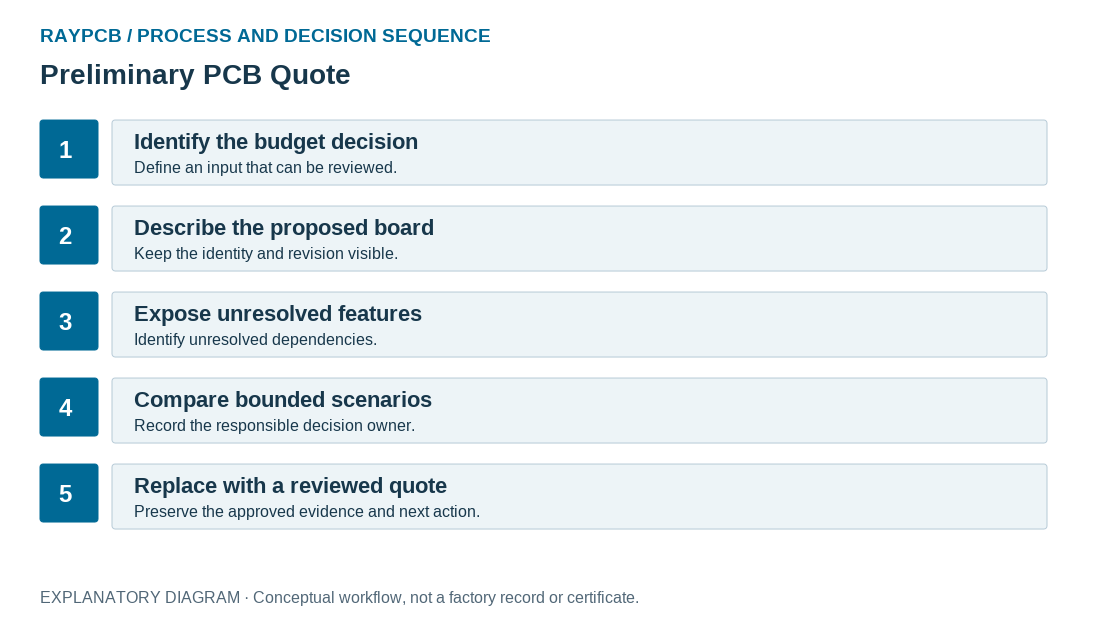
Your task: Identify the budget decision. Use the preliminary pcb budget range to record the next decision.
State why the estimate is needed
A budget for an early project, a comparison between layer counts and a purchasing authorization are different uses. Tell the supplier which decision the estimate will support. A figure suitable for feasibility planning may not be suitable for a purchase order.
Identify the current design stage and which dimensions or requirements are likely to change. A rough outline and proposed stackup can be enough to start a discussion, but they do not define all drilling, routing, testing or process complexity.
Label the request preliminary and keep that label with the returned number. Avoid copying a provisional unit cost into a business case without its quantity, construction assumptions, exclusions and date.
For first-time purchasing questions about bare-board scope, files and inspection, the PCB manufacturing FAQ explains what must be clarified before a budget becomes an order.
Provide a minimum useful construction brief
Include approximate dimensions, proposed layer count, target finished thickness, copper requirements, material family or mandatory grade, finish and expected quantity. Identify likely special features such as controlled impedance, filled vias, cavities, flex regions or unusual tolerances.
If a requirement is unknown, say so and ask for a proposal or a scenario. An empty field may be interpreted differently by different suppliers. Distinguish a deliberately flexible requirement from a decision that has simply not been made.
State whether the request is for bare boards or assembled boards. A PCB budget does not include component procurement, assembly, programming or functional testing unless those items are explicitly added.
Use scenarios for choices that could move the route
Compare technically plausible options, such as two proposed layer counts or material constructions, with the same quantity and delivery assumptions. Explain which engineering questions must be resolved before choosing between them.
Avoid a single percentage allowance that is expected to cover every unknown. A possible additional lamination cycle is a different uncertainty from freight or a small dimensional change. Identify the important unknowns individually.
For a hypothetical interface board, the estimate may assume ordinary through holes while the design team is still considering a finer-pitch device. If that device forces a different via strategy, the estimate needs renewed review rather than a silent update to the total.
Calculate a range only from entered assumptions
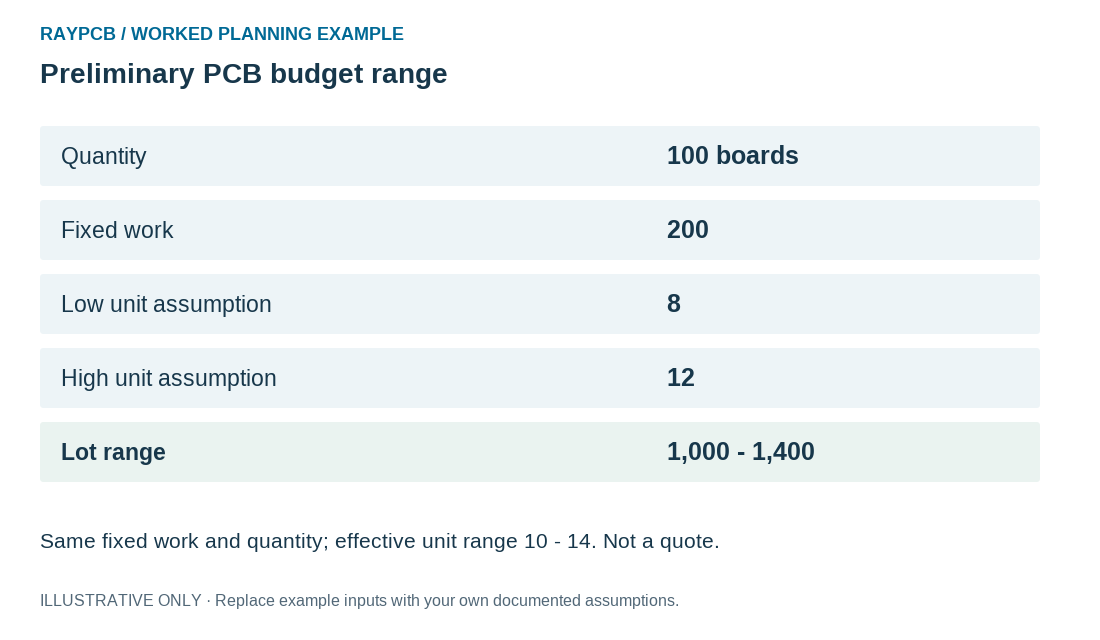
The worksheet uses your low and high unit-cost assumptions, fixed charges and quantity. It shows the resulting lot range and effective unit range. There are no hidden market rates, material multipliers or claims that RAYPCB will supply at those values.
Preliminary PCB budget range
Preliminary PCB budget range
How to use and interpret this worksheet
Enter an ordered quantity, a low recurring unit-cost assumption, a high recurring assumption and fixed charges. Use the same construction scope and currency for both ends. The low value must not exceed the high value. These are your assumptions, not prices supplied or guaranteed by this website.
The low lot scenario is fixed charges plus quantity multiplied by the low unit value. The high scenario uses the high unit value. Effective unit figures spread the fixed charge across the ordered quantity. They are planning allocations, not independent supplier offers.
A useful range has an evidence basis. Record which quotation, construction option or internal estimate supports each input. If the board could require an entirely different manufacturing route, create a separate scenario and explain the route difference instead of hiding it inside a narrow percentage allowance.
Check exclusions such as freight, tax, duty, special reports, engineering work and changes after release. The model includes only what you put into the fields. It cannot establish an upper bound on the cost of an unfinished design or predict material availability.
Load the labeled example only for demonstration, then clear the fields before entering project assumptions. Input changes disable the old download until recalculation. Save the current result with its assumptions and replace it when the design or quote basis changes. No order or enquiry is submitted by the tool.
Use numbers obtained from a relevant estimate or your internal planning basis. If you have no cost evidence, use the tool to understand the arithmetic and request supplier input rather than inventing a narrow range.
The low scenario must not exceed the high scenario. Both should cover the same scope and currency. Taxes, freight, duties, additional engineering work and revision changes remain excluded unless you explicitly include them in your entered assumptions.
Keep a decision record with the review
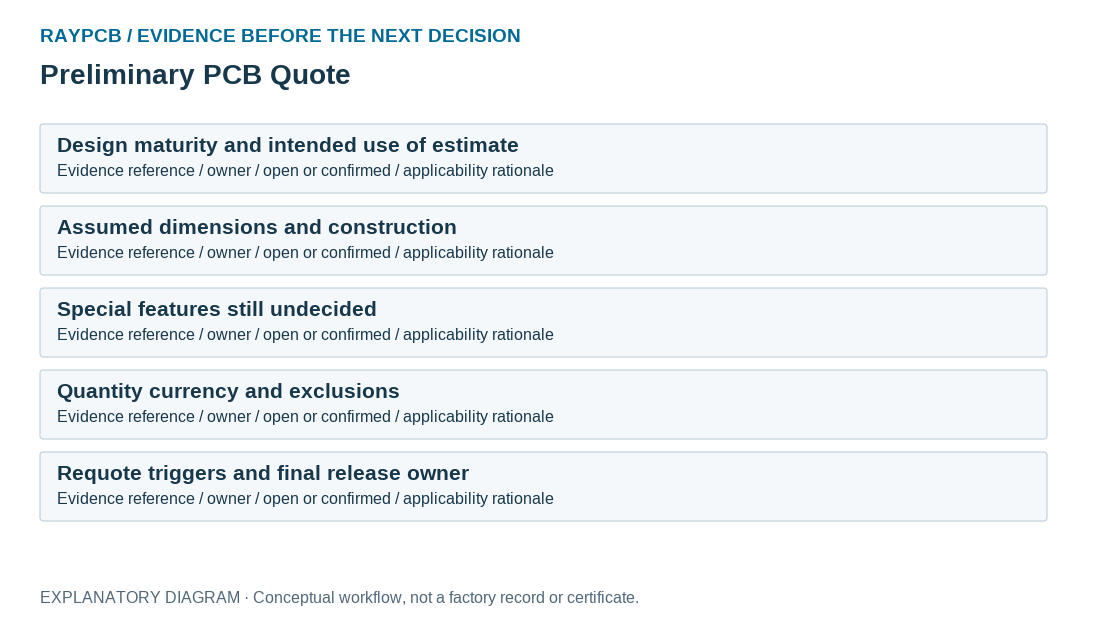
Use this record to connect the discussion to supporting information. Record the source, revision and reviewer for each item. Confirmed means the responsible person has reviewed the evidence; it does not mean this website has verified it. Keep confidential documents in your approved project system.
| Review topic | Record to retain | When it remains open |
|---|---|---|
| Design maturity and intended use of estimate | Identify the controlled scope and the person authorized to approve it. Keep the current reference together with the intended decision. | Clarify the boundary before treating the review as a release instruction. |
| Assumed dimensions and construction | Reference the actual file, data source or agreed requirement, including its revision or date and the person who reviewed it. | Request the missing evidence and identify which downstream decision depends on it. |
| Special features still undecided | Record the conditions and assumptions that make the evidence applicable. Separate a proposed value from an approved requirement. | Keep the assumption visible and define whether the next activity may proceed under a bounded exception. |
| Quantity currency and exclusions | Identify responsibility for the next operation and the evidence expected afterward. Distinguish preparation from a completed result. | Assign a named role and an agreed decision point; do not turn an unanswered question into an approval. |
| Requote triggers and final release owner | Record the final disposition, affected quantity or revision and the authority accepting it. Preserve the reason for any exception. | Retain the item in the action list and review its consequence before committing work or materials. |
Review the record again when the product, supplier proposal or supporting data changes. A result from an earlier revision is historical evidence, not automatic approval for the current one. If an item is not applicable, retain the reason and the person who made that decision.
Keep commercial and technical assumptions together
A useful estimate records quantity, currency, validity, delivery basis, included operations and exclusions. Technical assumptions should be listed beside them, including material, construction, inspection and any unresolved features.
The date matters because availability and pricing can change. An earlier estimate is not a standing price commitment. Confirm the terms again when the design is ready for purchase.
For assembled boards, component pricing may depend on exact manufacturer part numbers, packaging and purchasing quantities. Use PCBA quote requirements when the request includes populated boards; do not expand a bare-board estimate by an unsupported generic assembly percentage.
Know what triggers a new estimate
Changes to board size, layer count, material, holes, copper, finish, tolerances, special processes, inspection or quantity can change price or feasibility. Some changes are minor; others change the manufacturing route. Ask the supplier to review their effect.
Keep a change list between the preliminary brief and the final release. The final package should identify which assumptions were confirmed and which were replaced. This makes the movement in cost understandable instead of appearing arbitrary.
The low-cost PCB manufacturing guide explains cost drivers. For laminate decisions, the material cost and reliability guide keeps technical fit ahead of price comparison.
Convert the estimate into a reviewed quotation
Provide the final manufacturing exports, drawing, approved construction and acceptance requirements. Resolve engineering queries, confirm quantities and agree the commercial basis. A formal quotation should refer to the reviewed package and identify any remaining conditions.
Do not authorize manufacturing from an obsolete preliminary description when newer files exist. A purchase order should connect to the correct quotation and released revision. If the schedule requires an early material commitment, define exactly what is being authorized and the risk if the design changes.
Altium's PCB pricing discussion explains why fabrication and assembly costs need distinct inputs. It provides context, not a current price for your board. The supplier's reviewed offer remains the commercial basis.
Questions about incomplete designs
Can I request pricing without Gerbers? You can request a budgetary discussion with a construction brief, but the uncertainty and exclusions must remain visible.
Is the upper value guaranteed? No. It is the result of the assumptions entered or quoted, not a universal cap on an unfinished design.
What should RAYPCB receive? Send the current outline, proposed construction, quantity, target timing and a list of open decisions. Start with PCB manufacturing. If the work is circuit or layout design rather than manufacturing, use the PCB design RFQ guide to define that separate service scope.