
RAYPCB · ENGINEERING & PROCUREMENT
PCB Supplier Evaluation: Compare Evidence Before Price
PCB supplier evaluation should establish whether a fabricator or assembler can support your specific construction, acceptance requirements and delivery program. A long capability table or low quotation is a starting point, not proof of fit. This guide organizes the questions that engineering, procurement and quality teams should ask, and helps distinguish supplier statements from reviewed evidence without reducing qualification to an arbitrary score.
Your task: Define mandatory requirements. Use the supplier evidence request worksheet to record the next decision.
Open supplier evidence request worksheet · Discuss the project
Qualify the process your product needs
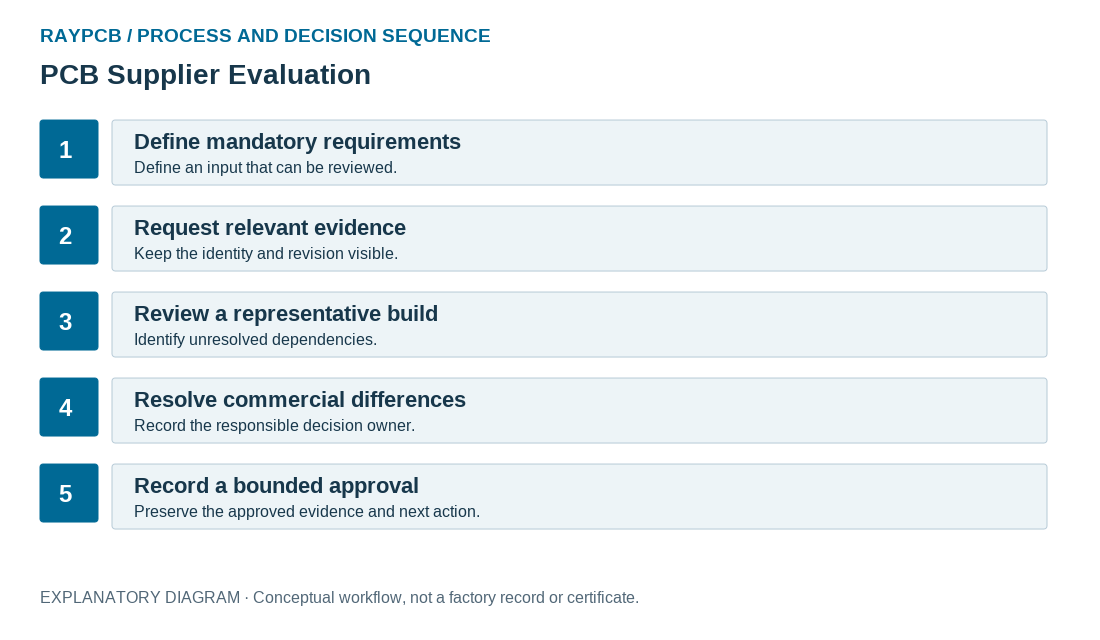
Start with your own requirements. Identify board construction, materials, features, assembly packages, environmental conditions, inspection and test expectations. A supplier strong in straightforward rigid boards may require a different review for sequential lamination, RF materials, flex or a difficult assembly.
Ask which operations are performed at the proposed site and which are subcontracted. The commercial entity, manufacturing location and certificate scope should be clear. An equipment photograph alone cannot establish that the proposed route is available for your order.
Separate a capability limit from a routinely supported production condition. A successful demonstration at an extreme feature size does not automatically define a stable operating window for a different stackup or quantity.
Ask for evidence matched to the claim
For construction capability, request relevant process information and qualification evidence. For inspection, ask about coverage, methods, acceptance criteria and records. For traceability, ask how an affected material lot would be connected to delivered units.
Certificates should be checked for issuing body, site, scope, validity and applicability. A certificate belonging to another legal entity or site may not support the proposed supply route. Do not infer product approval from a quality-management certificate.
Request appropriately redacted examples when detailed records contain customer information. The aim is to understand how the system works, not to obtain another customer's design. A supplier that respects confidentiality should be able to discuss process without exposing restricted files.
Use a trial build to test the handoff
A representative trial can reveal how the supplier handles ambiguous data, engineering questions, material substitutions, first-piece review and release records. Select a build that exercises the relevant risks, rather than the simplest possible board merely to obtain a sample.
Define what the trial must demonstrate and how findings will be reviewed. Do not treat one successful lot as proof of every future construction. Conversely, a well-investigated issue can provide useful evidence about corrective-action quality.
A hypothetical comparison might show two suppliers delivering acceptable boards, but only one clearly documenting an approved stackup change. The distinction matters for repeatability even if both samples function. Keep observations factual and separate from subjective impressions.

Compare commercial offers on an equal basis
Normalize quantities, specification, testing, documentation, delivery terms and validity. Identify exclusions, nonrecurring charges, material commitments and excess-stock responsibilities. A lower total can reflect a different scope.
Ask how changes after release are handled and how disputed or nonconforming product is contained and investigated. Define communication and escalation contacts. These terms should be negotiated and recorded rather than inferred from website language.
Use low-cost PCB manufacturing analysis for cost drivers, or PCBA quote requirements for assembled-board scope. This page owns evidence-based supplier selection rather than providing another price calculator.
Keep a decision record with the review
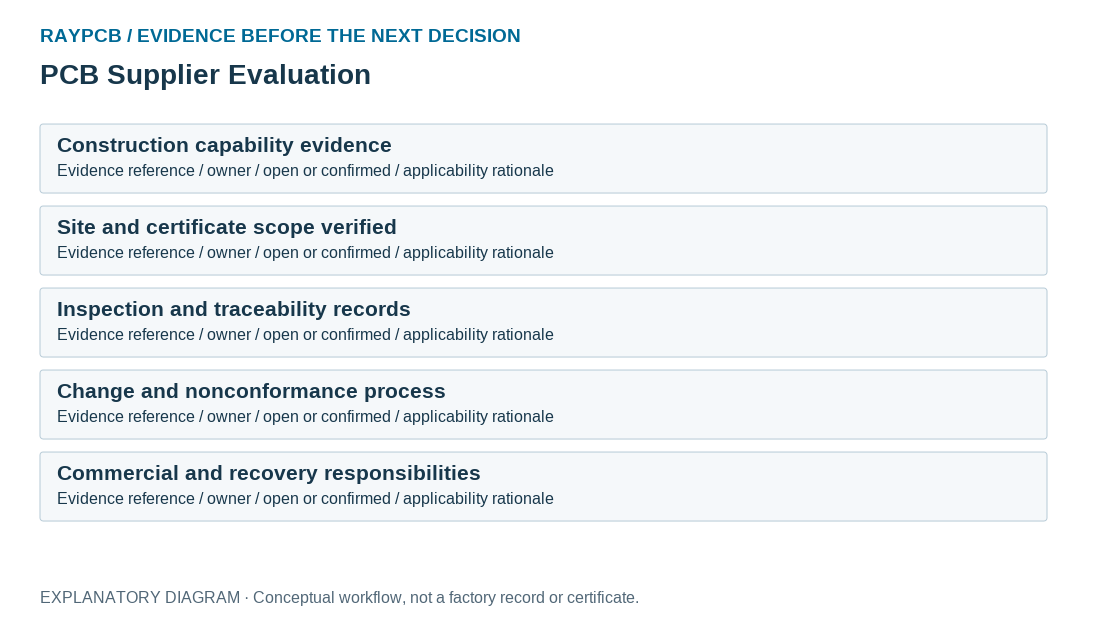
Use this record to connect the discussion to supporting information. Record the source, revision and reviewer for each item. Confirmed means the responsible person has reviewed the evidence; it does not mean this website has verified it. Keep confidential documents in your approved project system.
| Review topic | Record to retain | When it remains open |
|---|---|---|
| Construction capability evidence | Identify the controlled scope and the person authorized to approve it. Keep the current reference together with the intended decision. | Clarify the boundary before treating the review as a release instruction. |
| Site and certificate scope verified | Reference the actual file, data source or agreed requirement, including its revision or date and the person who reviewed it. | Request the missing evidence and identify which downstream decision depends on it. |
| Inspection and traceability records | Record the conditions and assumptions that make the evidence applicable. Separate a proposed value from an approved requirement. | Keep the assumption visible and define whether the next activity may proceed under a bounded exception. |
| Change and nonconformance process | Identify responsibility for the next operation and the evidence expected afterward. Distinguish preparation from a completed result. | Assign a named role and an agreed decision point; do not turn an unanswered question into an approval. |
| Commercial and recovery responsibilities | Record the final disposition, affected quantity or revision and the authority accepting it. Preserve the reason for any exception. | Retain the item in the action list and review its consequence before committing work or materials. |
Review the record again when the product, supplier proposal or supporting data changes. A result from an earlier revision is historical evidence, not automatic approval for the current one. If an item is not applicable, retain the reason and the person who made that decision.
Build an evidence request instead of a score
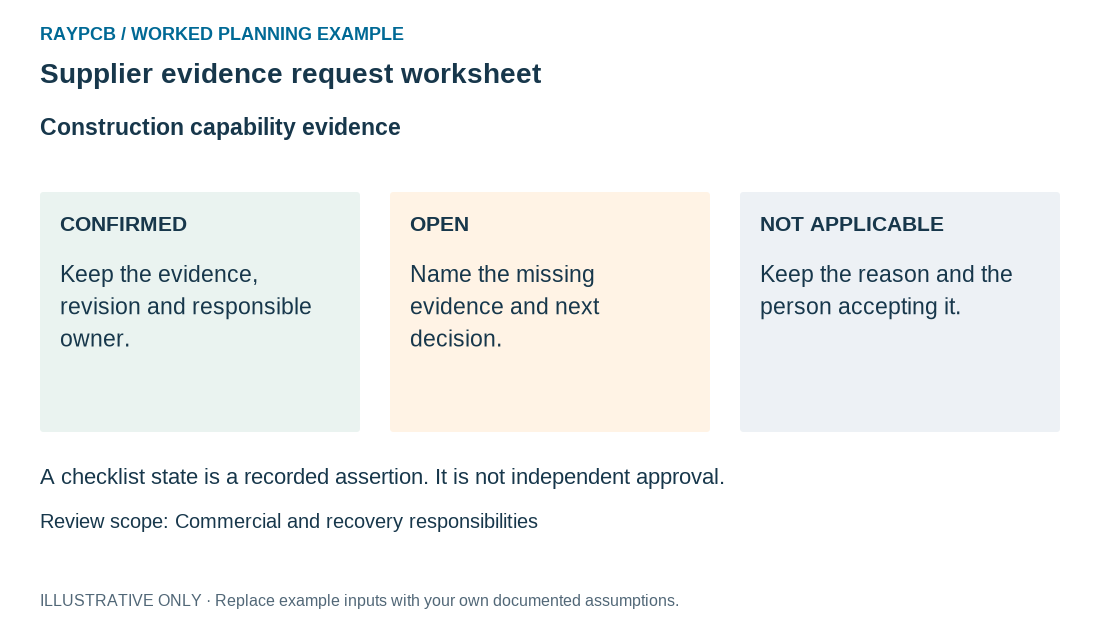
The worksheet identifies whether key evidence is confirmed, open or not applicable, and records the next action. It does not rank suppliers, authenticate certificates or approve a supplier. A single unresolved mandatory requirement can outweigh numerous satisfactory answers.
Supplier evidence request worksheet
Supplier evidence request worksheet
How to use and interpret this worksheet
Choose a narrow review boundary before filling in the worksheet. Use one product revision, one proposed build or one supplier decision. If several configurations differ, keep separate records or explain precisely which evidence applies to each. A short reference is enough; the tool does not need drawings, customer names, confidential part lists or passwords.
For every item, distinguish confirmed evidence from an unresolved assumption. Confirmed means that the responsible person has reviewed the relevant information, not merely that a document exists somewhere. Open means the decision or evidence is still missing. Not applicable requires a rationale because it is an applicability decision, not a shortcut to completion.
Record a concrete next action with an owner and a target decision point. For example, replace ask engineering with obtain the approved revision from the design owner before material release. The useful output is an actionable handoff, not a readiness percentage. No weighted score is used, because the consequence of one mandatory gap may exceed that of several completed items.
Load example only to learn the controls. Example mode remains clearly labeled even if you edit its values. Clear the form before entering your own review. Changing an input invalidates the old result and disables its download until you generate a new record. Download the current text if it helps your discussion; it is not automatically added to an enquiry.
Keep supporting approvals and measured results in the controlled project system. This worksheet stores nothing between visits and does not verify files, supplier statements or legal applicability. A completed record can support a review meeting, but the authorized team remains responsible for the release decision.
Keep must-have requirements separate from preferences. A cosmetic reporting preference should not receive the same treatment as an unsupported construction or missing safety-related test. The qualification authority should decide the consequence of each gap.
Download the record and use it during a technical call or audit. Mark who reviewed each document and when. An uploaded document or a checked box is not independent verification by this website.
Review ongoing control, not just the first order
Ask how process changes, source changes and material substitutions are communicated. Establish which changes require customer approval and what records are retained. Repeat orders need a controlled baseline and a way to detect deviations.
Discuss demand changes and recovery planning. Capacity depends on the relevant process route and the production mix, not only on total factory output. Request realistic commitments for your quantities and release pattern.
For continuing programs, review the responsibilities of electronic contract manufacturing. For board work, PCB manufacturing and PCB assembly remain the service owners.
Map standards to the actual purchase
Identify applicable workmanship, performance, process and product requirements separately. Specify the document revision, class and agreed deviations where relevant. A phrase such as IPC compliant is incomplete without scope.
Use electronics manufacturing standards to organize the document map. The IPC standards framework describes major process and acceptance documents, while ISO's certification guidance explains the distinction between standards and certification.
Neither a website guide nor a supplier questionnaire replaces a qualification decision by your organization. Retain the evidence, unresolved conditions and approval authority in a record that can be reviewed when the product or supply route changes.
Questions buyers should ask before approval
Is a certificate enough? No. Check its applicability and combine it with product-relevant process and delivery evidence. A certificate does not identify the exact inspection performed on your lot.
Should every supplier receive the same questionnaire? Use a consistent core, then add questions for the construction and risks involved. An enormous irrelevant survey can obscure the important gaps.
How can RAYPCB be evaluated? Send the project requirements and the evidence your qualification process needs. Discuss scope and availability directly. This guide makes no unsupported claim about a certificate, audit result, capacity figure or approval status.