RAYPCB · ENGINEERING GUIDE
PCBA Functional Test Cost: Separate NRE, Cycle Time and Retest
PCBA functional test cost has two distinct parts: the work needed to develop and qualify the test, and the recurring effort to run it on assemblies. Fixtures, software, instruments, loads, handling, stabilization and reporting can all contribute. A cost per board is meaningful only when the test scope is clear.
Use this page to compare quotations or build an internal planning scenario. The calculator contains no market rate or automatic RAYPCB price. You enter the allowances and receive a transparent breakdown for the stated quantity.
Separate development from execution
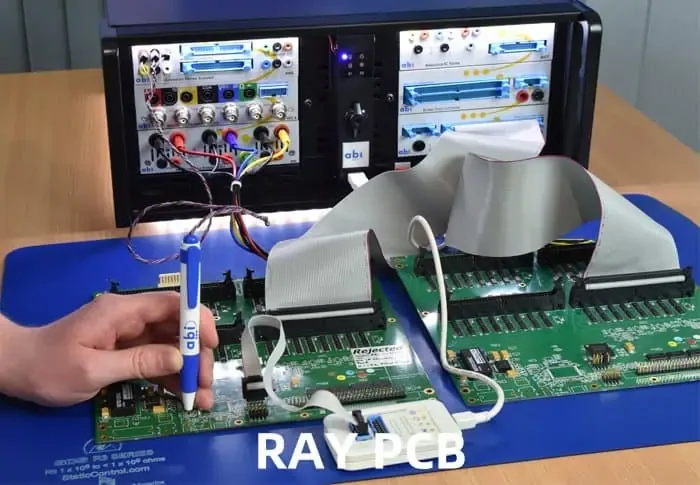
Nonrecurring work may include specification review, fixture design, interface electronics, test code, fault handling and correlation. Existing customer tooling can reduce some work but may still require adaptation, validation or maintenance.
Recurring work includes loading, connections, program execution, recording and unloading. Some tests require thermal settling, charging or communication setup that dominates the actual measurement time. Ask suppliers which operations are included in the quoted cycle.
FCT planning allowance and station time
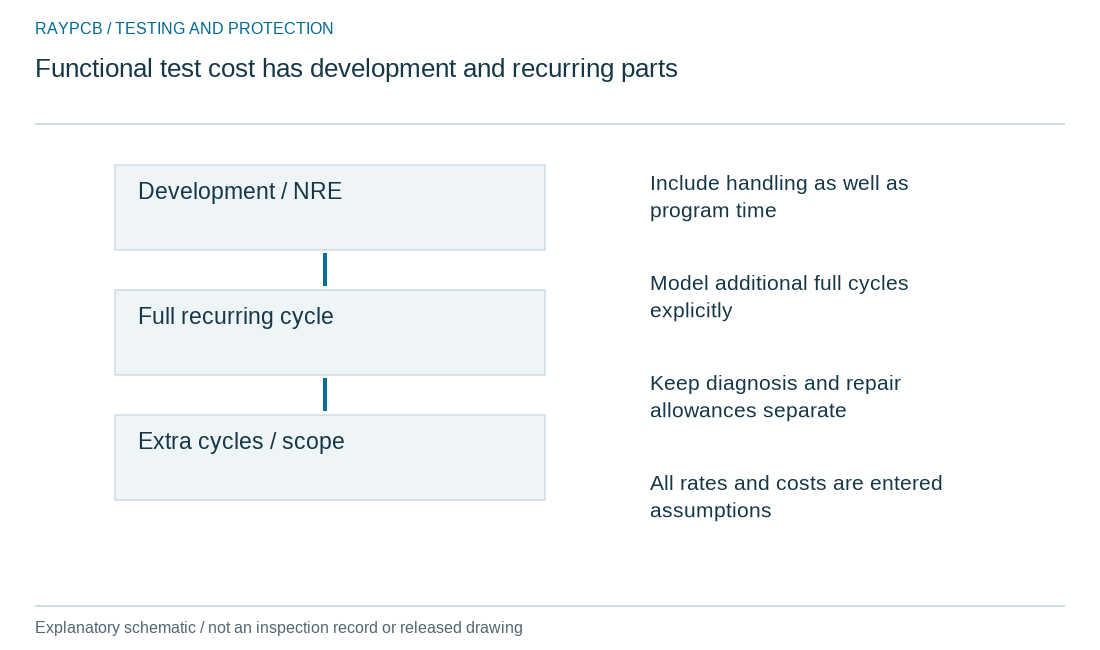
FCT planning allowance and station time
Use the current inputs and keep the assumptions
Choose the engineering question before entering numbers. Fields begin blank. Load example fills teaching values so you can understand the model; those values are not recommended dimensions, process settings or market prices. The example label remains visible after edits. Reset before preparing a record based entirely on your own project data.
Use the displayed units and keep a reference for each input. Counts must describe the same scope, and measurements must share the declared conditions. A threshold entered by you remains your supplied review condition. The website does not turn it into an IPC limit or an approved product requirement. If the necessary value is unknown, obtain the evidence rather than replacing it with an attractive assumption.
Read the result and its limitations together. An access fraction is not fault coverage, a cost allowance is not a quotation, and a completed evidence checklist is not a safety or quality approval. Negative margins remain visible where the model permits them. They identify a conflict in the entered scenario rather than silently adjusting the result.
Changing an input invalidates the result and disables its download until you run the tool again. The text record contains the inputs, result and limitations. Processing stays in your browser; no CAD files, instruments or certificates are read. No data is automatically transferred to the enquiry form. Download and attach the record manually if useful, or contact RAYPCB directly without completing the tool.
| Input | What to establish before using it |
|---|---|
| Review reference | Use a nonconfidential revision or scope reference. |
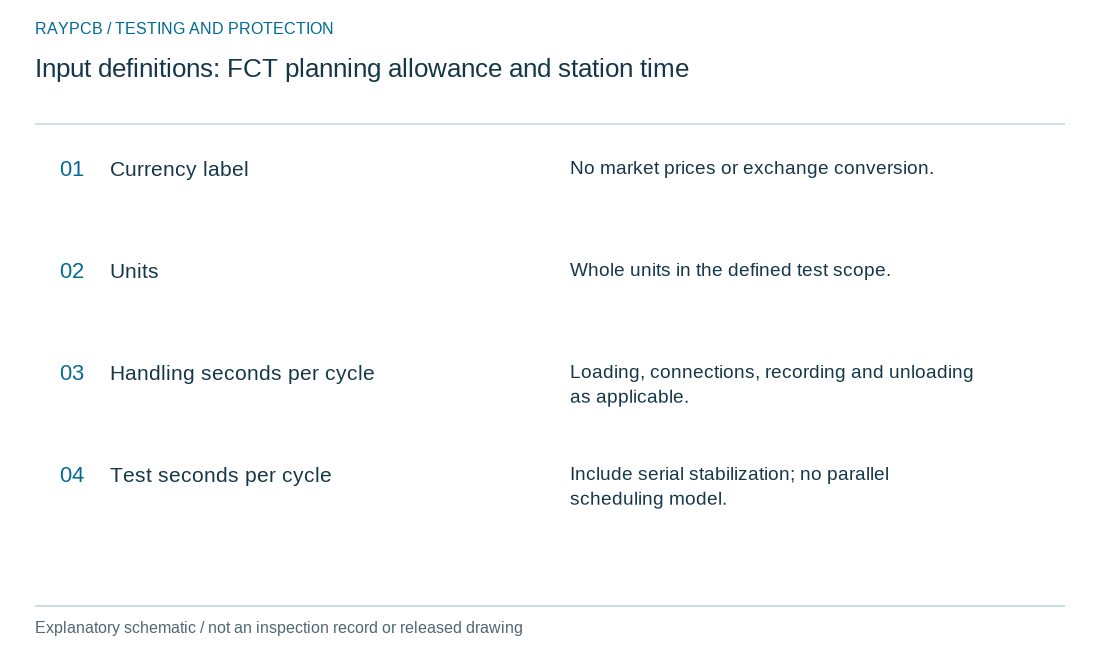
| Currency label | No market prices or exchange conversion. |
| Units | Whole units in the defined test scope. |
| Handling seconds per cycle | Loading, connections, recording and unloading as applicable. |
| Test seconds per cycle | Include serial stabilization; no parallel scheduling model. |
| Additional full-cycle fraction · percent | Extra cycles divided by original units; not repair yield. Maximum supported 100%. |
| Entered hourly allowance | Your scope-specific rate, not a market rate. |
| Development / fixture allowance | One-time allowance for this configuration. |
| Other recurring allowance per unit | Costs not already included; avoid double counting. |
Define what the program verifies
The functional testing guide owns the method overview. This cost page focuses on scope and economics. A power-on indication is a smaller task than exercising interfaces, loads, firmware options and calibrated measurements across defined conditions.
Provide test points, operating states, expected responses and limits. If those are not ready, quote a specification-development task separately rather than assuming the assembler can infer all product requirements from the BOM.
| Review item | What to establish |
|---|---|
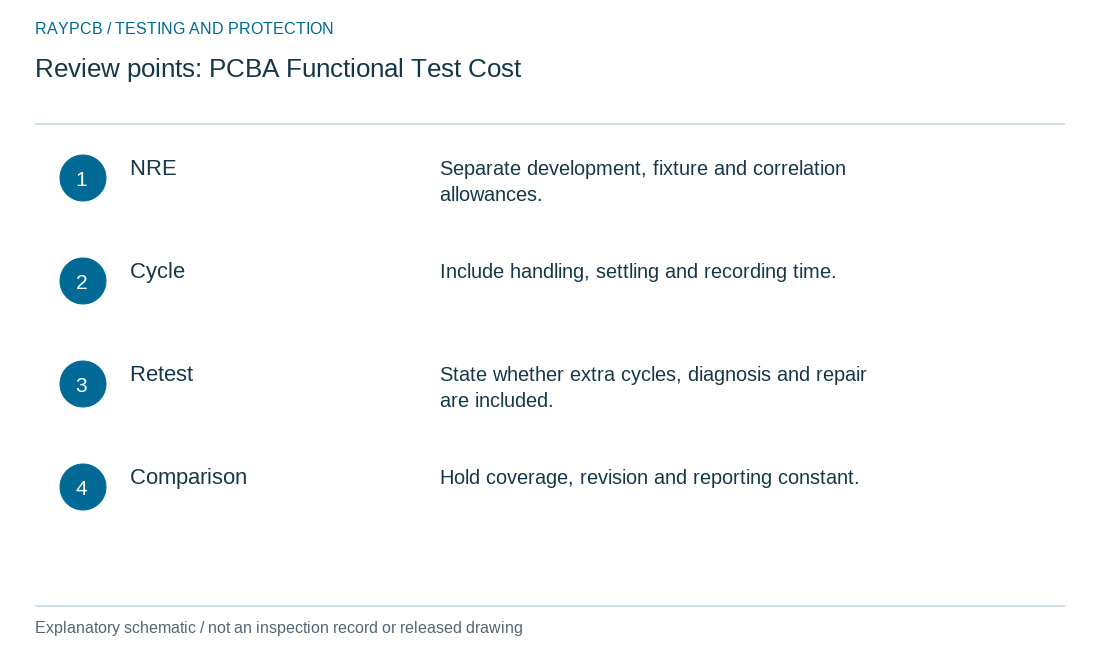
| NRE | Separate development, fixture and correlation allowances. |
| Cycle | Include handling, settling and recording time. |
| Retest | State whether extra cycles, diagnosis and repair are included. |
| Comparison | Hold coverage, revision and reporting constant. |
Make the time model explicit
The worksheet adds entered handling and test seconds, applies an entered additional full-cycle retest fraction, and multiplies by quantity. Hours multiplied by an entered hourly allowance estimate execution cost. Setup and additional per-unit allowances are added separately.
The retest factor is an assumption about extra complete station cycles, not a measured defect probability or expected final yield. It excludes diagnosis and repair unless included elsewhere. Parallel fixtures, shared operators and overlapping stabilization need a more detailed capacity model.
Compare identical acceptance scope
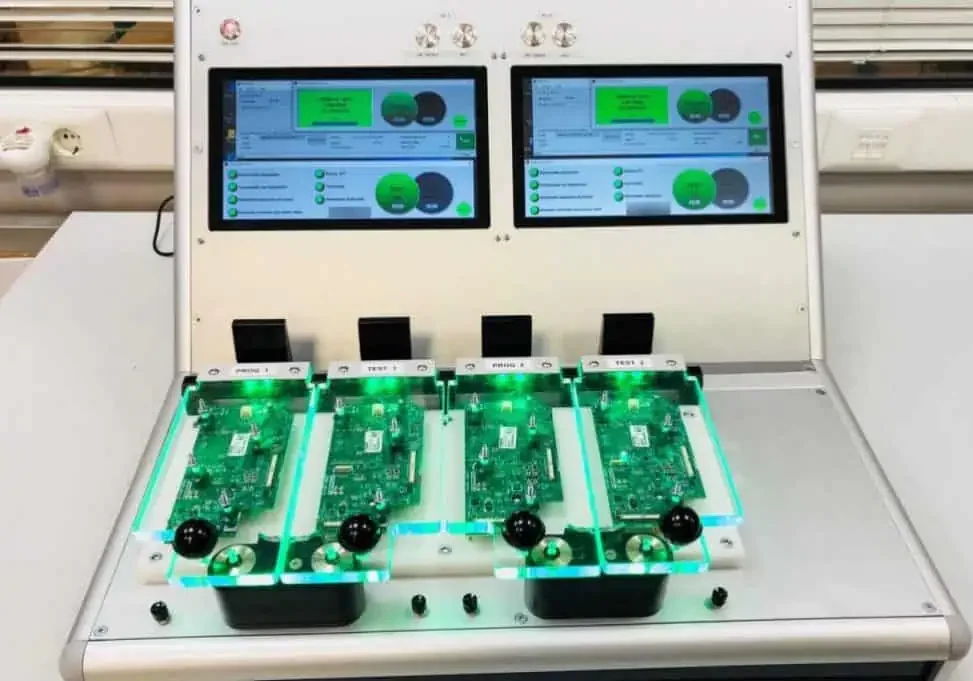
One quotation may include a fixture while another assumes it is customer-supplied. One may record numerical measurements; another may store only a result flag. Retest, fixture changes and test-program ownership can materially affect lifecycle cost.
Keep the same board revision, quantity, supported options, coverage and reporting when comparing totals. A lower test price achieved by removing a critical check is a scope change that requires engineering approval, not a simple purchasing saving.
Consider design stability and future variants
An early prototype often needs troubleshooting and requirement refinement. A stable production design may support a repeatable automated station. Fixture and software changes can recur when connectors, firmware, limits or fitted options change.
Use the test-fixture specification to define supported configurations and change responsibilities. Avoid amortizing one setup fee across speculative future volumes unless the commercial agreement supports that assumption.
Example: cost drivers hidden in handling
Consider a planning example where the electrical sequence takes 40 seconds but loading, connections and unloading take another 50 seconds. Counting only the program understates the station effort. A handling improvement may reduce cost more effectively than removing a useful measurement.
Record real observations before changing the model. If the station can test several units concurrently, identify shared and per-unit steps; dividing the entire cycle by site count can overstate throughput when loading or instrument resources remain serial.
What a complete FCT enquiry includes
Provide the current assembly revision, quantities, schematic, test specification, firmware identity, fixture status, loads, output record and acceptance owner. State which items are fixed and which need development. Request an explicit list of exclusions.
The optional downloaded estimate is a local planning record and is not sent automatically. Contact RAYPCB directly for a reviewed proposal, or use the PCBA test specification guide to resolve missing requirements before requesting a comparable quotation.
Questions to resolve before the next build
Why do FCT quotations differ so much? They may include different engineering work, fixtures, instrument resources, operating conditions or report detail. Compare those items before comparing the unit price. A basic power-on check and a documented multi-function sequence are different services. The cost worksheet can expose assumptions, but it cannot make unequal coverage equivalent through arithmetic.
Can an existing fixture remove all setup cost? It may reduce mechanical development, but the new location or supplier still needs to review compatibility, instructions, software, calibration and correlation. Missing documentation can add work even when the fixture arrives ready to connect. State the supported configuration and provide the release records so the quotation can distinguish reuse from redevelopment and identify any remaining validation tasks.
Compare the complete economic scope
Compare alternatives only after the technical scope is aligned. Record the product revision, quantities, test functions, reporting and supported variants. If one proposal includes development and another assumes an existing validated system, their per-unit prices are not directly comparable. Make exclusions visible before calculating a difference.
Divide costs into development, reusable assets, recurring operation and change-related work. A fixture, program and correlation effort may benefit later orders, but only while the supported configuration remains valid. Do not spread a setup allowance across speculative future quantities without recording that assumption. Keep ownership and availability of the resulting assets explicit.
Measure the full station operation. Loading, identification, connections, settling, measurement, recording and unloading can consume more time than the electrical sequence. Observe representative units and variants under realistic handling conditions. Do not turn the fastest single cycle into a promised sustained output without considering the operating pattern.
Keep retest, diagnosis and repair separate. A repeated complete cycle adds station time; finding the cause of a failure can require engineering effort; repair changes the assembly and requires its own verification. A single percentage cannot describe all three. The simple calculators model only the operations stated beside their fields.
Check for double counting when building allowances. An hourly station rate may already include an operator, equipment or overhead, while a separate line might include those same items again. Conversely, a quoted machine rate may omit labor and support. Use a consistent basis and one currency for the compared scenarios, documenting what is included.
Review sensitivity to uncertain inputs. If quantity, cycle time or change frequency is poorly known, compare several defensible scenarios rather than trusting one precise-looking total. Keep the technical scope fixed while varying an economic assumption. If the lower-cost route changes coverage or product risk, that is an engineering decision requiring separate review.
Finish with a supplier-ready question. Provide the current files and the task you want quoted, then ask for a breakdown of development, tooling, recurring execution and optional reporting. The worksheet can make assumptions easier to discuss, but the reviewed proposal remains the commercial authority. A transparent estimate is useful even when it reveals that more requirements must be defined before a reliable quotation is possible.
Standards, source context and limits
Use each reference for its stated scope. Equipment and material documentation applies to the identified product and conditions. A published study describes its own specimens and methods; its settings are not universal production limits. Public standard summaries and revision tables do not replace the controlled normative document.
Agree the applicable standards, revisions, product class where relevant, measurement methods and exceptions before production. Distinguish printed-board requirements, assembly workmanship, laboratory competence and finished-product certification. A method name or photograph does not establish that a supplier holds an accreditation or that a particular test is included in an order.
Archive photographs illustrate relevant boards, equipment or operations from the existing RAYPCB website. They are not evidence of current equipment ownership or results from your project. Original diagrams explain concepts and measurement boundaries; they are not inspection records or released manufacturing drawings. Confirm the actual service and reporting scope in the project review.