
RAYPCB · ENGINEERING REFERENCE
Pyralux AP-PLUS: Thick-Core Design & Legacy Review
Understand the historical thick-core AP-PLUS construction, review dimensional consequences, and confirm the current supply specification before release.
Original engineering guidance · References checked September 27, 2026
What does Pyralux AP-PLUS mean on an older drawing?
Pyralux AP-PLUS is a historical thick-core, all-polyimide copper-clad laminate designation. Its important distinction is the dielectric thickness, rather than a promise of unusually heavy copper. When an older drawing names AP-PLUS, first establish the original construction and then confirm the current product identity, supply and qualification requirements. Do not replace the callout with an assumed modern equivalent.
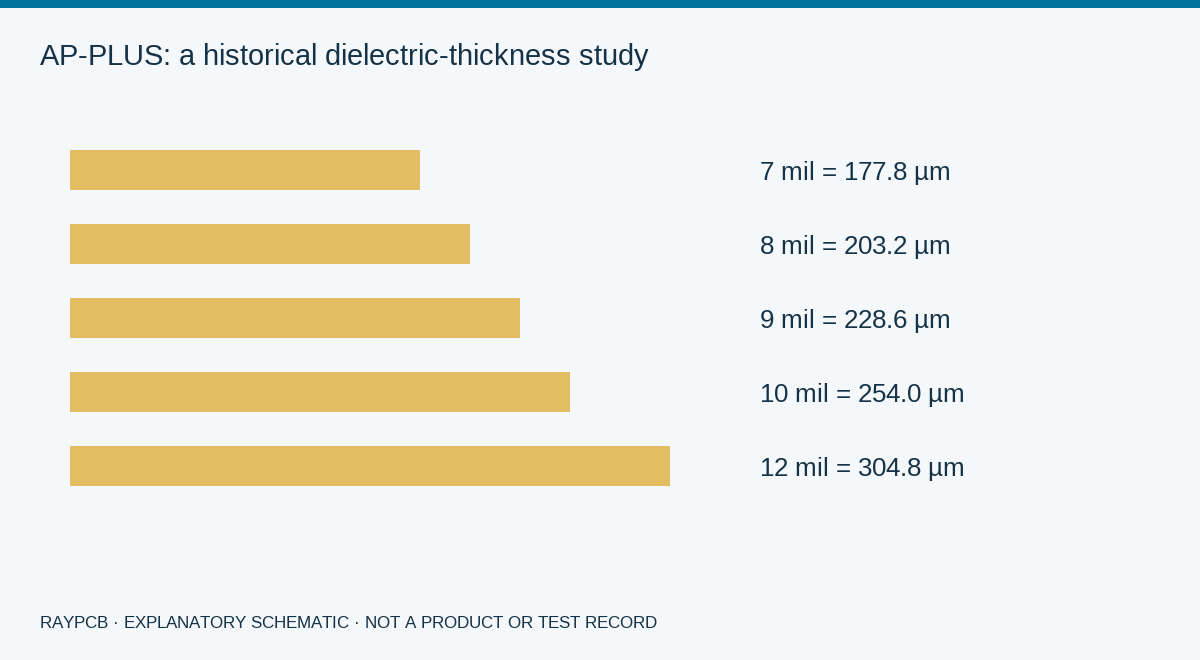
Historical DuPont AP-PLUS literature describes double-sided constructions with core options in the 7–12 mil range. This page uses those options only to explain geometry and legacy review. It does not confirm that the historical catalogue, sheet formats or delivery claims remain available. The current Qnity laminate directory is the starting point for present product enquiries; a missing name in a directory is not sufficient evidence to declare either continued supply or discontinuation.
For a new design requiring ordinary AP construction selection, use the Pyralux AP family page. This AP-PLUS page serves a different job: interpreting thick-core requirements, comparing the consequences of a proposed change and assembling a controlled requalification request for an existing design.
Separate historical evidence from a current orderable specification
| Review item | What the legacy record can establish | What must be confirmed now |
|---|---|---|
| Product family | Original AP-PLUS name and drawing history | Current supplier identification and document revision |
| Cross-section | Intended copper and polyimide arrangement | Actual offered foil, dielectric and tolerances |
| Electrical design | Original model and acceptance targets | Candidate construction, model inputs and verification |
| Mechanical fit | Original section and installation envelope | Finished thickness, formed geometry and assembly fit |
| Procurement | Previous part number and approved source | Availability, lot documentation, format and quotation |
The archived manufacturer literature examined for this review supports the thick-dielectric interpretation. Its old product list is not loaded into an orderable SKU selector. Current supply could not be established from that historical sheet, so the tool below is deliberately a dimensional study. This avoids presenting a plausible catalogue code as a confirmed procurement choice.
Also keep units explicit. Seven mil converts to 177.8 µm; twelve mil converts to 304.8 µm. Exact unit conversion and rounded material-designation values are not the same thing. Use the supplier’s approved nominal dimension and tolerance on an order, and identify the unit system that governs if the drawing presents both. Do not silently correct a supplier document by mixing exact conversions into selected rows.
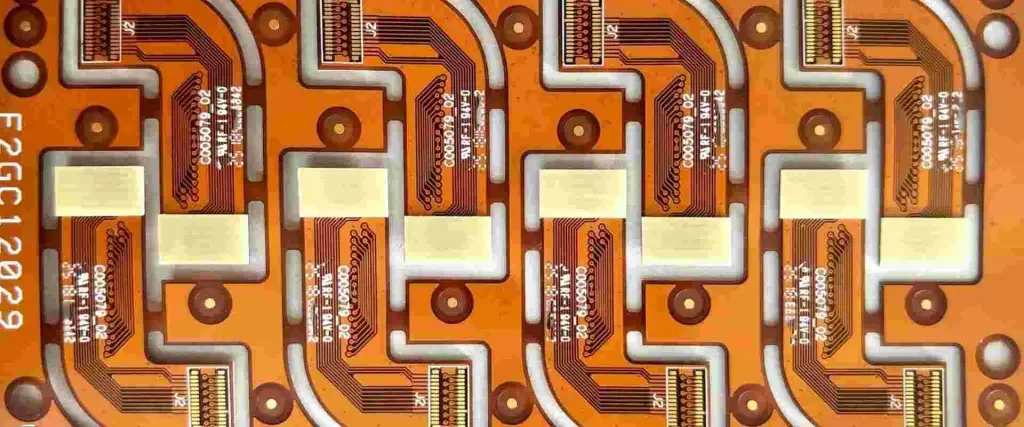
Explore thick-core geometry without inventing a replacement SKU
RAYPCB ENGINEERING
Pyralux MaterialsAP-PLUS Legacy Thickness Planner
Loading AP-PLUS Legacy Thickness Planner…
For an illustrative 8 mil dielectric and 35 µm copper on each face, the geometric base is 8 × 25.4 + 35 + 35 = 273.2 µm. Adding a combined 50 µm of local covering or other approved layers gives a concept total of 323.2 µm. This example converts units and sums dimensions; it does not establish a commercially available AP-PLUS construction or a finished tolerance.
The tool preserves the chosen core, copper and additions as separate entries. If the total differs from the drawing target, ask which physical element is allowed to change. Reducing dielectric thickness changes electrical spacing; reducing copper changes conductor geometry; removing a covering layer changes insulation and environmental exposure. A small numerical difference can therefore conceal a significant functional change.
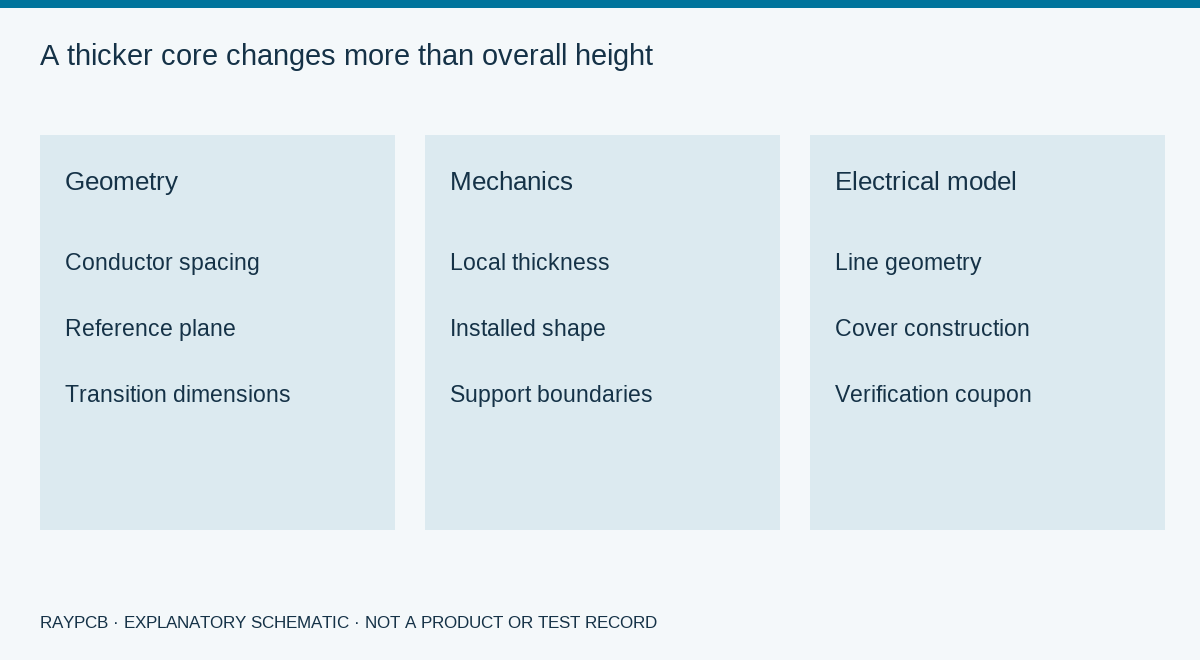
A thicker dielectric changes the signal geometry
Holding the trace width fixed while increasing its spacing from the reference conductor changes the transmission-line structure. Conversely, holding the impedance target fixed generally requires a revised geometry when spacing changes. The new width must still fit the routing channels, pads, transitions and spacing requirements. Neither a thickness conversion nor a material-family name solves that electrical design task.
An evaluation drawing should identify which dielectric distance controls each signal layer. In a hybrid rigid-flex construction, that distance may be different in the flex span and rigid region. A trace that looks continuous in plan view can encounter a changed field environment at the transition. The controlled impedance page covers the broader modeling task; retain the actual layer arrangement and material data when preparing its inputs.
Compare dielectric data only with its measurement context. A legacy typical value is not automatically a valid design value for a current construction, frequency band or process. If the original qualification depended on measured transmission performance, keep the acceptance definition and measurement setup with the redesign request. A new simulation using guessed material inputs cannot establish equivalence to the original hardware.
Thickness is also a packaging and motion decision
A thick core may provide useful separation or support in one region while making a tight installation bend more demanding. Review the full local section, including copper, covering layers and attachments. The word “flexible” describes a material or circuit technology; it does not promise that every thick construction can repeatedly fold around an arbitrary radius.
Use a drawing of the installed route to show bend direction, restraints, free length, possible twist and the transition into supported regions. Where movement occurs, record the motion range and required service cycles. A static assembly that is bent once and then restrained has a different validation task from a moving interconnect. Do not transfer qualification results between them solely because both drawings name AP-PLUS.
For a replacement candidate, compare the mechanical interfaces first. Connector fit, mounting clearances and assembly sequence may constrain the change before material performance becomes the main question. The flex stackup guide can help record the regional construction, while the actual bend and life requirements remain project-specific.
Run a documented legacy-material review
Start by collecting the last approved fabrication drawing, material specification, available certificates and any original electrical or mechanical validation. Distinguish a missing record from a failed requirement. An old purchasing description such as “AP plus, one ounce” is not sufficient to reconstruct the complete stack, especially when additional bonding layers were specified elsewhere.
Next, identify the decision owner. Procurement can obtain availability and document revisions; fabrication engineering can assess process implications; the design owner must decide whether a material change requires validation or a formal revision. Keeping those responsibilities visible reduces the risk of an expedient supply substitution becoming an undocumented design change.
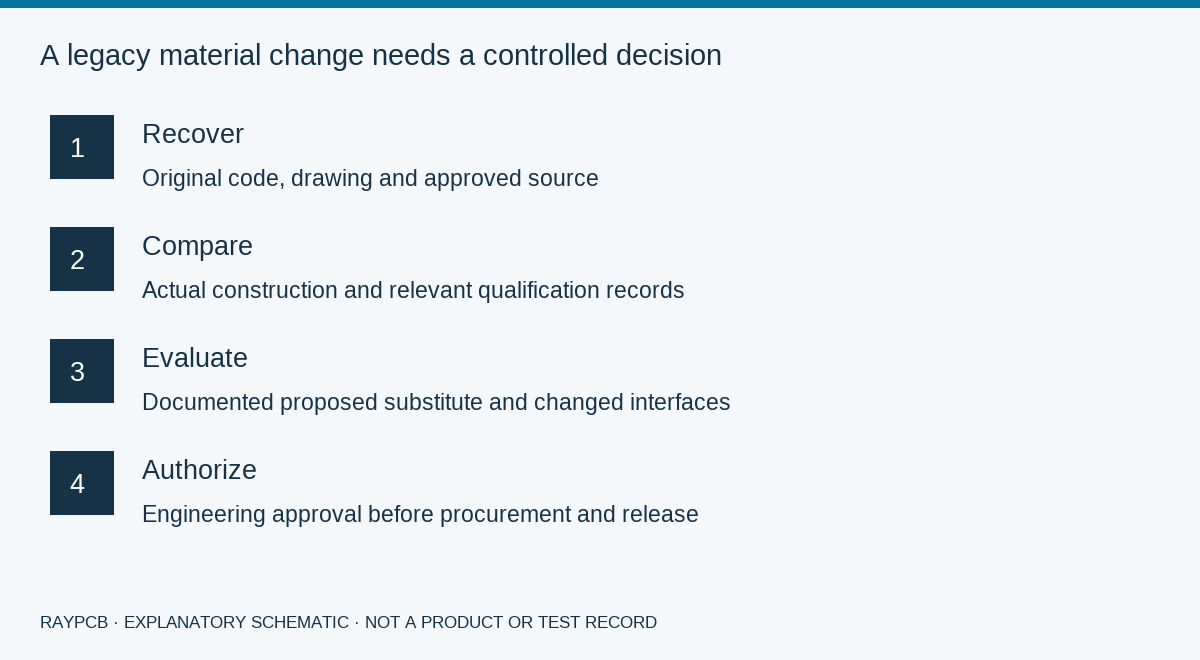
| Stage | Required output | A useful review question |
|---|---|---|
| Recover the baseline | Controlled section and original material record | Which dimensions and material identities were approved? |
| Describe the candidate | Current supplier construction and evidence | Which properties or process layers differ? |
| Assess the impact | Electrical, mechanical and process review | Which existing acceptance results no longer transfer? |
| Verify and release | Agreed tests and authorized drawing revision | What evidence closes each identified change? |
Do not use this sequence to delay a straightforward enquiry. Send the evidence that exists and identify the gaps. A manufacturer can respond more usefully to a clearly bounded legacy problem than to a guessed replacement code presented as already approved. The Pyralux manufacturing overview provides the commercial entry for that conversation.
Process compatibility belongs to the complete stack
All-polyimide construction does not remove the need to review the remaining materials. A legacy design may combine the base with a particular coverlay, bonding film, stiffener adhesive or rigid section. The response to heat, pressure and subsequent assembly depends on those interfaces as well as the core. Keep them in the process review instead of evaluating the base in isolation.
Avoid copying an old generic press profile into the new fabrication notes. The relevant variables include the actual bonding system, stack thickness, copper distribution, tooling and the way the part reaches its specified conditions. Controlled supplier instructions and qualified process records should define the manufacturing route. This page intentionally does not invent a single temperature, pressure or dwell for every AP-PLUS application.
Inspection should close the requirements that motivated the material choice. That might include section thickness, registration, electrical isolation, controlled impedance or dimensional fit. Additional reliability work depends on the application and the effect of the proposed change. Passing an ordinary continuity test does not establish that an altered thick-core construction retains the original transmission or bending performance.
Estimate the review scope before assuming a material premium
RAYPCB ENGINEERING
Pyralux MaterialsPyralux AP-PLUS Documented Build Budget
Loading Pyralux AP-PLUS Documented Build Budget…
For a legacy build, cost can be driven by documentation recovery, minimum purchase quantities, format changes, usable panel area and requalification, as well as the laminate itself. A quotation for unchanged repeat manufacture is not directly comparable with a quotation that includes a material change and new validation. Define those scopes separately before comparing totals.
The budget worksheet uses only allowances entered by the visitor. Its AP-PLUS scope explicitly retains supply uncertainty. For example, ten planned panels at 80 each, 100 circuits with an extra 2 per circuit and 150 setup gives 1,150 in the selected currency. That arithmetic does not confirm availability or cover any unlisted validation program. Changing the scope or currency clears the old allowance fields so a previous figure is not reused accidentally.
An enquiry should attach the legacy drawing, the exact callout, required quantities and the reason for the review. State whether an unchanged build is required or a substitute may be proposed for approval. Request an engineering review directly if the supply identity is unresolved; the geometry and cost worksheets are optional supporting records.
Questions about AP-PLUS and existing designs
Does AP-PLUS mean thicker copper than every AP construction?
No. The historical distinction is thicker dielectric. Specify copper separately on each face, and do not infer a copper weight from the family suffix.
Is AP-PLUS currently available in every historical code?
That has not been established here. Confirm the current supplier document, exact construction, format and availability for the actual request. Historical literature alone is insufficient purchasing evidence.
Can the tool convert a legacy code into a replacement material?
No. It only explores nominal cross-section arithmetic. A replacement needs material identity, design impact and authorized validation, not a lookup based on a similar thickness.
Should the old URL be replaced with an AP series page?
The technical tasks differ: AP supports normal series selection; AP-PLUS supports historical thick-core interpretation and controlled change. Readers can move between them without losing the context of their drawing.
Bring the requirement and the drawing together
Send the board revision, construction, quantity and the standard or engineering question you need reviewed. Identify unresolved requirements so the response can address them.
Send requirements for reviewOptional: attach the downloaded worksheet manually. This guidance does not certify a design, approve a shipment or replace the applicable authorized standards.