
RAYPCB · ENGINEERING GUIDE
Isola IS420 PCB: Thermal Reliability and Stackup Data
Isola IS 420 is a lead-free epoxy laminate and prepreg system whose thermal behavior and construction data support a controlled multilayer design. This page focuses on converting the specific IS 420 requirement into a stackup, rather than treating every high-Tg FR-4 product as interchangeable.
The Isola PCB overview supports family selection. For an existing design, begin with the layer thickness convention and the source revision, then identify which thermal and electrical requirements are actually controlled.
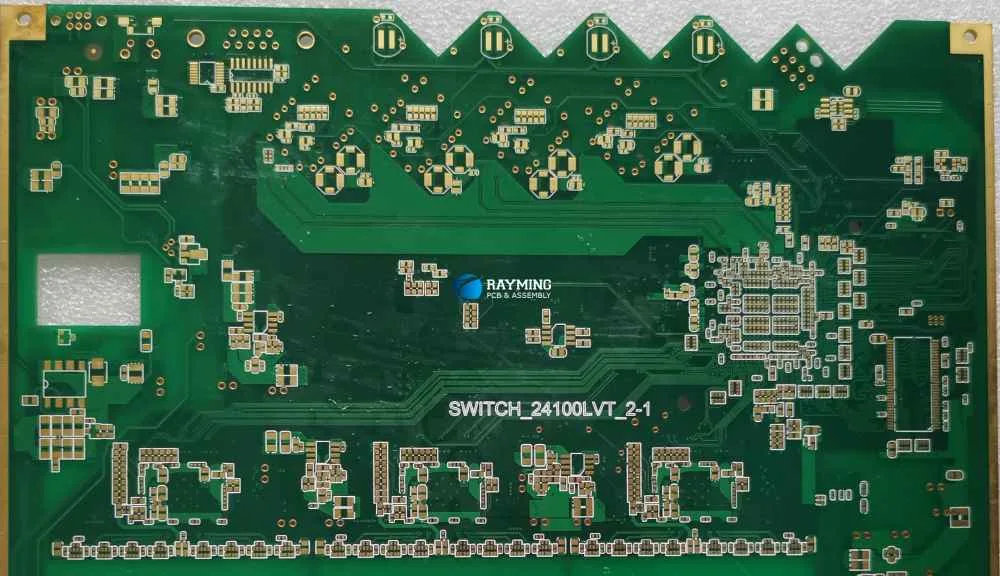
Read the exact IS420 data rather than a neighboring name
Isola's current product page lists typical DSC Tg of 170°C and Td of 350°C at 5% mass loss. It also describes UV blocking and fluorescence for manufacturing imaging. Those optical attributes help identify process compatibility; they are not evidence that a finished PCB has passed AOI.
Do not replace the 170°C value with an IS 410 or 185HR headline simply because the product names are nearby. If the original drawing demands a minimum property, agree the purchase requirement and method instead of converting a typical value into a guarantee.
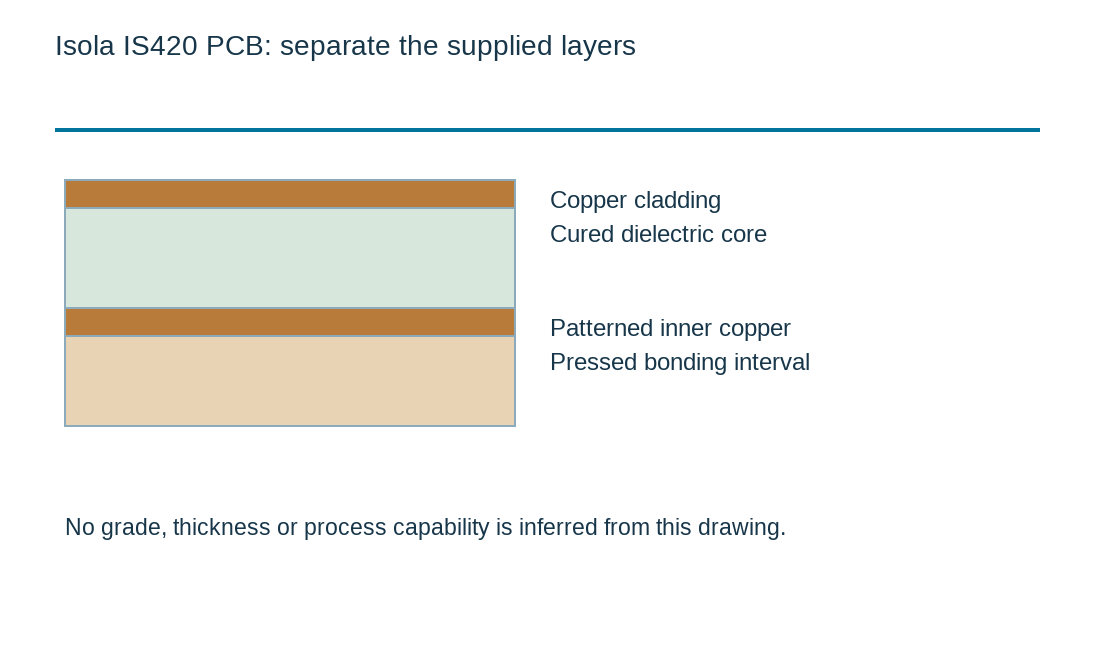
Evidence and construction decision
| Item | Source or model boundary | Action for the design review |
|---|---|---|
| Tg / Td | 170°C DSC / 350°C typical | Do not repeat an unsupported 180°C value. |
| AOI context | Fluorescent material supports inspection | No inspection pass is implied. |
| Thickness model | Dielectric plus supplied copper | Pressed bonding intervals need separate review. |
Resolve whether thickness includes copper
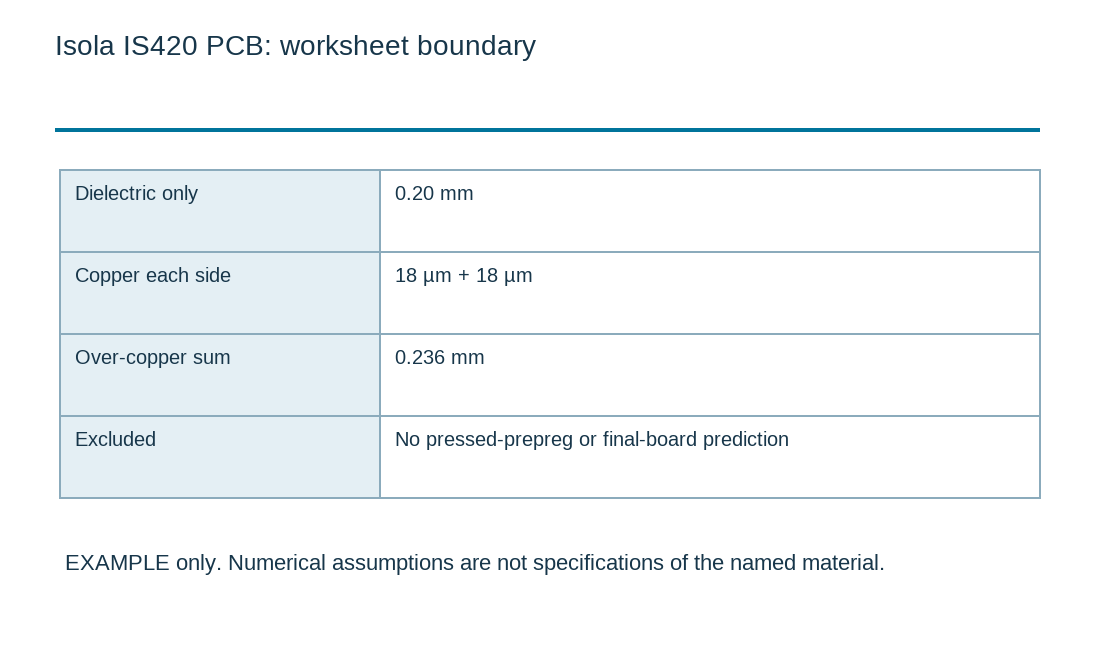
A core drawing may specify dielectric thickness or total thickness over cladding. These conventions produce different numbers. A 0.20 mm dielectric with 18 µm copper on each side has an arithmetic over-copper total of 0.236 mm. That calculation does not include etching, plating or a pressed prepreg interval.
The core worksheet keeps these quantities separate. Use it when reconciling a stackup drawing with a laminate order, and state which measurement is controlled. For the finished multilayer, add each actual layer and tolerance rather than treating the nominal core total as a finished-board specification.
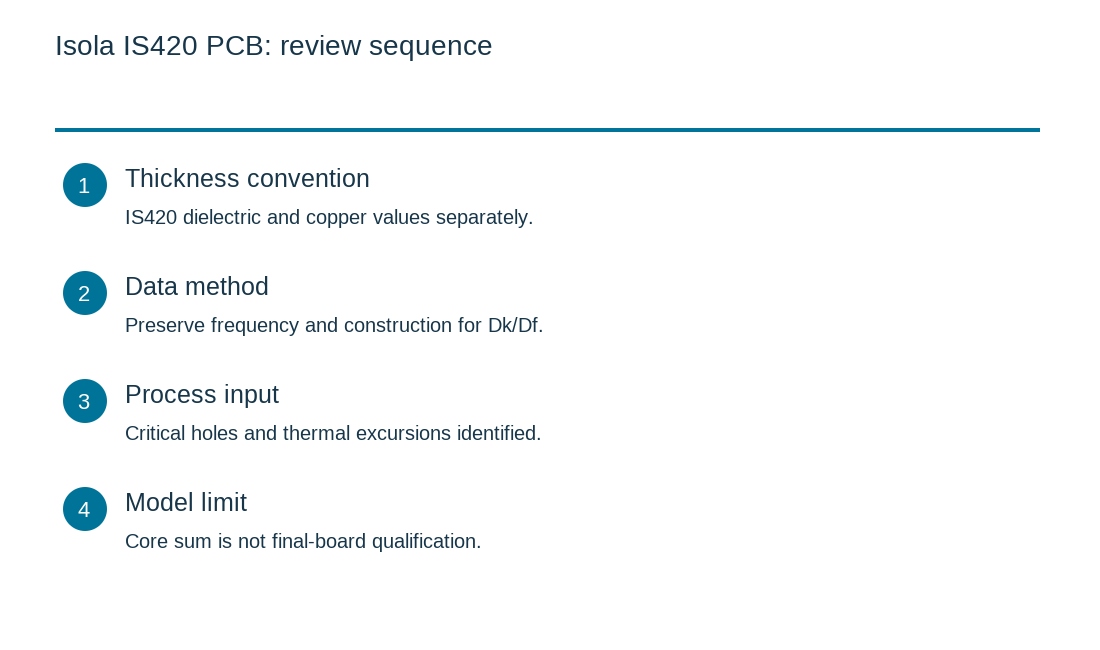
| Review item | What to establish |
|---|---|
| Thickness convention | IS420 dielectric and copper values separately. |
| Data method | Preserve frequency and construction for Dk/Df. |
| Process input | Critical holes and thermal excursions identified. |
| Model limit | Core sum is not final-board qualification. |
Core supply thickness reconciliation
Core supply thickness reconciliation
Use the current inputs and keep the assumptions
Start with the example only to inspect the units and the calculation boundary. Replace every assumption with a value tied to your own document or measurement. An empty numeric field is not zero. The review-reference field is a local label; avoid entering customer names, confidential part numbers or other private information into a public worksheet.
After calculating, read the notes alongside the numerical result. Changing any input invalidates the displayed result and disables its download until you calculate again. For a comparison, keep the units, geometry, material condition and measurement boundary consistent. A long decimal result does not imply equally precise input data. The downloadable record stays on your device and can be attached manually to an inquiry. It is not automatically transferred into the Contact form.
If an input is unknown, identify the person or document needed to resolve it. Do not fill a gap with a favorable generic value simply to obtain a result. You can request a material or fabrication review without using the tool. The arithmetic illustrates a relationship; it does not accept a construction, certify a material, establish current pricing or replace a supplier process specification.
| Input | What to establish before using it |
|---|---|
| Review reference | Nonconfidential revision label. |
| Cured dielectric thickness · mm | Supplier basis excluding copper. |
| Top copper thickness · µm | As supplied, before inner-layer etching. |
| Bottom copper thickness · µm | As supplied, before inner-layer etching. |
Optional cost comparison from your own allowances
Use a quotation or a clearly labeled internal assumption for each input. Keep the quantity, construction and inspection scope the same when comparing alternatives. This uncalibrated planning model adds entered values; it contains no current market rates and does not issue a RAYPCB quotation. You can contact the team without completing it.
Optional project allowance comparison
Use construction data for controlled impedance
The official IS 420 page includes frequency-dependent Dk and Df tables and prepreg constructions. At 2 GHz it lists a typical Dk of 4.04 and Df of 0.0210 with Bereskin stripline context. Other frequencies and resin contents differ; these values should travel with their method and specimen information.
Ask which construction the field solver represents. The same impedance target can be reached using different trace widths and dielectric heights, but etch tolerance and loss will differ. If the actual concern is a long channel, move to a complete loss review rather than using a thermal-grade label to infer bandwidth.
Let the process drawing carry the difficult details
Show hole spans, copper distribution and any local thick-copper or mechanically constrained areas. Identify the assembly history and planned rework. The material name does not communicate how many thermal excursions the finished plated structure must tolerate.
When comparing 185HR, keep the geometry and evidence requirements consistent. If the starting document is a legacy FR402 callout, first recover its original functional limits. An alternative should be justified by the requirements it satisfies, not by a larger Tg number alone.
Compare a complete manufacturing scope
Panel size, usable area, layer construction, copper and inspection scope can affect the commercial proposal. The optional budget worksheet sums allowances supplied by the visitor. It does not estimate an IS 420 market rate or promise that a given thickness is in stock.
Separate one-time engineering or tooling from recurring board and test costs. Compare quotations at the same quantity and revision. An inexpensive proposal that silently changes the copper or dielectric construction is not yet equivalent to the analyzed board.
Prepare the IS420 stackup for review
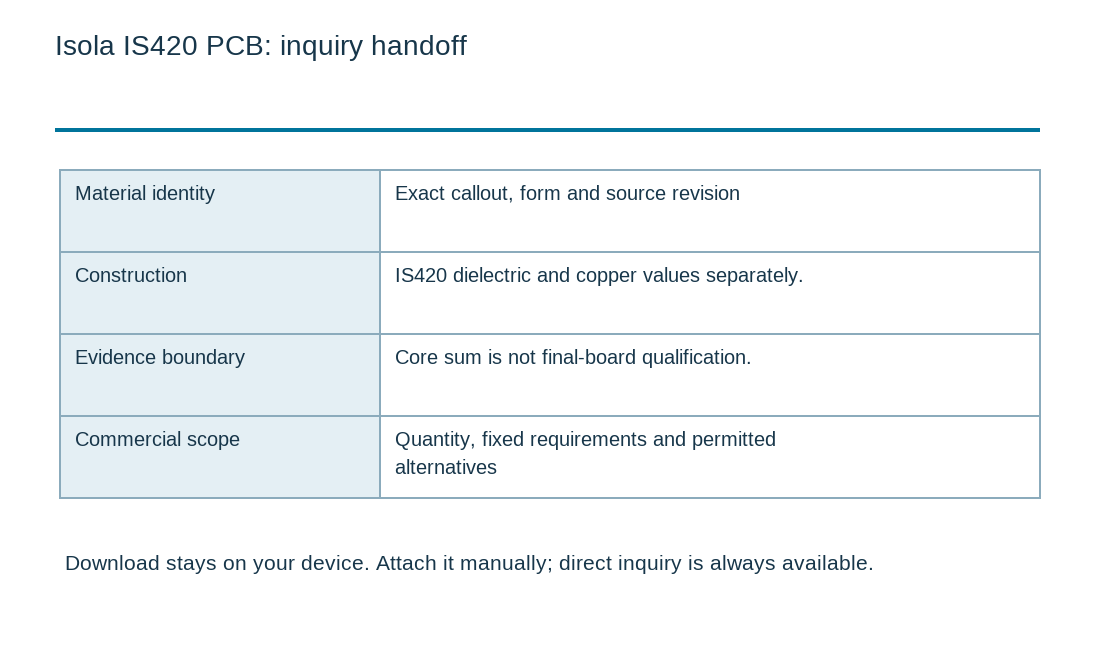
Send the fabrication files, drawing revision, exact material requirement, copper and thickness conventions, drill data, impedance table and acceptance requirements. Include any restrictions on equivalent grades and identify who can approve changes.
The useful next step is an agreed stackup and a list of resolved or open exceptions. Preserve that record alongside the material declaration and relevant inspection results. The worksheet supports dimensional clarity; it does not qualify the press cycle, electrical performance or completed board.
Close the material and construction decision together
The finished board combines a dielectric, copper patterns, holes, surface coatings and a manufacturing history. Its behavior cannot be inferred from a family name alone. State the supplied grade, reinforcement, thickness, copper and processing conditions that matter to the intended application.
Keep handling and assembly requirements with the fabrication drawing. A thin panel, punched outline or unusual support condition can change the production route even when the electrical circuit is simple. Ask the fabricator to review the actual features and panel format rather than assuming a dimensional example represents a production capability.
For cost comparison, hold the drawing, quantity, test scope and acceptance requirements constant. Record one-time tooling separately from recurring work, and distinguish raw material utilization from accepted-board yield. Any calculator on this page uses supplied assumptions; an actual quotation requires the files and an agreed scope.
A source-qualified table should be read alongside the exclusions and footnotes, not separated from them. If the supplier limits an application, identify whether that limitation affects the current design before requesting a price. A familiar family classification does not override an explicit restriction, and a positive calculator result cannot remove it.
For a repeat build, compare the newly proposed supply with the previously approved material record. Exact grade, manufacturing site where relevant, foil treatment, reinforcement and dimensional basis can matter. Define which changes require notification and which need technical approval. This avoids turning a purchasing substitution into an unnoticed design change.
Receiving records should support the agreed identity and traceability requirement. A certificate for a raw material, a finished-board inspection report and an assembly test result cover different boundaries. Request the records that actually answer the project questions rather than collecting unrelated certificates.
When a source contains conflicting values, keep the discrepancy visible until a controlled revision or written supplier response resolves it. Do not create a new table by combining the most favorable entries from several sources. The released drawing, material list and quotation should all describe the same accepted construction.
Standards, source context and limits
Use the edition, amendment and material-document revision named in the purchase agreement. A standards title, marketing label or supplier product family does not establish that a particular lot meets a requirement. Public summaries are useful for scope; the controlled specification and applicable test method govern acceptance.
The examples on this page are illustrative engineering scenarios. They are not RAYPCB production records or guaranteed material values. Source links identify the organizations responsible for the referenced information. Confirm applicability to the exact grade, construction and test condition before carrying a number into a drawing or qualification report. Sources were reviewed on 3 October 2026. A public catalog search is not proof that an unlisted product never existed. Where the exact designation or current technical sheet could not be verified, this page provides a clarification workflow rather than an invented material specification. Current supply, construction availability and qualification remain separate questions.
For fabrication scope and the agreed construction requirements, see PCB manufacturing.