
RAYPCB · ENGINEERING & PROCUREMENT
BOM Component Purchasing: From Approved Part Numbers to a Ready Kit
BOM component purchasing turns a released parts list into approved, available material for an electronics build. It requires more than selecting the lowest displayed unit price. Identity, lifecycle, authorized sources, packaging, minimum quantities, alternatives and delivery commitments all affect the result. This guide helps buyers work with engineering so a purchasing decision remains aligned with the actual PCB assembly configuration.
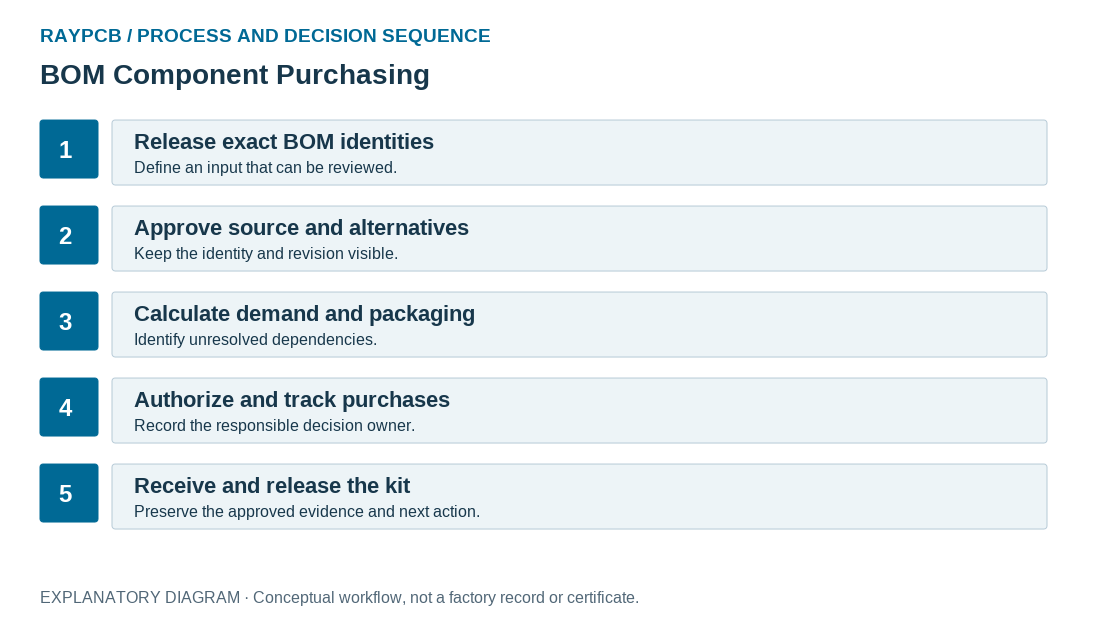
Your task: Release exact BOM identities. Use the component purchase quantity planner to record the next decision.
Open component purchase quantity planner · Discuss the project
Begin with a controlled and purchasable BOM
The BOM should identify manufacturer, full manufacturer part number, fitted quantity, reference designators and approved alternatives where applicable. Separate fitted components, do-not-fit positions and non-board items. State the product revision and population option.
Descriptions are helpful but cannot replace exact identity. Package suffixes, ratings, temperature grades and packing options may matter. If an internal code is used, provide a controlled mapping to the approved part.
Resolve duplicate or inconsistent lines before requesting prices. A BOM with two descriptions for the same device can lead to double purchasing, while a merged line can conceal different specifications.
Approve alternatives before treating them as supply options
An alternative needs engineering review for function, footprint, ratings, thermal behavior, software implications and any product-specific requirements. Distributor cross-reference suggestions are starting points, not automatic approval.
Record which product revision permits each alternative and whether approval is permanent or limited to a lot. Keep a proposed substitute distinct from an approved one.
A hypothetical regulator replacement may share a package but require different compensation or expose a different pin function. Purchasing it because the headline voltage and current match can create rework or a redesign. The appropriate check follows the exact device documentation.
Evaluate source and traceability as part of the purchase
Prefer the original manufacturer or an authorized distribution route where available and appropriate. Verify source status using current manufacturer information. Preserve purchasing and lot documentation required by the project.
Do not assume a low price or recognizable marking proves authenticity. If material must be sourced outside the normal channel, escalate the risk and required evaluation through the agreed quality process. A generic visual check cannot authenticate every component.
Use current manufacturer product pages and lifecycle notices when reviewing availability. Record the date and basis of the sourcing decision so a later buyer can understand why that route was chosen.
Calculate order quantity without confusing demand and packaging
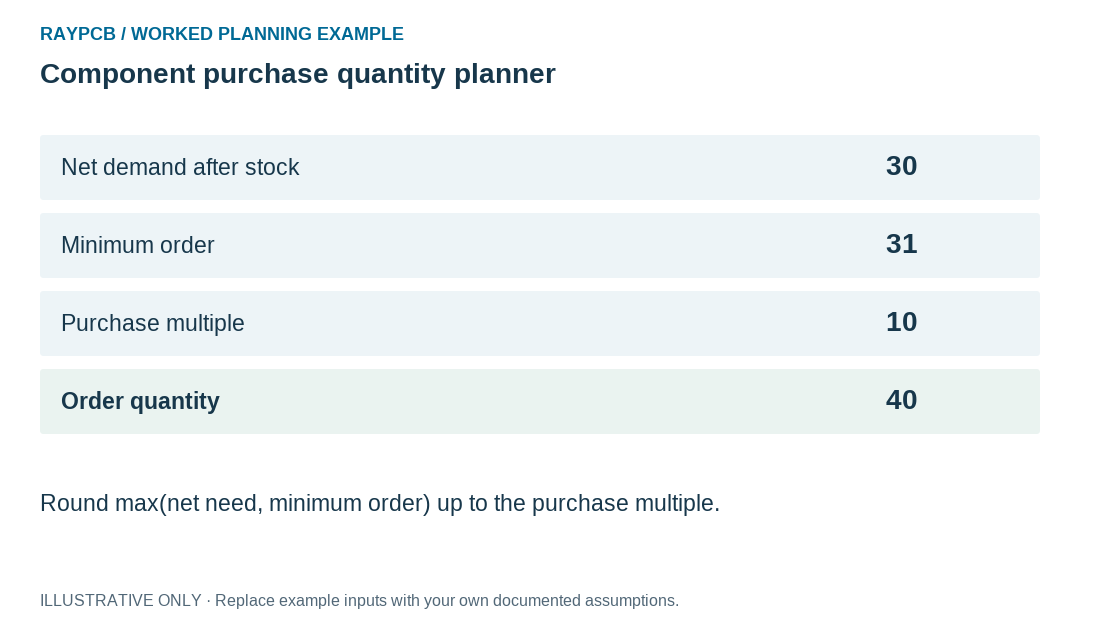
Fitted demand is build quantity times quantity per assembly. Then account for usable allocated stock and any agreed setup allowance. Minimum order and package multiples can increase the purchase quantity beyond immediate demand.
The calculator rounds an entered requirement to the entered purchase multiple after applying the minimum quantity. It also reports resulting excess. It does not fetch stock, approve a purchase or recommend a universal spare percentage.
Component purchase quantity planner
Component purchase quantity planner
How to use and interpret this worksheet
Enter the build quantity, fitted quantity per assembly, agreed allowance and usable allocated stock for one approved component. Then enter the supplier's minimum order and purchase multiple. Confirm those commercial inputs from the actual source; the worksheet has no live distributor connection.
Required demand is build quantity multiplied by quantity per assembly, plus allowance. Existing usable stock is deducted to find the additional requirement. If no additional parts are needed, the calculated purchase is zero even if a supplier has a minimum order. Otherwise the tool takes the larger of requirement and minimum, then rounds upward to the purchase multiple.
The reported excess is stock plus purchase minus demand. Review whether that excess has a credible future use and who owns it. A lower unit price at a larger quantity can still increase total exposure, especially when the design may change.
All counts must be whole parts and the purchase multiple must be greater than zero. Keep part identity, approved alternatives, source status and restrictive purchasing terms outside the arithmetic but inside the decision record. The tool cannot approve those conditions.
Load the illustrative example, then clear it before entering real values. Edits invalidate old results. Download the current calculation if useful and attach it manually to the purchasing discussion. It does not place an order, verify authenticity, check availability or authorize substitution.
Use supplier-confirmed packaging and minimums. If the price break requires a larger purchase, compare the excess-stock commitment with the expected consumption and revision risk rather than looking only at the per-piece price.
Keep a decision record with the review
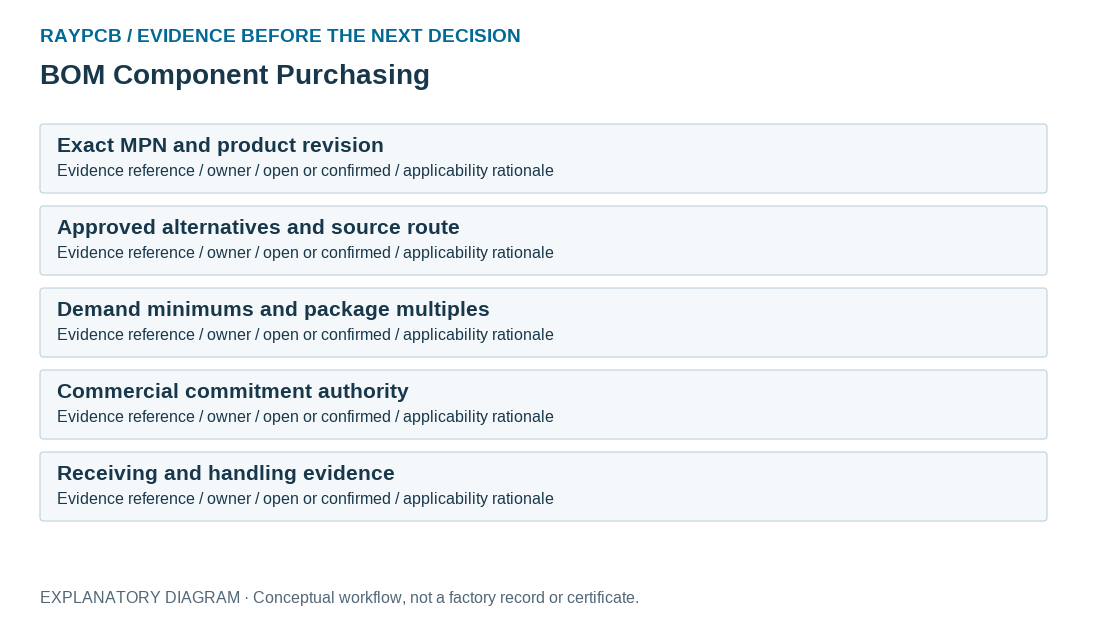
Use this record to connect the discussion to supporting information. Record the source, revision and reviewer for each item. Confirmed means the responsible person has reviewed the evidence; it does not mean this website has verified it. Keep confidential documents in your approved project system.
| Review topic | Record to retain | When it remains open |
|---|---|---|
| Exact MPN and product revision | Identify the controlled scope and the person authorized to approve it. Keep the current reference together with the intended decision. | Clarify the boundary before treating the review as a release instruction. |
| Approved alternatives and source route | Reference the actual file, data source or agreed requirement, including its revision or date and the person who reviewed it. | Request the missing evidence and identify which downstream decision depends on it. |
| Demand minimums and package multiples | Record the conditions and assumptions that make the evidence applicable. Separate a proposed value from an approved requirement. | Keep the assumption visible and define whether the next activity may proceed under a bounded exception. |
| Commercial commitment authority | Identify responsibility for the next operation and the evidence expected afterward. Distinguish preparation from a completed result. | Assign a named role and an agreed decision point; do not turn an unanswered question into an approval. |
| Receiving and handling evidence | Record the final disposition, affected quantity or revision and the authority accepting it. Preserve the reason for any exception. | Retain the item in the action list and review its consequence before committing work or materials. |
Review the record again when the product, supplier proposal or supporting data changes. A result from an earlier revision is historical evidence, not automatic approval for the current one. If an item is not applicable, retain the reason and the person who made that decision.
Distinguish quoted availability from a secured delivery
A temporary shortage and a discontinued part need different responses. For a part-specific manufacturer notice, follow the component obsolescence planning guide and calculate a last-time-buy scenario before committing to supply or redesign.
Stock shown during a search may change before ordering. An order acknowledgement, promised delivery and received accepted material are different states. Track them separately.
Identify critical parts and the latest decision date for alternatives. If a line is noncancelable or nonreturnable, obtain the appropriate purchasing authorization before commitment. Do not turn an uncertain annual forecast into a firm purchase without agreement.
The manufacturing lead-time risk guide shows how material readiness interacts with files and fixtures. A shortage is important because of the operation it blocks, not merely because its quoted lead time looks long.
Receive against identity, quantity and condition
Check the received material against the approved purchase and BOM mapping. Preserve original labels, packaging information and relevant handling history. Quarantine discrepancies rather than silently fitting whatever arrived.
Moisture-sensitive and ESD-sensitive handling must follow applicable device and process requirements. Texas Instruments' product shelf-life guidance is useful background on why storage and packaging matter; do not apply one generic expiry rule to all parts.
After receipt, use component kitting to prepare the specific build and inventory management to preserve reservations and movement records.
Compare total purchasing exposure
Unit price is one part of cost. Consider minimum order, packing charges, freight, excess stock, validity and the effect of an engineering change. A cheaper line can produce a larger total commitment.
Separate components purchased for the immediate lot from stock intentionally held for later releases. Agree ownership and disposition of excess material, especially in partial-turnkey arrangements.
Official distributor tools such as Arrow's BOM guide explain their own quoting and purchasing workflows. Use those tools to organize requests, while retaining engineering approval and project-specific purchasing controls.
Questions before purchasing a BOM
Can the buyer approve a drop-in replacement? Only if the organization's approval rules explicitly allow it and the required technical review has been completed. The phrase drop-in is not sufficient evidence.
Should all parts be bought at once? That depends on design maturity, lead times and commercial commitments. Record the tradeoff instead of using one rule for every project.
What should RAYPCB receive? Provide the controlled BOM, quantity, approved alternatives and sourcing responsibilities with your PCB assembly enquiry. The worksheet produces a local quantity note only; it does not place orders or connect to supplier inventory.