
RAYPCB · ENGINEERING REFERENCE
Halogen-free PCB: from material requirement to build review
Specify the material declaration, stackup and verification scope for your PCB. Prepare engineering questions and a cost allowance without confusing a laminate statement with product compliance.
Original engineering guidance · References checked September 30, 2026
What should a halogen-free PCB order specify?
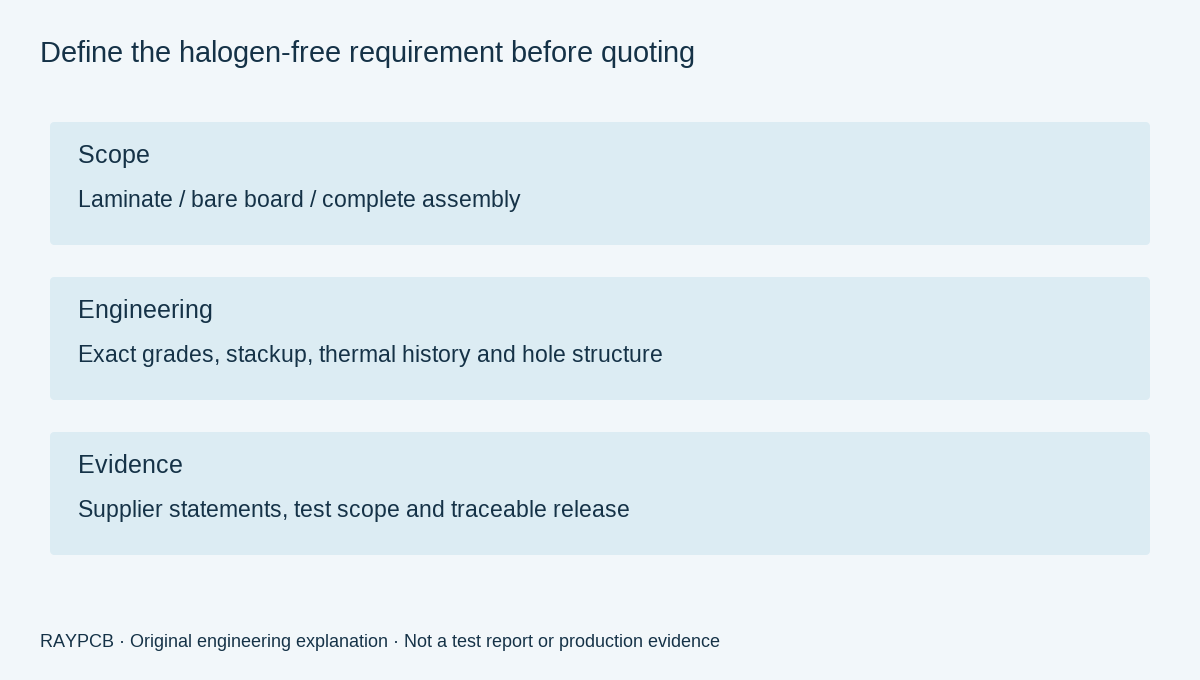
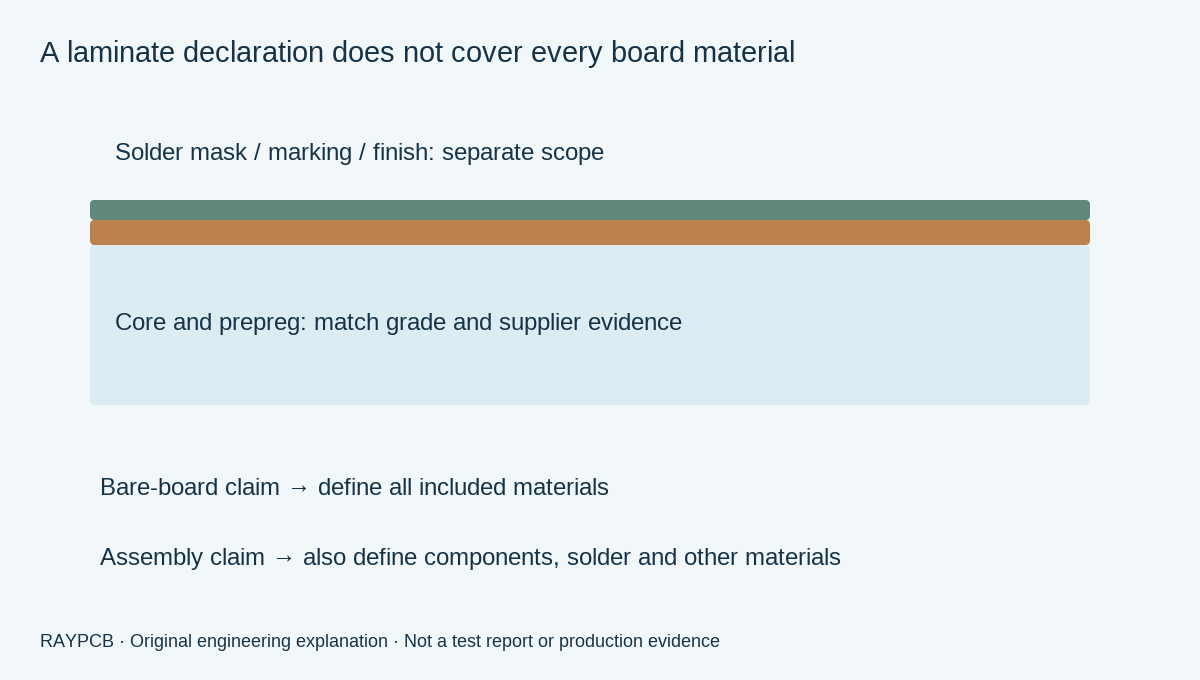
A halogen-free PCB order needs a defined material requirement and a defined statement scope. Identify the exact laminate and prepreg grades, the applicable criteria and the evidence required. Then state whether the claim concerns those base materials, the complete bare board or the assembled product. A supplier statement about one laminate does not automatically cover solder mask, marking ink, components or solder.
Halogen-free does not mean that an instrument will detect absolutely no halogen. It is a requirements term applied using a stated definition and material basis. It also does not mean that a board is automatically RoHS compliant, REACH compliant, recyclable or safer in every exposure scenario. Keep those requests separate so procurement can obtain the appropriate evidence instead of a broad but unsupported environmental statement.
This page is the project and manufacturing entry point. The companion halogen-free PCB material evidence guide explains how to read concentrations, report scope and supplier declarations. If you already have an approved construction, send it directly for review; there is no need to complete either worksheet before making an enquiry.
Define the boundary of the requested declaration
| Requested scope | Identify these items | Do not assume |
|---|---|---|
| Laminate and prepreg | Manufacturer, grade, construction and document revision | A core statement also covers a different prepreg |
| Complete bare board | Base materials plus mask, marking, finish and other included materials | A laminate result proves the entire board statement |
| Assembled product | Board, components, solder and other included assembly materials | A bare-board declaration covers every purchased component |
| Customer-specific policy | Exact restricted-substance list and material basis | A familiar industry label matches the customer's policy |
The scope should appear in the request for quotation and the purchase specification. If it changes after fabrication begins, additional document collection or testing may be needed. Naming the boundary early is therefore a practical scheduling decision as well as a documentation task. Ask who owns the final product statement and which suppliers must contribute information.
The IEC 61249-2-21:2003 catalog entry describes a specific class of non-halogenated reinforced copper-clad material. It is not a universal certification for every constituent of an assembled electronic product. Use the applicable standard and authorized edition together with the customer's procurement requirements; do not extend a material standard beyond its intended scope.
Selecting a material still requires a PCB design review
Removing a particular flame-retardant approach does not give every halogen-free material the same Tg, CTE, dielectric loss or processing behavior. Review the actual supplier grade and construction. The proposed core and prepreg should work together in the intended stackup, with finished dielectric thickness and copper requirements defined for the design.
For example, Isola's IS550H product page identifies a halogen-free laminate family and provides separate thermal and electrical information. It is an example of a named product record, not a recommendation for every halogen-free board or evidence of current RAYPCB stock. Confirm availability, construction and current supporting documents for your order.
If a design already uses controlled impedance, changing material can require new geometry or model inputs. Retain the Dk method, frequency and dielectric construction that support the calculation. A generic “FR-4 equivalent” substitution may not preserve the original electrical assumptions. Link the material approval to the released stackup and the controlled-impedance review where that task applies.
Thermal review should describe the assembly exposure, expected service environment and the board features most sensitive to dimensional change. Tg alone is not a maximum operating temperature and does not predict plated-hole reliability. Consider the relevant CTE direction and temperature interval and the qualification required for the actual construction.
Prepare the construction and evidence questions
RAYPCB ENGINEERING
Material EvidenceHalogen-free PCB engineering brief
Loading Halogen-free PCB engineering brief…
Enter copper-layer count, nominal board thickness and the smallest mechanical drill diameter. The worksheet reports their descriptive aspect ratio and prepares a scope-specific evidence reminder. The ratio is a geometric review input, not a manufacturing capability limit. It does not apply the same model to blind microvias or approve a demanding structure because a number was successfully calculated.
The record field should name the board revision, proposed core and prepreg, assembly exposure and unresolved material questions. If the declaration is missing or does not clearly match the grade, preserve that status in the brief. A checkbox or selected answer cannot authenticate a supplier document, so the output deliberately avoids a compliance certificate or a supplier score.
For an illustrative 1.6 mm board with a 0.3 mm mechanical drill, the nominal thickness-to-drill ratio is approximately 5.33. That says nothing by itself about permitted copper plating, hole quality or reliability. Send the actual fabrication drawing and acceptance needs so the engineering review can consider the complete feature rather than a single ratio.
Where the requirement enters manufacturing
Begin with material identity and document review before committing to a substitute. Confirm the purchased core and prepreg construction and preserve their traceability through the order. Then review the fabrication sequence against the material supplier's guidance and the fabricator's process. The goal is a consistent released construction, not a separate “green process” label attached to an otherwise undefined board.
Drilling, desmear, bonding and thermal exposure should be considered for the exact resin system. This does not mean that all halogen-free grades need the same adjusted settings. Generic recipes can be misleading because materials within the category differ. Any required change belongs in the validated manufacturing instructions and engineering review, not in a website calculator.
If the customer's statement covers the full bare board, keep a material map for the additional constituents. Changing mask color, finish or marking material can then trigger an evidence review without confusing it with a change to the core. For assembly scope, the component and solder documentation become additional workstreams; board fabrication alone cannot close them.
Acceptance records should match the agreed scope. Separate visual or electrical board inspection from chemical-content evidence and from longer-term reliability qualification. Each addresses a different question. A passed electrical test does not establish halogen content, and a material declaration does not prove that every plated connection survives the intended thermal history.
Build a transparent planning allowance
RAYPCB ENGINEERING
Material EvidenceMaterial and verification cost allowance
Loading Material and verification cost allowance…
Use this optional tool only when you have your own cost allowances. It adds quantity multiplied by a base fabrication allowance, one-time setup, incremental material procurement and evidence or testing costs. A user-selected contingency applies to that subtotal. The sample figures are invented teaching values, and the model is not calibrated to current supplier prices or RAYPCB quotation history.
Keep the categories non-overlapping. If the base unit allowance already includes the selected material, do not add the full material cost again. If a test package is already part of setup, enter zero for the additional testing allowance. Currency is a label; the tool does not fetch exchange rates. Shipping, tax, components and assembly remain excluded unless your record explicitly includes them.
The engineering brief and budget are separate worksheets. No automatic data transfer or price update is claimed. After changing the construction, quantity or evidence scope, review the cost assumptions and calculate again. The useful result is a transparent planning record that can be replaced by a project-specific quotation once the files and supply conditions are reviewed.
| Cost driver | Question for the quotation | Useful planning action |
|---|---|---|
| Approved material | Is the exact grade and construction available? | Identify permitted alternatives before purchase |
| Procurement quantity | Are there minimums or special formats? | Separate usable boards from material purchase units |
| Fabrication complexity | Do stackup or hole features change the process? | Submit the actual files and drawing |
| Evidence scope | Which declarations and tests are required? | Specify the report and responsible party |
| Substitution control | Must a change be requalified? | Agree the review route and schedule |
Comparing two quotations without a false environmental premium
Suppose quotation A includes the named core and prepreg plus standard material statements, while quotation B includes a broader bare-board evidence package. The prices cannot be compared fairly until those scopes are aligned. The difference may come from additional records or testing rather than from a universal percentage premium for halogen-free laminate.
Prepare a common requirements sheet: exact construction or permitted alternatives, quantity, included materials, report scope and acceptance needs. Ask each quotation to identify assumptions and exclusions. If a grade is unavailable, request a documented alternative and the engineering differences. Do not approve a substitution simply because both products have “halogen-free” in their descriptions.
For a repeat order, preserve the approved material and evidence version with the drawing revision. A supplier's updated statement, changed formulation or revised customer policy may need attention even when the PCB artwork has not changed. This approach supports traceability without demanding that every reorder repeat every possible test unnecessarily.
What to send for a meaningful response
Send fabrication files, stackup, board outline, quantity and delivery requirements together with the exact material or selection criteria. Include the applicable halogen-content requirement, declaration scope and any required report format. State which items are mandatory and which are open for engineering advice. Attach the material documents you are actually using so the review is not based on a guessed catalog version.
You can begin with the PCB material directory if the substrate family is still open. Once the construction is defined, the PCB manufacturing service provides the fabrication route. Use Contact for the actual project enquiry; downloading a worksheet neither submits the project nor transfers it into the contact form automatically.
Halogen-free PCB purchasing questions
Is a halogen-free laminate automatically RoHS compliant?
No. The terms answer different questions. The European Commission's RoHS overview describes restrictions on specified substances in electrical and electronic equipment. Obtain the appropriate statement for the relevant materials and product scope instead of inferring it from a laminate label.
Does halogen-free mean zero chlorine and bromine?
No. Procurement definitions use stated limits and a defined material basis. Match the applicable requirement, measurement method and report. A result below a detection limit should be interpreted with the laboratory's reporting and decision rules, not automatically entered as zero.
Can RAYPCB quote before I choose a final grade?
An enquiry can begin with the construction, application and mandatory requirements. Identify what remains unresolved so material options can be reviewed. A firm project quotation still depends on the agreed files, material availability and manufacturing scope.
Does the budget tool give a current selling price?
No. It sums user-provided allowances and a stated contingency. It has no live material pricing, inventory or quotation approval. Use it to organize a budget discussion, then request a quotation against the actual released requirements.
Bring the requirement and the drawing together
Send the board revision, construction, quantity and the standard or engineering question you need reviewed. Identify unresolved requirements so the response can address them.
Send requirements for reviewOptional: attach the downloaded worksheet manually. This guidance does not certify a design, approve a shipment or replace the applicable authorized standards.