
RAYPCB · ENGINEERING REFERENCE
Metal Core PCB Materials: Aluminum, Copper & Steel
Select a metal-base family by the thermal, weight, mechanical and electrical requirements. Keep alloy data separate from finished-board performance.
Original engineering guidance · References checked September 27, 2026
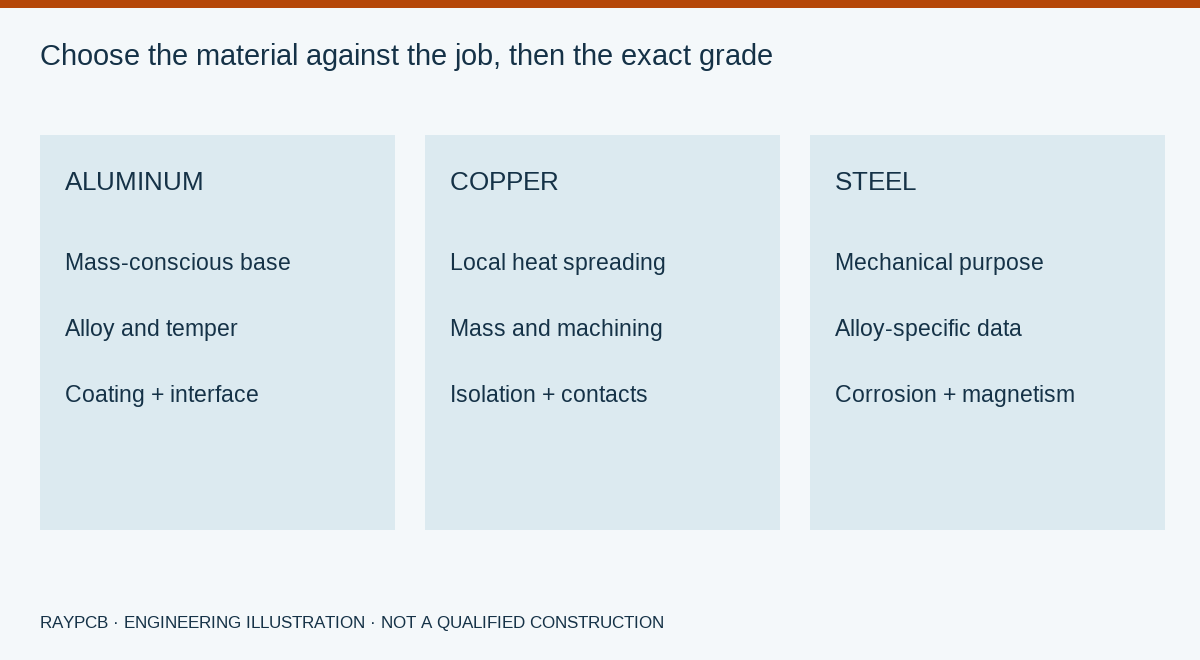
Select metal core PCB materials at the correct level
Metal core PCB materials include the base metal, insulating dielectric, circuit copper and any additional bonding or interface materials in the construction. Aluminum, copper and steel describe base families; they do not describe a complete laminate or finished-board specification. A useful selection starts with the product's heat paths, electrical separation, mass, mounting and environment. It ends with exact grades, dimensions, evidence and an agreed construction, not a single conductivity ranking.
This page compares three base families and organizes a material requirement. The aluminum-versus-copper page owns the deeper two-option comparison and numerical tradeoff. The metal core PCB service page owns the commercial overview. Keeping these roles separate lets you move from broad screening to a specific engineering review without rereading the same product description on several pages.
What each base family brings to the review
| Base family | Reasons to investigate | Questions before selection |
|---|---|---|
| Aluminum | A comparatively light base with useful heat spreading and common board applications | Exact alloy, temper, conductivity, surface treatment, flatness and interface requirements |
| Copper | Strong local heat-spreading potential and specified thermal or electrical contacts | Mass, fabrication route, oxidation protection, isolation and total system benefit |
| Steel or iron-based alloy | A defined mechanical, expansion, magnetic or specialized product requirement | Exact alloy, corrosion protection, magnetic behavior and whether thermal performance is sufficient |
These are directions for investigation, not approved substitutions. “Steel” includes many compositions with different properties; stainless steel should not inherit the conductivity or magnetic behavior of an unspecified carbon steel. Aluminum alloy data should not be replaced with a pure-metal value merely because the latter looks better. The selected grade and condition belong on the material specification and the procurement record.
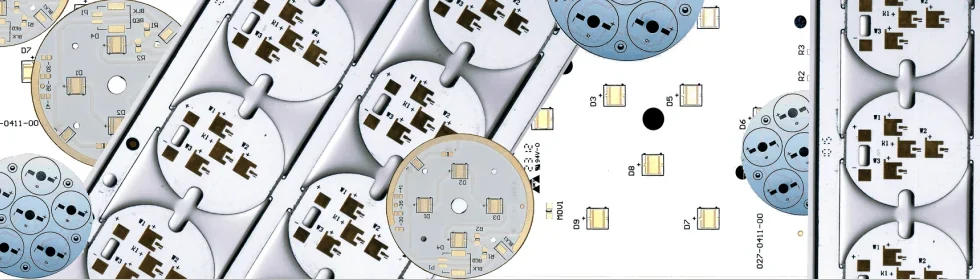
Material, laminate and assembly values answer different questions
At material level, conductivity describes heat conduction under stated conditions, density supports a mass calculation, and expansion data describe dimensional change with temperature. A laminate combines several constituents and interfaces. Its reported thermal result may depend on a particular test structure and method. The completed assembly adds heat sources, solder joints, surface treatments, hardware, a heat sink and the operating environment. Moving a number between these levels without checking its meaning creates false precision.
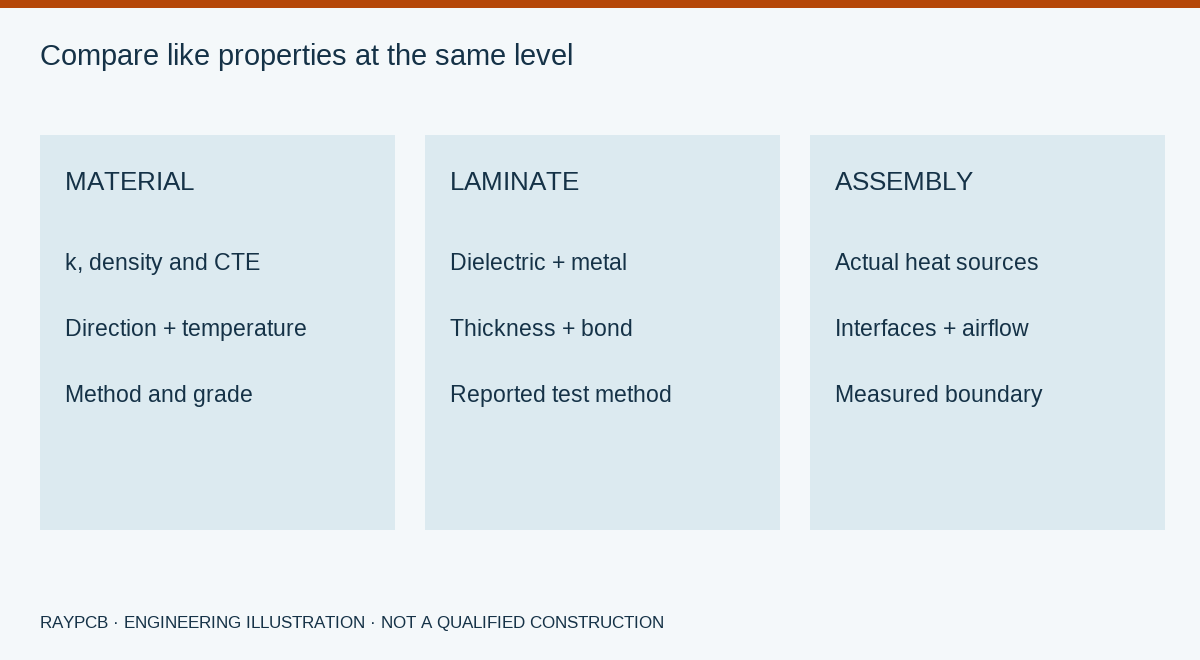
The Ventec material-selection guide provides an official starting point for dielectric and IMS selection factors. Use the exact grade data for a real proposal; the family name alone does not establish thermal, electrical or processing limits. Where the design instead needs metallized ceramic, the Rogers curamik material overview describes a different substrate route. Ceramic constructions should not be called polymer-dielectric IMS simply because both remove heat.
Screen your candidate data against explicit project limits
RAYPCB ENGINEERING
Metal ThermalMetal-Base Material Screening
Loading Metal-Base Material Screening…
Enter two to six candidate rows using a short grade label, conductivity, density and expansion coefficient. The worksheet computes bare-base mass from a shared area and thickness, then compares each row against your entered maximum mass, minimum conductivity and maximum expansion coefficient. It reports numerical matches and outstanding non-numeric requirements. It does not create a weighted “best material” score or choose stocked RAYPCB products.
The example rows deliberately use illustrative family values. Replace them with sourced grade data at appropriate temperatures before using the brief in engineering work. A candidate inside all three numerical limits can still fail electrical, mechanical, corrosion, process or supply requirements. A candidate outside one threshold may prompt a justified requirement review, but the tool cannot relax that requirement or approve the alternative.
A screening result is the start of a decision
For a hypothetical 100 × 100 × 1.5 mm base, the volume is 15 cm³. Entering densities of 2.70, 8.96 and 7.80 g/cm³ gives base masses of 40.5, 134.4 and 117 g. With a 100 g maximum, only the first example fits the mass limit. If the conductivity requirement is also 100 W/(m·K), a hypothetical steel row at 50 W/(m·K) fails that threshold independently of its mass. These numbers illustrate the arithmetic and are not a specification for three unnamed commercial alloys.
The result still says nothing about the selected dielectric, acceptable voltage, mounting stiffness or source-to-sink resistance. An expansion coefficient within a limit also does not prove solder-joint life. A complete assembly can contain several materials with different expansion, and the constraints determine how that mismatch produces strain. Record why each numerical threshold exists so that the next reviewer can distinguish a hard product requirement from an early design preference.
If thickness or outline changes, repeat the mass comparison and review the thermal and mechanical consequences. Reducing thickness to meet a weight limit changes stiffness and the geometry of the heat path. A thicker material can improve lateral spreading while increasing a through-thickness distance; these are different mechanisms. Avoid a material decision based on one formula while the physical design changes around it.
Aluminum-base selection: include the surface and joint
Aluminum is worth investigating when the product needs an efficient use of mass and a practical metal-backed construction. Specify the alloy and relevant condition, then review surface preparation, bonding and the external cooling interface. The board outline, mounting pattern and permissible flatness affect how much of the base can make useful contact with the intended heat sink. A nominal material value does not describe that joint.
When requesting an aluminum PCB, identify the dielectric system, circuit copper, finish and fabrication tolerances as well as the base. Do not assume a supplier's standard sheet has the required electrical isolation or thermal evidence. If an alternate sheet is proposed, review the changed material and test basis before treating it as interchangeable. The design drawing should preserve the properties on which the product actually depends.
Copper-base selection: test whether the improvement matters
Copper can be useful when local spreading or a specified contact benefits from its properties, but the complete thermal path determines the result. A higher conductivity value cannot remove the resistance of an unchanged dielectric or a poor external interface. The base mass and fabrication details also remain part of the product decision. An exact grade, material condition and surface treatment are more useful than a generic “premium thermal PCB” label.
The C11000 alloy reference demonstrates how an alloy source identifies density, conductivity and temperature context. It does not establish every copper-core board's properties or available construction. For a copper-core PCB enquiry, state whether the design retains full dielectric isolation or includes a deliberate direct thermal contact. The latter changes the electrical and mechanical review; it is not simply a different metal color.
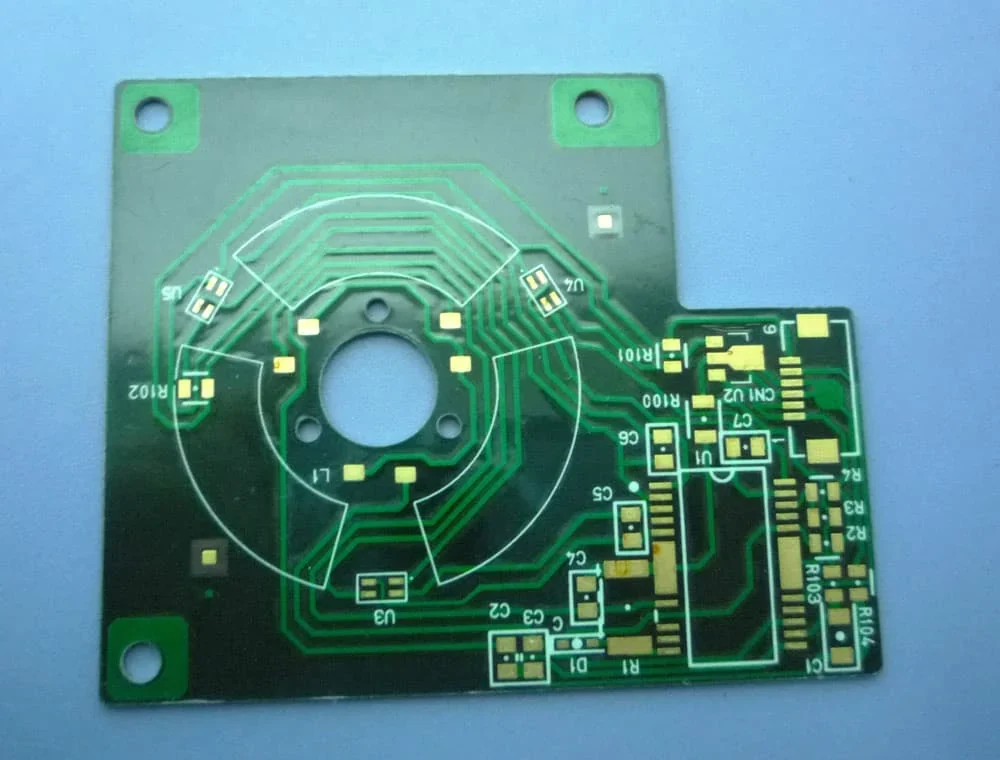
Steel-base selection: make the non-thermal reason explicit
An iron-based board may be investigated for a specific mechanical or product requirement. Name that requirement rather than assuming steel is a lower-cost version of an aluminum board. Alloy-dependent conductivity, expansion, magnetic response, corrosion and processing all need review. A magnetic requirement can be useful in one application and undesirable near another component or sensor. Surface protection may affect electrical contact, bonding or the heat-sink interface.
Use the iron PCB product page for the related manufacturing discussion, and provide the exact proposed alloy where known. If the alloy is unresolved, list the mechanical loads, environment, coating constraints and thermal boundary that control the choice. There is no universal steel-base property set that the page can safely substitute for those requirements. A surface photograph cannot verify the chemistry or condition of the base.
The dielectric is a separate material selection
Whichever base family is chosen, an insulated construction still needs an appropriate dielectric. Define grade, finished thickness, property methods and electrical requirements. Copper-to-metal separation at outlines, holes and mounting features deserves explicit attention. Working voltage, transients, environment and the product insulation function cannot be reconstructed from a thermal conductivity number. The insulated metal substrate guide provides a dedicated worksheet for that part of the decision.
When a design introduces routing layers or a central metal section, define the corresponding hole classes and insulation regions. The multilayer metal-core guide owns that construction review. Keep the family comparison concise here and move to the relevant task page when the question becomes dimensional or process-specific. This avoids replacing a real section drawing with a broad materials table.
Make the material choice reproducible and quoteable
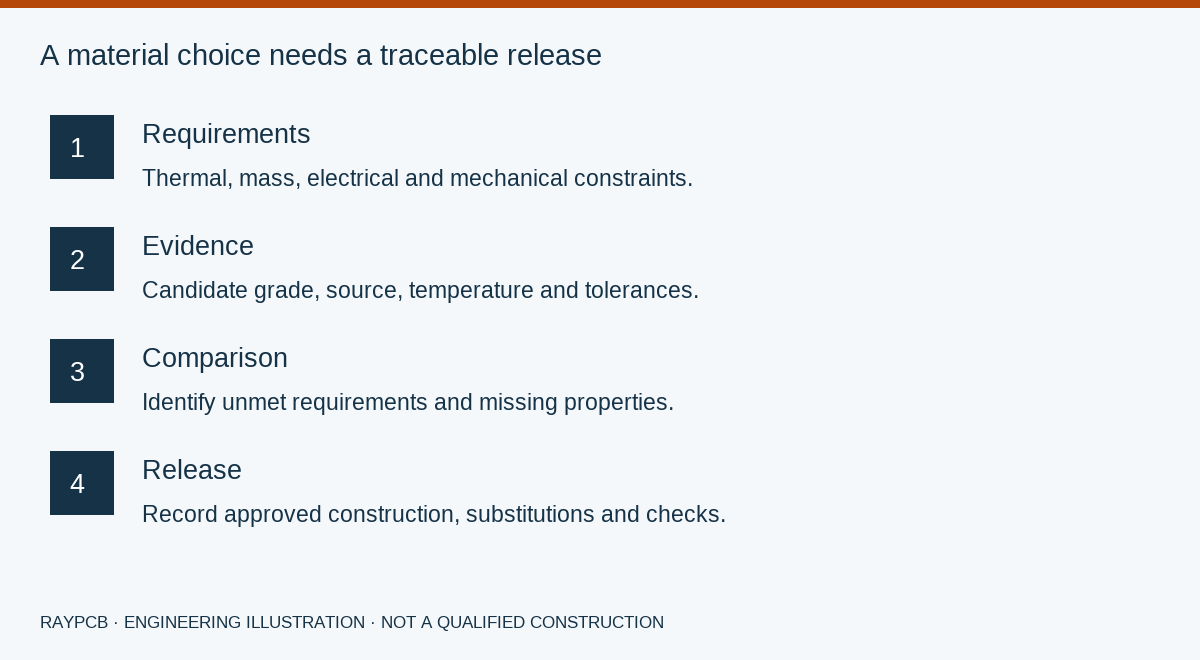
Record the candidate grade, supplier document, revision, dimensions and conditions behind each important value. Distinguish required minimums or maximums from typical catalogue data. Identify acceptable alternatives and the approval route for substitutions. Include relevant test records, environmental requirements and the intended metal connection. A specification should allow purchasing and manufacturing to obtain the same construction without relying on the memory of the original designer.
For commercial comparison, use equivalent quantities, material scope, fabrication operations, inspection and delivery terms. Panel utilization, machining, isolation treatment and available sheet sizes can affect the quotation; density alone is not a price model. Ask which requirement drives a premium and whether a design change would preserve the product function. An uncalibrated estimate is useful only when its assumptions and exclusions remain visible.
The final selection should connect to a PCB manufacturing review and a representative product verification plan. Materials are one part of the heat-removal system, and a convincing laboratory result needs a defined operating boundary. The intended outcome is an informed enquiry and a controlled release, not a longer list of material names or an unsupported claim that one family wins every application.
Metal-core material selection questions
Does the tool recommend a stocked material grade?
No. It screens the data you enter against your thresholds. Availability, exact construction, supplier evidence and manufacturing feasibility require a separate review.
Can I compare conductivity values from different test methods?
Only after understanding what each value represents. Material direction, temperature, specimen and interface treatment matter. Keep dielectric, laminate and assembled-system results in separate categories.
Is steel always magnetic and copper always the best thermal choice?
No universal family statement should replace grade and product evidence. Steel magnetic behavior depends on the alloy and condition, while a complete thermal system can be limited by a different material or interface.
What should I send if I do not know the grade yet?
Send the drawing, electrical isolation requirements, heat sources, cooling boundary, mass limit, mounting conditions and environment. Clearly mark unknowns so that the material review addresses the actual product task.
Bring the requirement and the drawing together
Send the board revision, construction, quantity and the standard or engineering question you need reviewed. Identify unresolved requirements so the response can address them.
Send requirements for reviewOptional: attach the downloaded worksheet manually. This guidance does not certify a design, approve a shipment or replace the applicable authorized standards.