
RAYPCB · ENGINEERING GUIDE
Epoxy Resin for CCL: Formulation, Fillers and Laminate Behavior
Epoxy resin used for copper-clad laminate is part of a formulated material system. Resin chemistry, curing system, fillers, reinforcement, copper interface and processing all contribute to the finished laminate. A broad resin name cannot by itself describe the electrical, thermal or manufacturing behavior of a PCB material.
This page explains those boundaries and the questions raised by a formulation or supplier change. It does not provide a production resin recipe. The interactive register organizes the evidence needed to review a material system without pretending that a few headline properties fully qualify it.
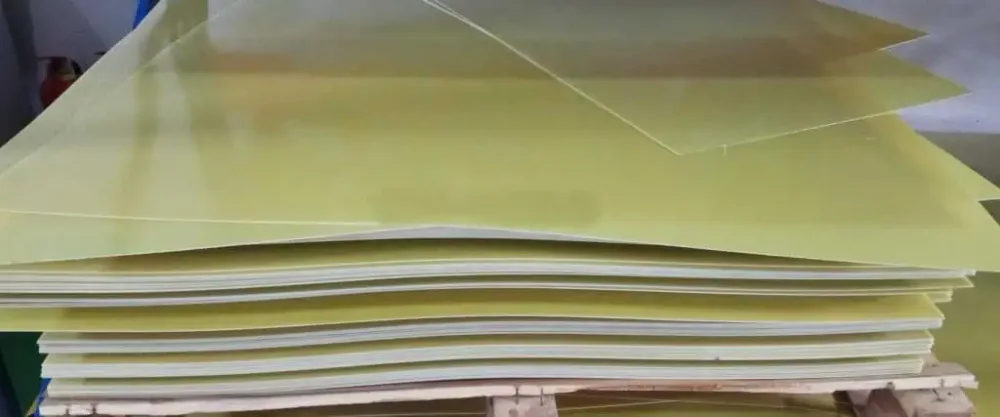
Separate resin chemistry from the finished composite
A neat resin, a reinforced cured laminate and a copper-clad construction are different test specimens. Their properties need not be identical. Keep the physical form and constituent context with every reported value.
The PCB material directory owns the broader family and supplier overview. Here, the focus is the formulation-to-construction relationship. When a datasheet reports a property for a laminate, do not relabel it as a universal property of the resin alone or assume it applies to every reinforcement and copper combination.
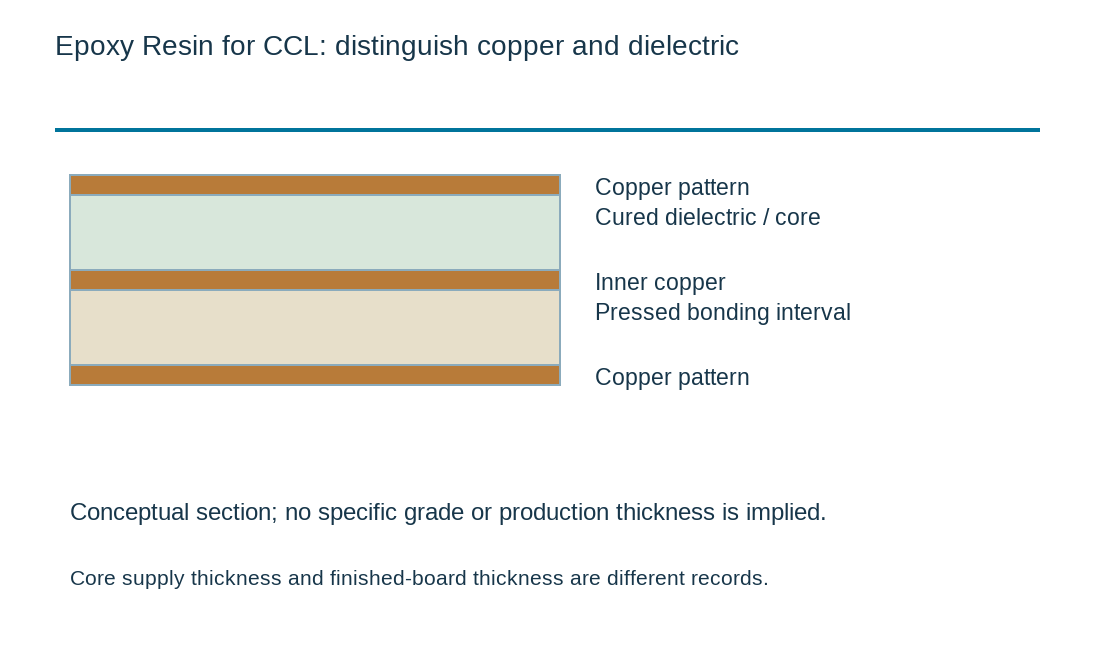
Formulation review
| Record | Meaning | Avoid this shortcut |
|---|---|---|
| Resin system | Chemistry and curing context | Not a production recipe |
| Composite | Fillers, reinforcement and copper | Not neat resin alone |
| Change evidence | Exact revised product and relevant tests | Not similar Tg as blanket equivalence |
Understand the role of curing and processing
The resin system is selected and processed to achieve a particular supplied and finished condition. Cure behavior and processing instructions belong to the exact product. A public overview cannot establish a press cycle, storage life or rework procedure for all epoxy-based materials.
Use the supplier's current processing guide for the named grade and form. The laminate storage page explains why a cured core and a B-stage prepreg need different handling records. An uncontrolled attempt to improve storage or cure behavior can change the material that the manufacturing process expects.
| Review item | What to establish |
|---|---|
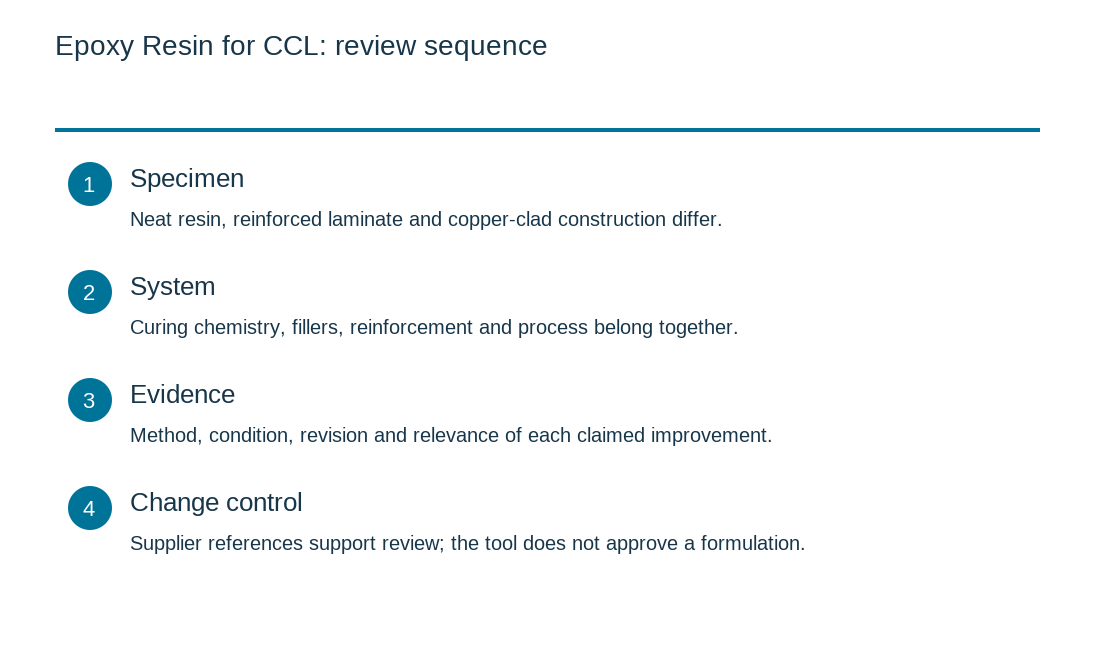
| Specimen | Neat resin, reinforced laminate and copper-clad construction differ. |
| System | Curing chemistry, fillers, reinforcement and process belong together. |
| Evidence | Method, condition, revision and relevance of each claimed improvement. |
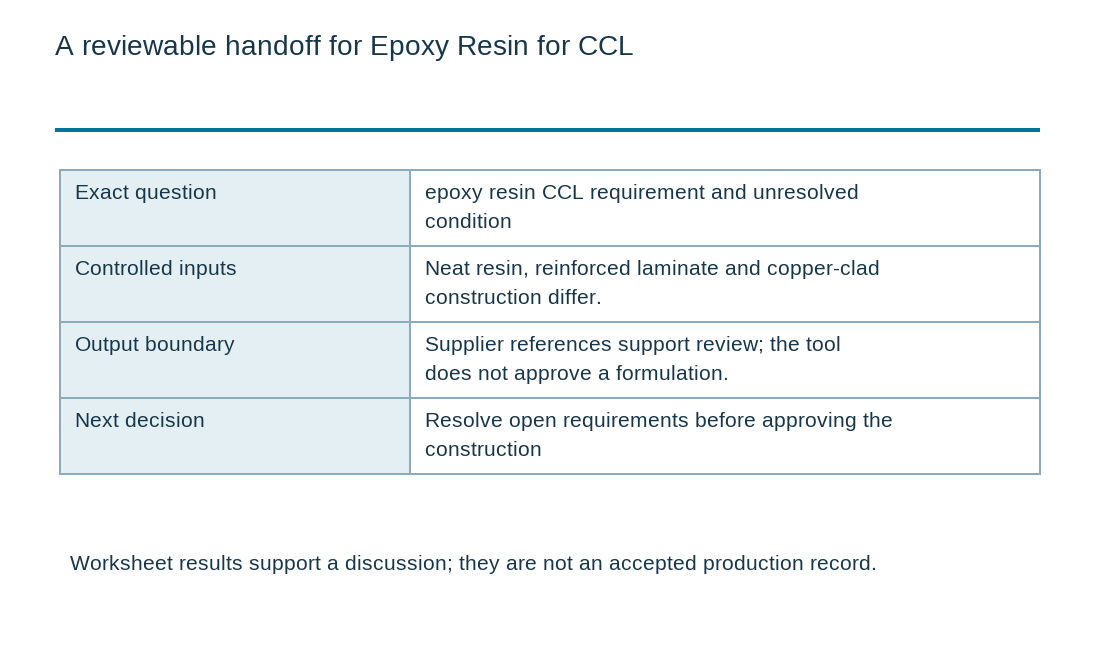
| Change control | Supplier references support review; the tool does not approve a formulation. |
Keep fillers and reinforcement in the explanation
Fillers and glass reinforcement can influence the composite's dimensional, thermal and electrical behavior. Their effects must be considered in the complete system rather than through a simplistic rule that adding more of one constituent always improves performance.
The fiberglass fabric page distinguishes cloth construction and resin mass fraction from the finished dielectric. That distinction is important when comparing formulations: equal mass percentages do not necessarily mean equal volume fractions, and a filled system cannot be fully described by a two-phase resin-and-glass model.
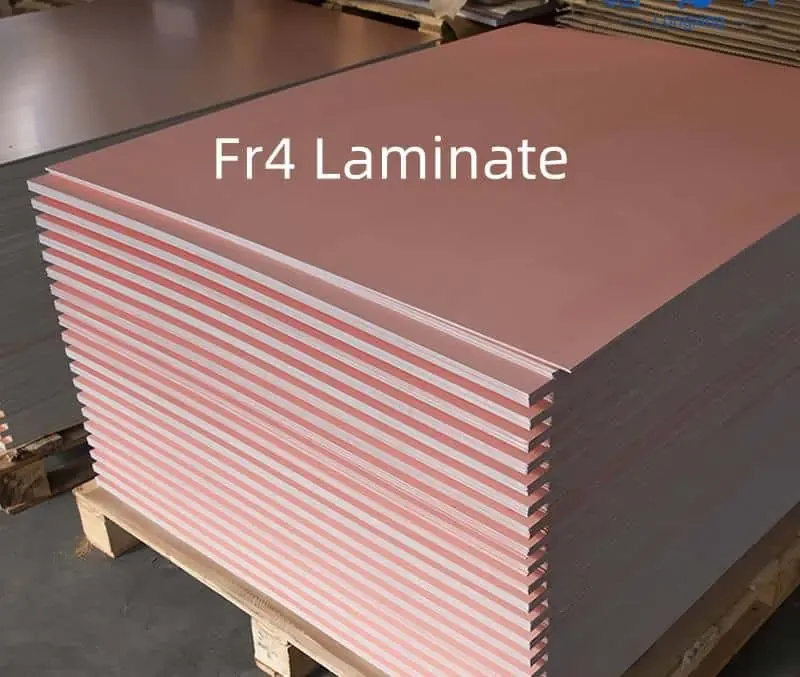
Resin-system change review
Resin-system change review
Use the current inputs and keep the assumptions
Start with the example only to inspect the units and the calculation boundary. Replace every assumption with a value tied to your own document or measurement. An empty numeric field is not zero. The review-reference field is a local label; avoid entering customer names, confidential part numbers or other private information into a public worksheet.
After calculating, read the notes alongside the numerical result. Changing any input invalidates the displayed result and disables its download until you calculate again. For a comparison, keep the units, geometry, material condition and measurement boundary consistent. A long decimal result does not imply equally precise input data. The downloadable record stays on your device and can be attached manually to an inquiry. It is not automatically transferred into the Contact form.
If an input is unknown, identify the person or document needed to resolve it. Do not fill a gap with a favorable generic value simply to obtain a result. You can request a material or fabrication review without using the tool. The arithmetic illustrates a relationship; it does not accept a construction, certify a material, establish current pricing or replace a supplier process specification.
| Input | What to establish before using it |
|---|---|
| Review reference | Nonconfidential revision label. |
| Requirements and evidence · CSV | Status is Open, Recorded or Not applicable. Recorded needs a source reference; exclusions need a reason. |
Read electrical data with method and construction
Dk and Df values should retain frequency, test method, conditioning and specimen information. A resin-system modification may change electrical behavior, but the finished channel also depends on copper and geometry. Do not infer complete insertion loss from a formulation label.
When a candidate is proposed, request comparable data for the actual laminate construction. Record whether each value is typical or controlled. If conditions differ, mark the comparison unresolved instead of creating a favorable numerical ranking from unrelated test results.
Separate thermal properties from process approval
Transition behavior, decomposition, expansion and long-term exposure describe different aspects of a material. A change that improves one measured property does not automatically approve a different assembly process or service environment. The complete construction and required evidence still matter.
The BT material guide provides a distinct resin-family context without implying that all thermoset systems are equivalent. For restricted-substance and assembly questions, the lead-free and RoHS page separates the chemical declaration from thermal-process compatibility. Keep those boundaries explicit in the review.
Worked example: a supplier announces a formulation change
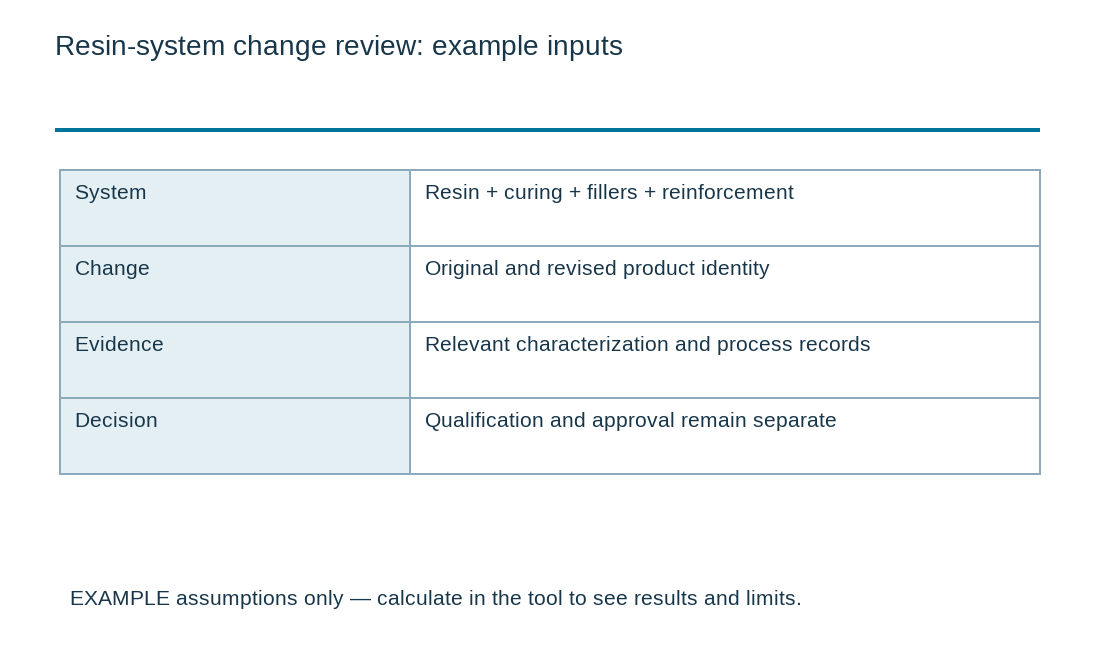
Suppose a supplier proposes a revised grade with similar nominal Tg and thickness availability. The engineering review should ask which constituents or processes changed, which electrical and mechanical data remain applicable, and what qualification supports the revised product. Similar headline values do not close all of those questions.
Use the evidence register to retain the original and proposed identities, required properties, source documents and open issues. A Recorded status means a reference has been supplied, not that the tool has validated it. The responsible design and manufacturing authorities must assess applicability to the actual board.
Review development claims as evidence questions
Material development may target lower loss, dimensional stability, thermal behavior, process compatibility or environmental requirements. Treat each claimed improvement as a question about method, construction and tradeoffs. Avoid presenting every new formulation as an across-the-board replacement for existing qualified material.
Ask whether the proposed benefit is demonstrated in a relevant specimen and whether other requirements remain satisfied. Record availability and manufacturing readiness separately from laboratory characterization. A technology direction is useful context, but it is not a current delivery commitment or an independently verified production result.
Prepare the material-system inquiry
Send the current grade, proposed change, stackup, application conditions and the requirements that control the decision. Include electrical-data conditions, thermal exposures, declarations and any customer change-control obligations. Identify which evidence is already available and who approves the change.
A useful response should connect the exact product to the requested construction and explain remaining qualification or process questions. The worksheet helps organize that exchange, but it does not formulate a resin, certify compliance or approve an untested substitute. Keep the final decision with the controlled material and drawing revision.
Turn a material question into a reviewable purchase requirement
A useful material callout connects the required function to a named document, a measurable condition and an approval owner. Keep the exact grade and supplied form with the thickness basis, copper treatment, test method and substitution rule. This prevents a purchasing shorthand from silently replacing a more precise engineering requirement.
Distinguish typical characterization from a guaranteed supply limit. A typical result may help compare options, but it is not automatically the acceptance value for an incoming lot. If a supplier proposes an alternative, compare the properties that affect this design and the manufacturing evidence needed to use it. Record the decision with a drawing or material-list revision instead of leaving it only in an email thread.
For an inquiry, provide the construction, required quantity, application conditions and any nonnegotiable specification references. Ask which requirements need additional evidence or lead time. A clear open question usually produces a more useful response than a broad request for the best laminate.
Standards, source context and limits
Use the edition, amendment and material-document revision named in the purchase agreement. A standards title, marketing label or supplier product family does not establish that a particular lot meets a requirement. Public summaries are useful for scope; the controlled specification and applicable test method govern acceptance.
The examples on this page are illustrative engineering scenarios. They are not RAYPCB production records or guaranteed material values. Source links identify the organizations responsible for the referenced information. Confirm applicability to the exact grade, construction and test condition before carrying a number into a drawing or qualification report.
For fabrication scope and the agreed construction requirements, see PCB manufacturing.