
RAYPCB · ENGINEERING REFERENCE
PCB Prepreg Shelf Life: Storage, Expiry & Lot Tracking
Keep calendar expiry, cumulative exposure and material condition separate. Build a lot record using the approved limits for your exact resin system.
Original engineering guidance · References checked September 28, 2026
How long can PCB prepreg be stored?
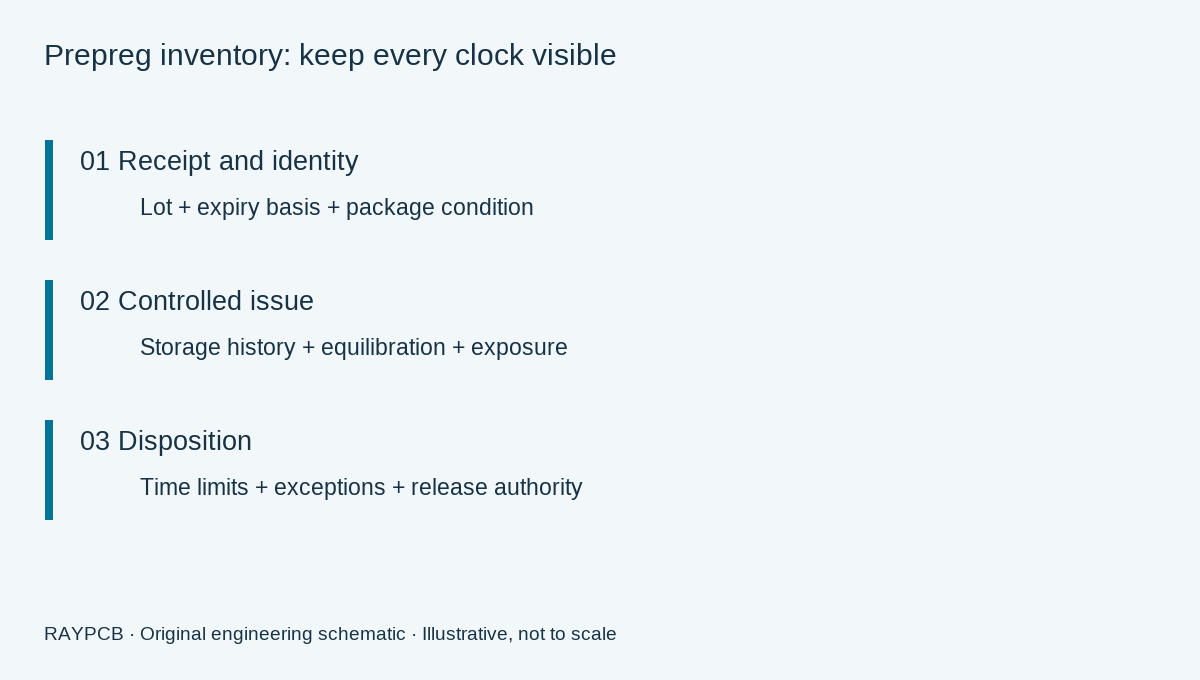
PCB prepreg shelf life is specific to the material, storage conditions and approved lot record. Use the expiry and handling instructions supplied for the exact resin system. A general three-month or six-month statement is not enough to release a lot. Calendar age, exposure outside controlled storage, package condition and the applicable conditioning procedure must be reviewed together.
The practical task is to preserve the material's traceable condition from receipt to layup. This page provides a lot and exposure worksheet, an exception workflow and examples of the records that make a release decision reproducible. It does not authorize expired material, assign a universal refrigerator setting or prescribe a bake cycle.
For the function of the bonding sheet in a multilayer board, see the PCB prepreg material guide. This page focuses on perishable prepreg inventory. Cured laminate and completed boards have different handling questions and should not inherit a prepreg rule merely because all three arrive in similar packaging.
Separate the four clocks and conditions
| Control | What it answers | Record to keep |
|---|---|---|
| Approved expiry | When must this lot be reviewed or used? | Supplier lot label, starting basis and controlling document |
| Cumulative exposure | How much permitted out-of-storage time has been consumed? | Removal, return and exposure accounting under the approved procedure |
| Equilibration | Can the package be opened without an uncontrolled transition? | Approved conditions and evidence of completion |
| Material condition | Is this actual package suitable for release? | Storage log, seal condition, deviations and disposition |
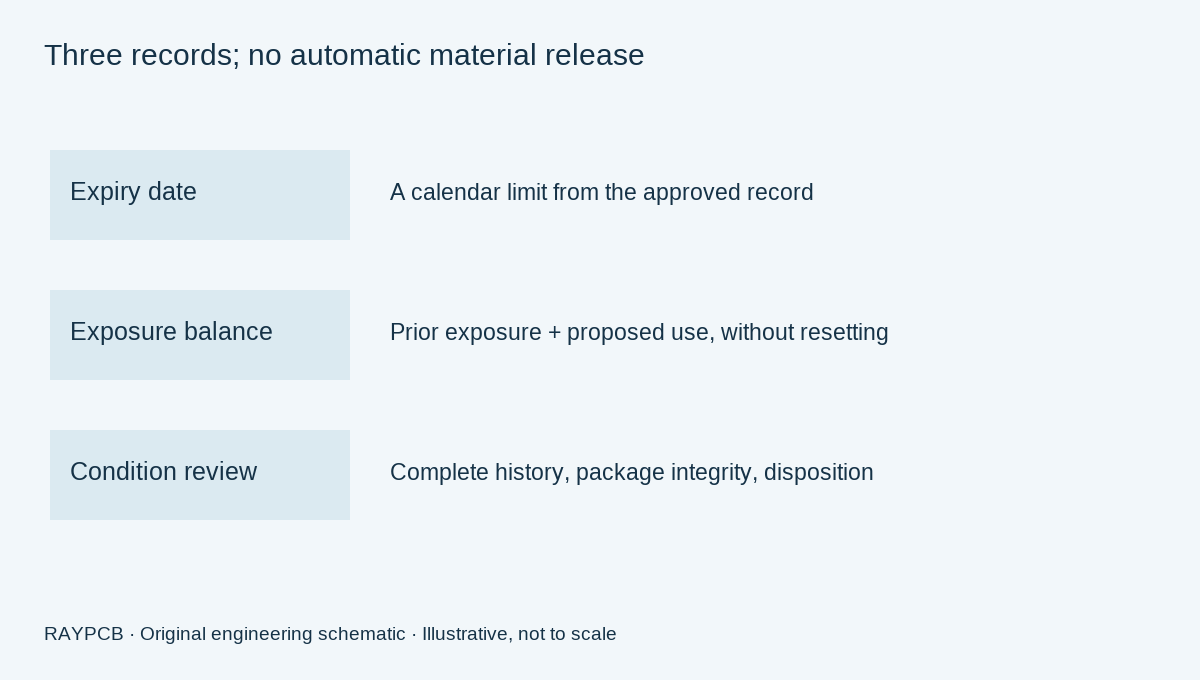
A package can be within its calendar life and still need review because the environmental history is missing. Conversely, a calendar date alone does not explain whether a supplier-approved retest or extension exists. Keep the time calculation and the release authority separate. The operator should be able to identify both the remaining recorded allowance and the person or procedure responsible for disposition.
Do not reset a cumulative clock when a package returns to controlled storage. Resealing can be a required handling step, but it is not evidence that prior exposure never occurred. If the applicable procedure uses another definition of exposure, record that definition explicitly and use it consistently across shifts.
What manufacturer guidance can and cannot tell you
Arlon's Prepreg Shelf Life note describes receipt-based conditions of 180 days below 5°C, or 90 days below 23°C and 50% relative humidity, for the material scope addressed by that note. Its applicability must be checked against the ordered product and controlling specification; these are not automatic limits for every supplier's prepreg.
The Isola IS415 processing guide calls for controlled storage and packaged equilibration before opening. That example illustrates why a warehouse temperature entry alone is insufficient. Use the current product-specific guidance and the lot instructions together; resolve inconsistent or missing instructions with the material supplier before use.
Where an IPC material specification is required by the contract, identify the applicable revision, material specification sheet and purchasing requirements. A reference in a manufacturer note does not grant permission to apply an old clause or another product's condition universally. Record the actual controlling requirements in the lot file rather than copying an unsupported “IPC shelf life” statement onto every storage bin.
Build the record at goods receipt
Assign a unique lot or package identifier that remains readable after sheets are cut or divided. Record the manufacturer, resin system, glass style, resin-content option and quantity. Keep the supplier label, certificate references and receipt date together. Distinguish a manufacture date, shipment date and receipt date because different requirements may start from different events.
Review package integrity before moving the material into its approved environment. A torn barrier bag, unclear expiry label or unrecorded shipping excursion is an exception to resolve, not a reason to guess the missing information. The receiving record should describe what was observed without asserting that appearance proves the resin is fit for lamination.
If one package is divided, give each child package a traceable relationship to the original lot and preserve the relevant exposure history. A fresh label must not create a fresh shelf life. Identify the amount removed, the amount returned, the packaging procedure and the responsible operator so that later inventory counts can be reconciled.
Lot expiry and exposure worksheet
Enter the approved expiry from the actual record and the proposed use date. Enter a cumulative exposure limit only when the material procedure defines one. The illustrative eight-hour example is a software example, not a recommendation. If your procedure has no such allowance, obtain the correct handling basis rather than treating the example as authority.
RAYPCB ENGINEERING
Prepreg ConstructionPrepreg lot expiry and exposure record
Loading Prepreg lot expiry and exposure record…
A time balance is not a material release
Consider an illustrative lot received on September 1, 2026, with an approved expiry date of December 1, 2026. A review date of September 28 leaves 64 whole calendar days to that entered expiry date. If the approved cumulative exposure allowance were eight hours, with 2.5 hours already recorded and 1.5 additional hours planned, the remaining entered allowance would be four hours.
The worksheet reports that no entered time limit has been reached only when the records are marked complete and no deviation is known. It still requires material release. A missing humidity log or a damaged package can make the time arithmetic irrelevant to the immediate decision. Select the deviation state to carry that issue into the downloaded brief.
The tool deliberately requests review on the expiry date itself and when the planned exposure reaches the entered limit. That conservative workflow boundary avoids pretending to know a supplier's exact time-of-day convention. It is a review trigger, not a redefinition of the supplier's specification. Negative remaining time stays visible so an overrun cannot look like a fresh allocation.
Plan the transition to the layup environment
Define how material leaves storage, how it is identified during equilibration and how the operator knows when opening is permitted. The relevant procedure should address the actual starting conditions, package size and destination environment. A fixed warm-up time copied from another product or package format is not a reliable substitute for an approved instruction.
Keep the material protected while it moves through this transition. Condensation is a reason to control the sequence, not a reason to open cold packaging for convenience. Once a package is opened, record the event and handle the sheets using the approved clean process. Traceability should continue through cutting, kitting and layup rather than ending at the storeroom door.
Thin constructions need particular attention to handling damage. Creases, lost resin, disturbed edges or contamination can be localized, so a bulk inventory label cannot describe every cut piece. The 106 thin-prepreg guide discusses the design and handling questions for a thin-glass construction. It does not set a different universal shelf life merely because the fabric is fine.
A clear hold-and-review workflow
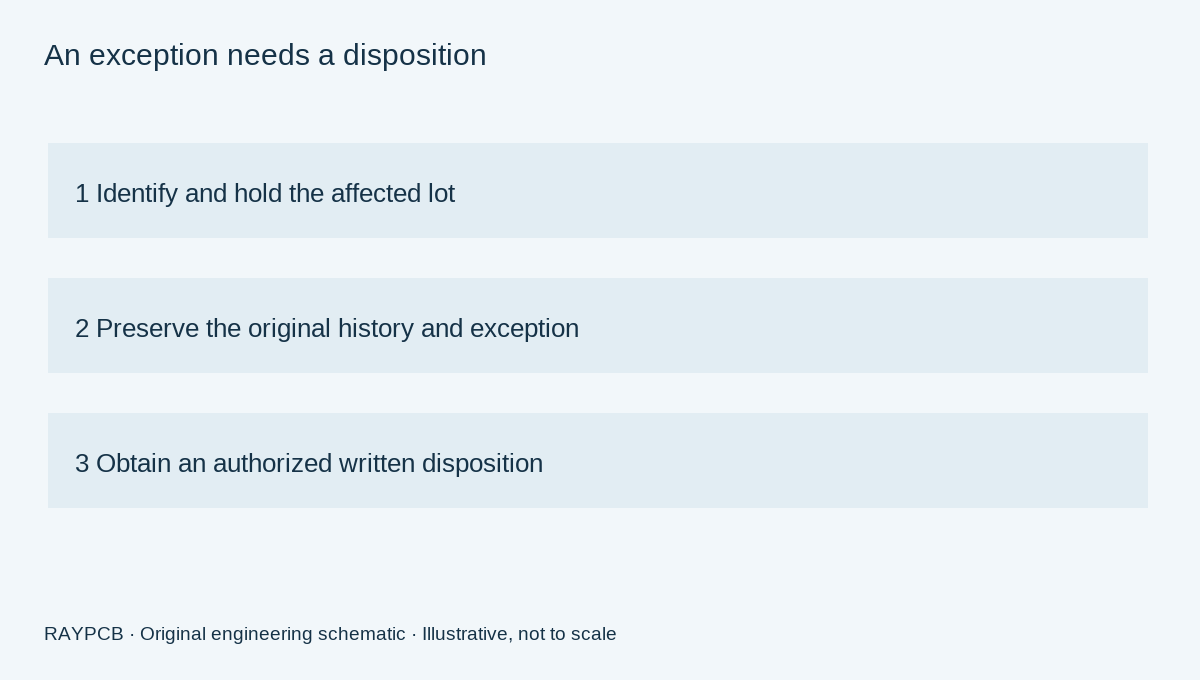
When an expiry, exposure or storage exception occurs, identify the affected material and keep it out of unrestricted issue. Preserve the original records and document the deviation. Ask the material supplier or authorized quality owner what evaluation and disposition are required for the exact resin system and intended use.
| Event | Immediate record | Decision owner should resolve |
|---|---|---|
| Expiry reached | Lot, quantity and approved expiry basis | Whether use, retest, extension or rejection is permitted |
| Exposure exceeded | Actual accumulated time and conditions | Applicable evaluation and disposition |
| Storage log missing | Time interval and affected packages | Whether sufficient evidence can be recovered |
| Package damaged | Condition, location and discovery time | Contamination or moisture evaluation requirements |
| Instructions conflict | Both document references and revisions | Which requirement controls this order |
Do not relabel expired prepreg as newly received material. Do not apply a drying or baking recipe intended for cured cores or completed boards to uncured prepreg. Thermal treatment can change the resin state; any conditioning process needs product-specific authorization. A successful visual check or a single test result should not be generalized beyond the scope of the agreed disposition.
Connect inventory status with the actual build
The layup traveler should identify the lot used for each required bonding material and the board revision it supports. Where multiple resin systems or constructions are stored, verify identity before issue rather than relying on sheet color. Confirm that the material schedule matches the approved stackup and that any permitted substitution has followed the agreed review process.
Coordinate the material issue with the planned production window. Pulling more material than the work area can use may create avoidable exposure and partial packages. Conversely, withholding identification details to save time creates uncertainty when an issue is discovered later. The useful target is a traceable, workable flow, not merely a low inventory-age number.
The PCB lamination process guide addresses what happens after the approved material reaches layup. Keep material release, process control and final board acceptance as connected but distinct records. None of them is replaced by the expiry worksheet.

What to send when shelf life affects a project
If you are supplying customer-owned material, disclose the exact product, quantity, lot, storage history, expiry and handling instructions before the board order is accepted. Explain any known excursions or incomplete records. That allows the manufacturing review to address the actual risk and responsibility rather than discovering a material issue after scheduling.
For a completed-board enquiry, provide the board files, quantity, material requirements and relevant qualification or traceability expectations. The PCB manufacturing team can review the scope with those requirements visible. Do not send a request that assumes material supplied near expiry will automatically be accepted; agree that point explicitly.
The worksheet's download is a portable record of your inputs and the time arithmetic. It does not read a warehouse sensor, validate a certificate, upload a file or notify a supplier. Attach it manually when useful, together with the controlling documents. Keep confidential lot or project information in the agreed project channel rather than in a public comment.
Shelf-life questions and release boundaries
Does refrigeration restart prepreg shelf life?
No reset is assumed here. Use the supplier-approved rule for the exact lot and preserve prior history. Moving material to another environment is not evidence that earlier time or exposure can be erased.
Is six months a universal IPC requirement?
No universal limit is applied by this page or tool. Check the contractual specification, revision, product instructions and starting-date definition. Manufacturer examples explain why conditions matter; they do not replace the requirements for your material.
Can expired prepreg be retested?
The supplier and authorized quality process must determine whether evaluation or extension is permitted and what evidence is required. The worksheet flags the lot for review and cannot grant an extension or establish a retest plan.
Why does the tool not ask for voltage or layer count?
It is an inventory and exposure record, not a board reliability model. Intended use may affect the disposition review, but inserting board parameters into a calendar calculation would create an unsupported appearance of engineering approval.
Can this replace the inventory system?
No. Inputs remain in the current browser memory and require manual download. Use the controlled inventory and quality records for traceability, approvals and durable history. The worksheet helps prepare or review a record; it is not a connected material-management system.
Review your prepreg construction
Send the board revision, construction, quantity and the material or lamination question you need reviewed. Identify unresolved requirements so the response can address them.
Send requirements for reviewOptional: attach the downloaded worksheet manually. This guidance does not certify a design, approve a shipment or replace the applicable authorized standards.