
RAYPCB / Buyer resources
RAYPCB / BUYING & ENGINEERING
Read a PCB quote: line items, subtotal and exclusions
Check one quotation before comparing several suppliers.
A PCB quote breakdown should identify delivered quantity, included services, additional fees, shipping and validity. Unknown charges remain unknown; they are not zero.
Check the entered charges
RAYPCB ENGINEERING
Quote and Evidence WorkbenchesSingle quote subtotal
Loading Single quote subtotal…
Optional worksheet. No files are uploaded and no enquiry is sent. The guide and examples remain readable without JavaScript.
| Field | How to read it | Do not assume |
|---|---|---|
| Unit price | Confirm the delivered quantity unit | Per panel means per individual PCB |
| Setup and test | Add only charges outside the unit rate | Every named service is additional |
| Blank charge | Ask what remains unresolved | Blank means free |
| Timing | Identify start event and delivery milestone | Factory completion means customer arrival |
Read one PCB quote from top to bottom
A PCB instant quote may show a unit price, a manufacturing subtotal and a delivery estimate in the same interface. Those figures do not necessarily describe the same scope. Before comparing suppliers, first make sure you understand the quotation in front of you. This page provides a line-item worksheet and a practical reading order for one quote: identity, quantity, technical inclusions, one-time charges, delivery and release conditions.
Start by recording the quote identifier, issue date and the board revision. A screenshot of a price can be useful context, but a reviewable quotation needs enough information to connect that number to the intended design. If a saved configuration can change when inputs are edited, keep a dated record of the actual inputs alongside the output. Do not rely on a browser tab as the only evidence of what purchasing approved.
The worksheet here adds values that you enter. It does not obtain a RAYPCB price, verify another supplier's offer or calculate a manufacturing rate from a board drawing. Leave unknown charges blank; enter zero only when no additional charge is confirmed. For a new request, go directly to the PCB and assembly quote page. For comparing several suppliers after this review, use the separate PCB quote comparison workflow.
Confirm the quantity basis first
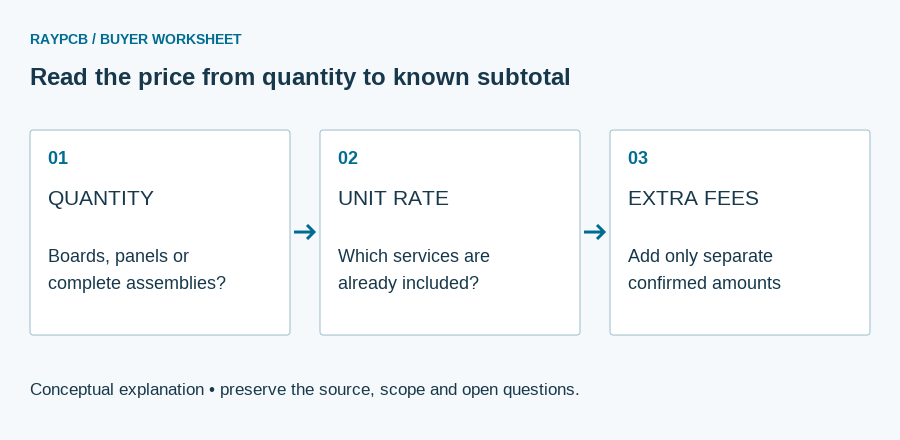
The denominator determines whether a unit price is meaningful. Identify whether the quoted quantity means individual boards, fabrication panels, assembly arrays or completed assemblies. Also check whether the commercial quantity refers to ordered pieces or a stated number of delivered acceptable pieces. If a panel contains four boards, a price per panel cannot be compared directly with a price per individual board without understanding the complete delivery arrangement.
Record any minimum order or minimum manufacturing charge as stated by the supplier. Do not infer one from a promotional example. A small prototype order can carry a setup charge that is spread across relatively few pieces; a later larger order may use a different panel arrangement or procurement basis. Dividing an old total by a new quantity is not a valid way to predict the next unit price.
Check spare boards, component attrition and extras separately where relevant. For assembly, excess components supplied for setup are not necessarily extra finished units that will be delivered to the customer. If procurement needs a fixed number of usable assemblies, state that deliverable explicitly. Ambiguity at this stage can turn an apparently favorable quotation into an unexpected shortage when the project reaches integration or testing.
Separate recurring and one-time charges
Recurring fabrication or assembly charges normally scale with some aspect of the order, while setup and tooling may be charged once for a defined release. That distinction is useful for planning repeat orders, but the quotation must say when a charge is reusable. A changed panel, stencil aperture design, fixture or test program may create additional work even if the product name stays the same.
Use the worksheet's board subtotal as the entered unit price multiplied by the number of delivered boards. Add setup, additional test, freight and tax or duty amounts only when those amounts are separate charges in the quotation. If a test service is already included in the unit price, enter zero in the additional test field and retain the written inclusion. This prevents double counting while preserving the fact that the test still matters.
Do not treat every engineering activity as a charge that must appear independently. Some suppliers bundle services, while others itemize them. The procurement task is to establish what is included and under which conditions. A long list of line items is not inherently more transparent if the technical scope is unclear. Conversely, one consolidated price can be understandable when supported by a precise build specification and a clear list of exclusions.
A worked subtotal with one deliberately missing item
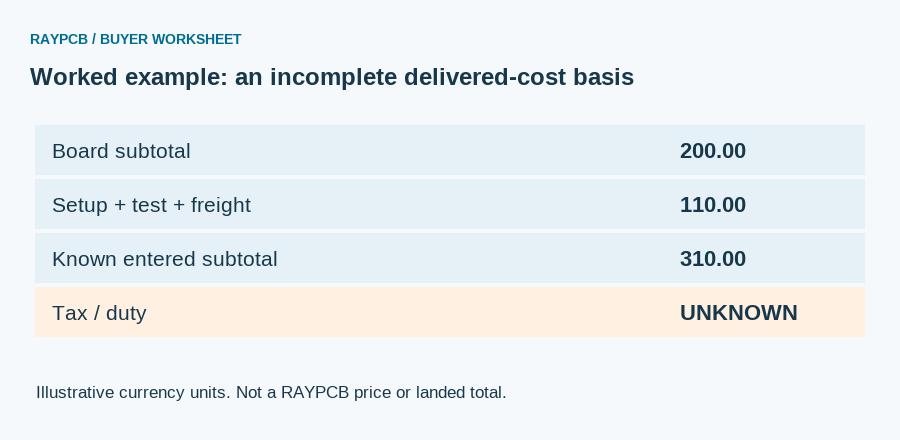
Take an illustrative quotation for fifty delivered bare boards at 4.00 currency units each. The board subtotal is 200.00. Add a separate setup charge of 60.00, an additional test charge of 20.00 and freight of 30.00. The known entered subtotal is 310.00, or 6.20 per delivered board before any unknown amounts. These numbers are a calculation example, not RAYPCB pricing or a current market benchmark.
If the tax and duty amount has not been established, leave that field empty. The result must remain a known subtotal with an unresolved amount, not a final landed total. Replacing an empty field with zero would change the meaning of the result even though it makes the arithmetic appear complete. Ask the supplier or the appropriate logistics specialist to clarify the actual transaction rather than assuming a generic import percentage.
Now imagine the quoted unit price already includes testing. Entering the same 20.00 again would overstate the known total by 20.00. The corrective action is to verify the inclusion and remove the duplicate addition, not to modify the supplier's unit rate. Keep a short note explaining why a field is zero or blank. This makes the worksheet understandable when another buyer reviews it later.
Match the technical scope to the drawing
Check material, layer count, finished thickness, copper requirements and finish against the released drawing. A broad material description may be insufficient when the design requires an approved grade or a specific electrical behavior. Likewise, a surface finish name may need additional agreed requirements for a particular assembly process. Commercial acceptance should not silently substitute for a technical review of these details.
Look for requirements that can disappear between a drawing and an online configuration: controlled impedance, filled vias, edge features, special tolerances, panel details and test deliverables. If a requirement is mandatory, its absence from a price screen should prompt a question. It should not be interpreted as proof that the supplier has included it at no extra cost. The PCB manufacturing service provides the broader context for fabrication review.
For assembly, separate bare-board manufacturing from component sourcing, placement, soldering, programming and testing. Confirm the exact BOM revision and any permitted alternatives. A price based on unspecified substitute components is not equivalent to one based on an approved manufacturer-part-number list. Ask who owns excess inventory and who approves changes before comparing apparent savings. These responsibilities can be more consequential than a small difference in the displayed assembly labor line.
Source context: Ucamco — official file formats.
Understand shipping, timing and quotation validity
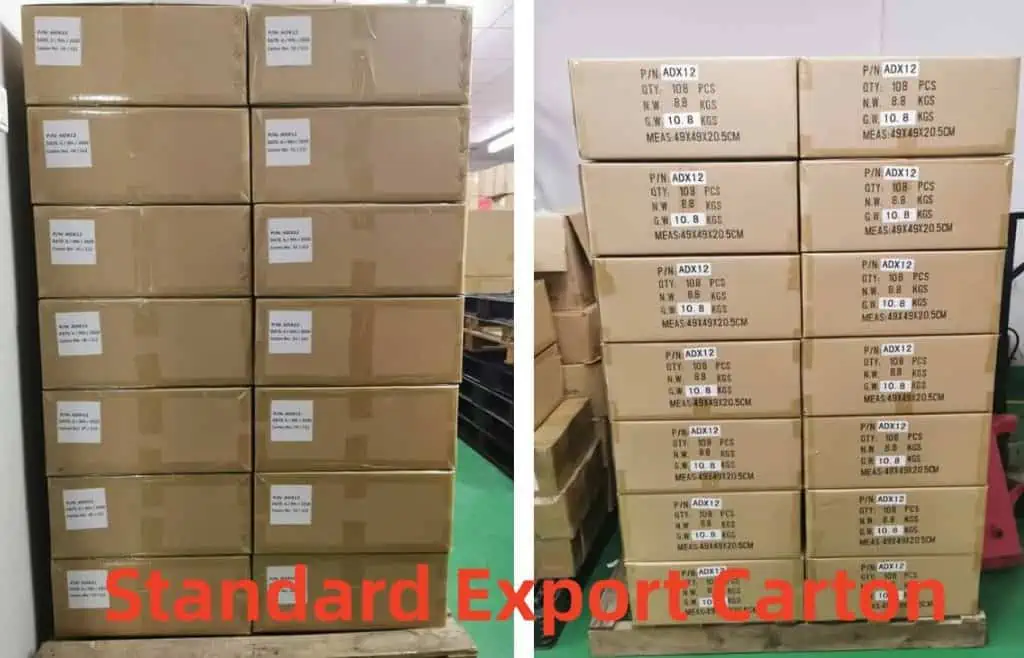
Read the delivery destination and shipment basis. A price that includes local delivery may not cover an international destination, and an order split into several shipments may incur different logistics costs. Packaging requirements also need to match the actual product and transport route. The worksheet records entered freight and tax amounts; it does not determine delivery terms, customs classification or the legal obligations of either party.
Check when the quoted production interval begins and what pauses it. Unapproved files, missing components or unresolved engineering questions may prevent release. Ask whether the stated date describes completion at the factory, dispatch or arrival at the customer's location. These are different milestones. If the project has a hard integration date, communicate that date and ask for a schedule that includes review and transport rather than only manufacturing time.
Quotation validity matters when a buyer delays approval or changes quantities. Keep the issue date, expiry or validity statement and the revision basis together. If no validity is stated, request clarification instead of inventing an expiry rule. For a repeat order, reference the prior quotation but obtain confirmation of the new scope and conditions. A previous successful delivery does not establish that material availability, logistics and commercial terms remain identical.
Resolve exceptions before the purchase order
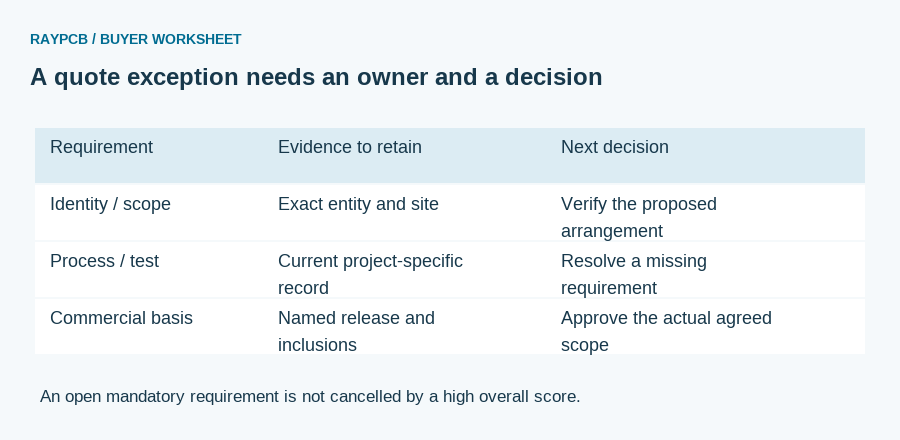
Make a short exceptions list rather than repeatedly resending the entire project. Each entry should identify the requirement, the supplier's current interpretation, the unresolved question and the person responsible for closing it. For example, a drawing may call for a particular inspection record while the quote only states a general test service. The question is which record will be supplied for this order, not whether inspection is important in general.
If engineering changes a requirement during negotiation, record the change against the quote and release identifiers. A lower price obtained by removing a mandatory feature is not a like-for-like saving. A legitimate alternative may still be valuable, but it requires explicit engineering approval. Purchasing should be able to see both the original requirement and the approved change without reconstructing the decision from several email threads.
When the quotation is clear, the purchase order should reference the agreed scope and released documentation. Resolve conflicting boilerplate, quantity descriptions and delivery milestones before relying on them. This page is a practical reading guide, not a substitute for your organization's contract review. The objective is a coherent handoff in which commercial approval, engineering release and supplier acknowledgement refer to the same build.
Frequently asked quote-reading questions
Why can the effective unit cost exceed the displayed board price? Separate order-level charges are distributed across the delivered quantity, so the arithmetic total per board can be higher. That does not automatically mean a hidden charge exists. The issue is whether the additional costs and their inclusion basis were clear before approval. Use the worksheet to make that basis visible.
Does a complete worksheet prove the quote is complete? No. It proves only that the entered categories contain numbers. Other services, exclusions or conditions may exist outside these fields. Can currencies be mixed? Not in this worksheet. Obtain a common-currency basis or make an explicit, dated conversion separately; an unrecorded exchange-rate assumption weakens the comparison. Does an instant result approve the files? No. Manufacturing review and release remain distinct steps.
For a RAYPCB enquiry, provide the board or assembly revision, delivered quantity and the specific cost or scope question that needs an answer. You can attach your downloaded note manually to the appropriate correspondence; the worksheet does not transfer it automatically to Contact. Use Contact RAYPCB for the project discussion. This keeps the next action direct and allows engineering to respond to the actual uncertainty rather than another generic request for the lowest possible price.