
RAYPCB / Buyer resources
RAYPCB / BUYING & ENGINEERING
Instant PCB quote: from configuration to engineering review
Know what the number covers before releasing your board.
An instant PCB quote estimates a selected configuration. Confirm the files, technical scope and commercial terms before treating it as a reviewed manufacturing quotation.
Plan your quotation request
RAYPCB ENGINEERING
Quote and Evidence WorkbenchesQuote readiness planner
Loading Quote readiness planner…
Optional worksheet. No files are uploaded and no enquiry is sent. The guide and examples remain readable without JavaScript.
| Stage | Answers | Still requires |
|---|---|---|
| Configuration estimate | What the selected model returns | File and requirement review |
| Reviewed quotation | Proposed scope and commercial basis | Customer approval of that scope |
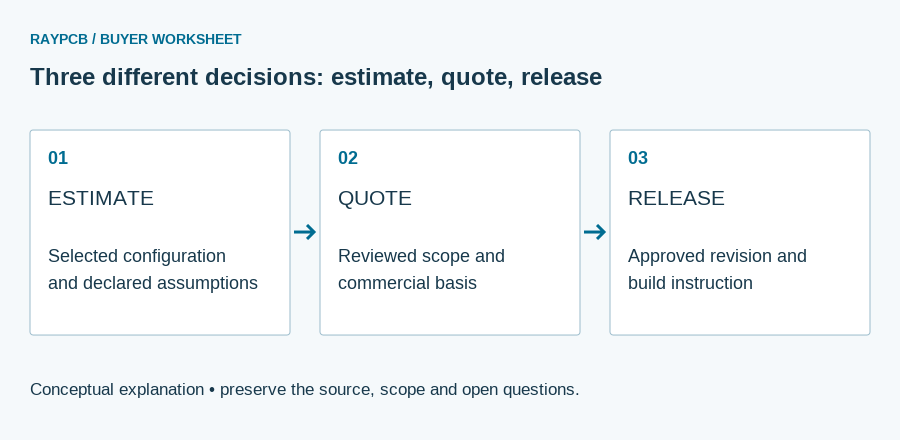
| Manufacturing release | Which revision may be built | Acknowledged and controlled execution |
What an instant PCB quote can tell you
An instant PCB quote is the result of applying a pricing model to a selected board configuration. It can help a buyer explore the effect of quantity, dimensions or a standard construction before committing to a build. It is most useful when the inputs correspond to the actual released design and the supplier explains what the displayed amount includes. A number without its assumptions is difficult to compare and even harder to approve internally.
The important distinction is between a configuration estimate, a reviewed quotation and an authorized manufacturing release. They answer different questions. An estimate asks what the declared configuration might cost under a model. A reviewed quotation defines the proposed commercial and technical scope. A release identifies the specific data that the factory is authorized to manufacture. Receiving a price does not, by itself, move a project through all three stages.
On this page, the planner helps you identify your next useful step. It does not query live material stock, inspect uploaded Gerbers, reserve capacity or generate a binding price. For a RAYPCB quotation, use the PCB and assembly quote request with your project requirements. You can enquire immediately; completing a worksheet is optional. If you have only an early concept, say which assumptions are still provisional instead of presenting them as released specifications.
Start with the build you actually need
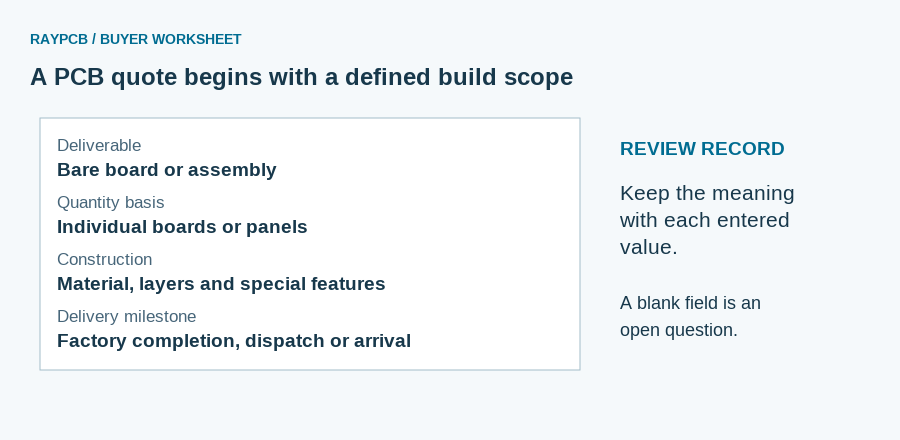
Define whether you need bare boards, assembled boards or both. A bare-board estimate does not establish component availability, assembly labor, programming or product testing. For a prototype assembly, the fabrication files may describe only one part of the cost. The BOM, placement data, assembly drawings and agreed test scope determine additional work that cannot reliably be inferred from board area alone.
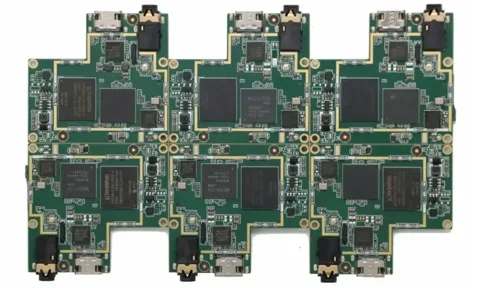
Next, identify the quantity unit. Ten individual boards and ten panels containing multiple boards are different requests. State finished board dimensions, the required delivery format and whether the buyer or manufacturer supplies the panel arrangement. An ambiguous panel quantity can make two apparently similar prices represent very different delivered quantities. If array construction is unresolved, describe it as an open question rather than selecting an arbitrary panel size to obtain a lower figure.
A useful starting description is specific without being long: one board revision, a stated number of delivered pieces, a named construction, a required finish, and an indication of whether assembly is included. Then add the constraints that could change the manufacturing route. For example, an impedance requirement needs a stackup discussion; a repeated-bend flex circuit needs its mechanical use described. These requirements belong in the quote request even when a simple online form has no dedicated field for them.
Which inputs usually need engineering attention?
Board outline, layer count, finished thickness and copper requirements establish the basic construction. They are not a complete manufacturing specification. The minimum feature that matters may be a local drill-to-copper clearance, a plated slot, a fine-pitch solder-mask feature, a particular via structure or a mechanical tolerance. A form with only size and layer count cannot resolve all of those details.
Materials should be specified at the level the design requires. A generic FR-4 selection may be appropriate for one project, while another requires an approved laminate family or exact grade. Do not assume that choosing a high Tg category also fixes high-frequency loss, glass construction or available copper foil. Likewise, selecting a copper weight does not explain whether a drawing requirement concerns starting foil or finished copper in a particular region.
Flag special construction early: controlled impedance, sequential lamination, filled or capped vias, mixed materials, heavy copper, unusual outline features and tight thickness tolerances can require a different review route. This is not an assertion that every such feature is unavailable online. It is a reason to confirm what the selected configuration actually covers. The PCB manufacturing service explains the wider fabrication route; use the relevant material or process page when one technical requirement drives the decision.
Prepare a coherent file package
Export fabrication data from the intended released CAD revision, then check that the files represent the same board. Include the relevant copper, mask, legend and outline information together with drill data and a fabrication drawing or equivalent specification. A human-readable release note is useful when the file names alone do not explain the intended construction. An archive containing several old revisions creates uncertainty rather than providing useful extra evidence.
Gerber image data and a board's fabrication requirements are related but different. Ucamco's Gerber Job format provides a machine-readable way to communicate job attributes in addition to image files. Whether your selected manufacturing workflow consumes those attributes should be confirmed. Do not assume that any uploaded archive automatically communicates every material, finish, tolerance or electrical-test requirement. The PCB file-format guide helps separate file roles before submission.
For assembly, keep the BOM, placement data and assembly documentation aligned with the fabrication release. A changed connector can affect the footprint, placement and enclosure interface simultaneously. The prototype quote release checklist focuses on this handoff. It is useful when the price was obtained against one revision and the engineer is preparing to send a later export for manufacture.
Source context: Ucamco — Gerber Job and fabrication attributes.
Read the displayed amount before comparing it
Ask whether the amount is a unit price, a board subtotal or an order total. Then identify additional setup, tooling, testing, packaging and delivery charges. Some suppliers include a service in the unit rate; others show it separately. Either presentation can be understandable if the scope is explicit. Adding an included charge again produces a false comparison, while treating an unknown charge as zero hides a gap.
The delivery location and commercial terms also matter. A manufacturing subtotal is not automatically the total delivered cost. Freight, duties and taxes depend on the actual shipment and applicable arrangement. Request clarification where the quotation is silent instead of applying a universal percentage from an unrelated order. The single-quote cost worksheet adds entered line items and keeps missing amounts visible; it does not calculate customs liability.
For example, consider an illustrative request for fifty boards. A unit price multiplied by fifty provides the board subtotal, but a separate one-time setup charge changes the effective cost per delivered board. That arithmetic is useful only when the quantity and inclusion basis are correct. It says nothing about whether the selected finish, test or material matches the design. Keep a technical scope check next to the commercial calculation, not in a separate email that the purchasing approver may never see.
Understand when the clock starts
A requested ship date is not the same as a confirmed production lead time. Ask which event starts the stated interval: file receipt, engineering approval, payment, material availability or a defined order release. If the project contains unresolved engineering questions, the date on which the files were first uploaded may not be the date on which manufacturing could reasonably start.
Separate fabrication time, assembly preparation, component procurement, testing and transport. A faster bare-board route will not necessarily shorten the whole project if a long-lead component or unfinished test fixture remains on the critical path. Conversely, a clear release package can prevent avoidable clarification cycles even when no manufacturing step is accelerated. Describe the actual program milestone rather than asking for a vaguely urgent build.
When discussing a repeat order, identify whether anything changed since the previous release. Different quantity, copper requirements, delivery destination or component alternatives can change price and timing. Reference the previous order as context, but do not assume that its commercial conditions carry forward indefinitely. A new quotation should state its own validity and the release to which it applies. This makes it easier for both engineering and procurement to recognize when a recalculation is necessary.
Choose a useful next step
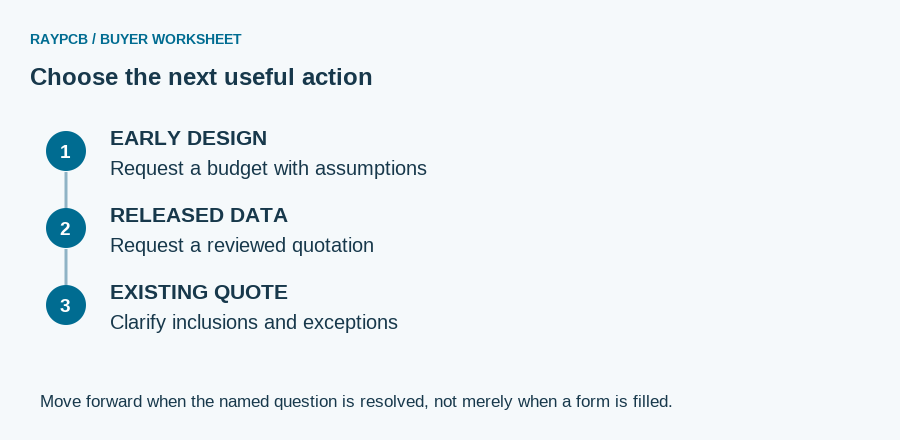
If you are still comparing architectures, request a budget with explicit assumptions. Describe which dimensions, layer count and quantity are approximate, and ask which design choices have the greatest cost consequence. A budget is useful for planning when its uncertainty remains visible. Turning a rough configuration into an apparently exact order total does not remove that uncertainty.
If the design is released, send the files and ask for a reviewed quotation tied to that revision. State mandatory requirements separately from preferences that can be discussed. For example, a required impedance target and an optional mask color have different consequences for engineering review. This distinction helps a supplier propose a practical alternative without silently changing the electrical or mechanical requirement.
If you already have multiple quotations, use the PCB quote comparison guide to compare equal scope. This page remains focused on the transition from an instant configuration to a reviewed request. It does not replace the comparison workflow or the commercial quote hub. A buyer should be able to move directly to the page that answers the next question, rather than repeating the same form across several nearly identical articles.
Questions to resolve before authorizing manufacture
Is an online estimate a binding price? That depends on the supplier's stated terms and the review stage. For RAYPCB, request a project quotation and confirm the scope in writing; this article and its planner do not establish a binding price. Does a successful upload prove manufacturability? No. Upload completion shows that a transfer finished, while manufacturing review requires the appropriate data, requirements and engineering decisions.
Can a quote be requested without Gerbers? An early budget discussion can begin with a written construction and quantity, provided missing information is clearly identified. The result should not be described as a fully reviewed fabrication quotation. Can the same price be used after changing the design? Ask for confirmation whenever a revision changes features, materials, quantity or the agreed scope. Preserve the old quote and the new release identifiers so that the change remains traceable.
Before sending an enquiry, name the project revision, define the build scope and quantity, identify special requirements and state the intended delivery milestone. Include open questions rather than guessing answers. That package gives engineering and purchasing a common starting point and makes the supplier's response easier to evaluate. Use Contact RAYPCB when you are ready; no calculator result is required to start a conversation.