
RAYPCB / RF MATERIALS & FABRICATION
Taconic EZ-IO-F PCB Material: Properties & Design
Review a spread-weave material designation and its RF stackup. Use the source context, engineering checks and project tools below to turn the material name into a usable fabrication specification.
Request a Taconic PCB quote
What to specify for EZ-IO-F
Taconic EZ-IO-F is covered here as a historical or specialty material designation. Spread weave changes reinforcement geometry but does not establish a universal Dk, skew or loss benefit for every layout.
| Field | Specification context |
|---|---|
| Material identity | EZ-IO-F |
| Reference Dk | Exact grade / construction data required |
| Reference Df | Not assigned; obtain a value for the chosen construction |
| Test context | Current grade-specific TDS required |
| Thermal conductivity | Confirm in the applicable supplier data sheet |
| Supply status | Confirm current grade, thickness, foil and order quantity; no stock promise |
Do not miss: Spread weave changes reinforcement geometry but does not establish a universal Dk, skew or loss benefit for every layout.
Historical provenance: the archived Taconic Laminate Material Guide used for this table. The historical values and stated test conditions are retained for identification; they are not current purchase limits. Verify the ordered grade against its original datasheet and certificate. For current product families and supplier document requests, consult the AGC Multi Material official solutions guide. That current guide does not independently verify every historical value above.
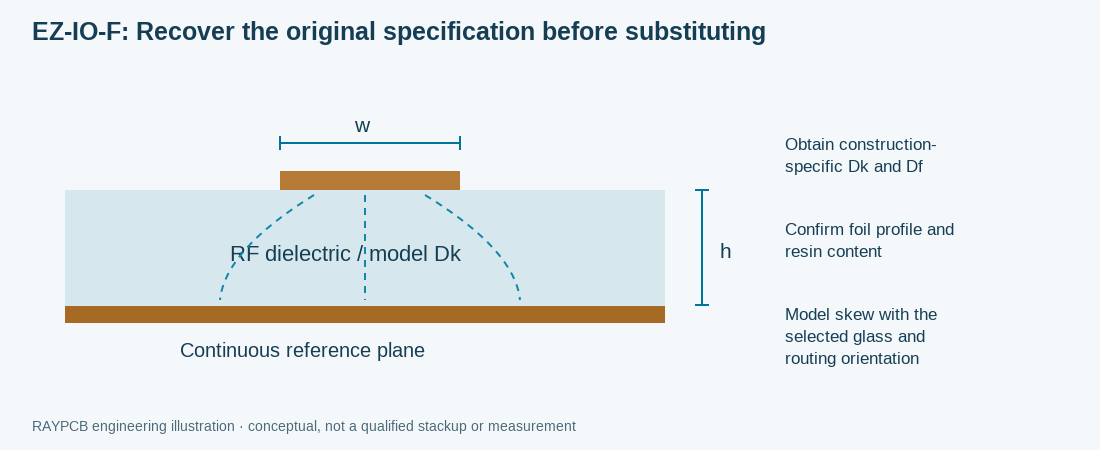
Recover the original specification before substituting
Historical material designations can survive in long-lived products after a catalog or supplier portfolio changes. The safest technical starting point is the released drawing and the applicable supplier document. Confirm the code, revision, available construction and acceptance tests before treating a newer product as equivalent.
- Obtain construction-specific Dk and Df
- Confirm foil profile and resin content
- Model skew with the selected glass and routing orientation
RAYPCB ENGINEERING
Taconic RF EngineeringTaconic PCB Design Workbench
Loading Taconic PCB Design Workbench…
The RF tool uses an editable model Dk; the preset is a supplier reference at its stated method and frequency. It is not a universal design Dk. Blank parameters stay blank until you provide a value. Geometry calculations do not approve a fabrication tolerance.
For microstrip, h is the dielectric separation to the reference plane; for symmetric stripline it is the total plane spacing. Propagation follows λg = c/(f√εeff). Thermal screening uses R = h/(kA). Read the selected model’s exclusions beside the result.
For more geometries and fabrication tolerance context, use the PCB impedance calculator and design guide.
From material callout to fabricated PCB
01
Material release
Name EZ-IO-F, the supplier revision, thickness and foil. Separate approved substitutions from suggestions awaiting approval.
02
CAM and stackup
Review layer references, panelization, copper balance, minimum features and finished geometry. Obtain construction-specific Dk and Df.
03
Process definition
Use the applicable laminate and bonding guides. Agree drilling, hole-wall treatment and lamination details for this construction; do not assume a universal FR-4 recipe.
04
Patterning and final build
Control conductor geometry, hole quality, mask openings and finish on exposed RF areas. Include special edges, cavities or connectors in the release.
05
Inspection and acceptance
Define dimensional, netlist and impedance checks. RF loss or phase measurements need a separate coupon/fixture, frequency range and acceptance limit.
Review the manufacturing capability tables for general process limits and quality documentation and acceptance planning for supplier review. A listed material property is not a RAYPCB test report.
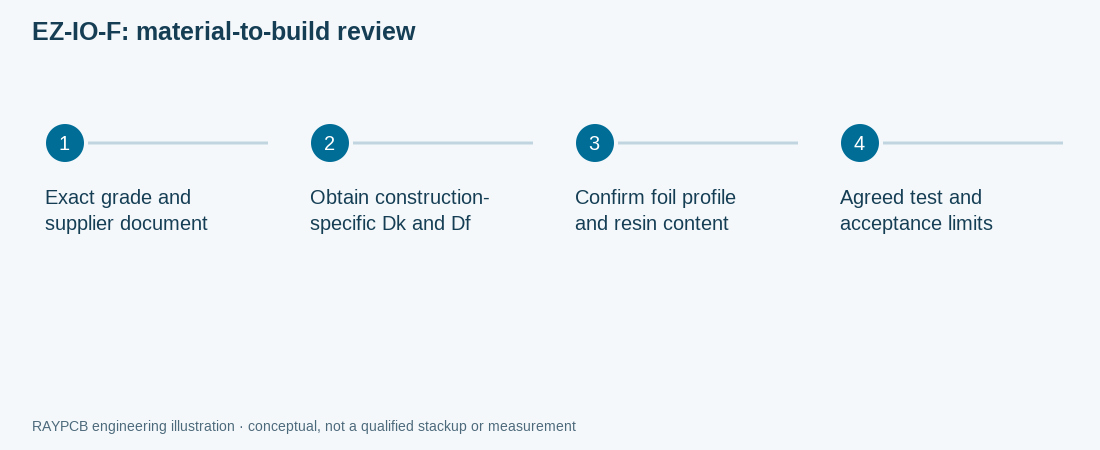
EZ-IO-F PCB cost & quotation brief
A quote for EZ-IO-F depends on the approved material construction, purchased sheet utilization, quantity, layer count, drilling/lamination work, finish and inspection scope. There is no defensible fixed “Taconic multiplier” across these products. For older designations, sourcing confirmation may be the first cost decision.
RAYPCB ENGINEERING
Taconic RF EngineeringTaconic PCB Cost & Quotation Brief
Loading Taconic PCB Cost & Quotation Brief…
Use the brief without prices, or enter your own setup and fabrication-area allowances to explore a simple two-layer planning range. The tool does not contain verified current supplier rates. Hybrid, multilayer, bonding-film and RF-qualified builds are routed to engineering quotation.
| Cost question | Information to provide |
|---|---|
| Material | Exact code, thickness, foil, substitutions allowed or prohibited |
| Fabrication | Gerber/ODB++, drill data, stackup, copper, outline and special features |
| Acceptance | Net classes, impedance target/tolerance and any RF test fixture |
| Order | Quantity, requested delivery date, repeat-build needs and assembly scope |
EZ-IO-F questions before ordering
What does the EZ-IO-F material name guarantee?
It identifies a material or family to resolve in the supplier documentation. The exact code, thickness, foil and data-sheet revision still need to be specified. It does not guarantee RAYPCB stock, lead time or an application qualification.
Which Dk should I use in my RF model?
Current grade-specific TDS required. Use a model Dk appropriate to your geometry and frequency. A process test value is useful reference data but is not automatically the effective permittivity of a microstrip.
Can I replace EZ-IO-F with another Taconic or Rogers grade?
Spread weave changes reinforcement geometry but does not establish a universal Dk, skew or loss benefit for every layout. Compare the complete electrical, mechanical and processing requirements, then approve the alternate explicitly.
What design detail deserves the first review?
Obtain construction-specific Dk and Df. Separate identity confirmation from performance comparison.
Does a netlist test verify RF performance?
No. Netlist testing checks connectivity. RF performance requires defined measurement structures, frequency range, reference planes and limits. State the required measurement in the RFQ.
How do I obtain a usable quotation?
Send the fabrication files, drill data, stackup, exact material code, quantity and acceptance requirements. Include your requested date; the delivery commitment depends on sourcing and process review.
Next useful references: Taconic PCB manufacturing · full Taconic material directory.
Send the design with its material context
Preliminary files are welcome. Identify the design revision and open material decisions so the enquiry can address the actual manufacturing scope.
Send EZ-IO-F files for review