
RAYPCB · Shengyi materials and manufacturing
Shengyi PCB: choose a grade around the requirement
Compare Shengyi PCB grades by test method, construction and manufacturing requirements. Prepare a material review and a transparent quotation brief.
Share your current requirements and open questions. Tool use is optional.
What is a Shengyi PCB?
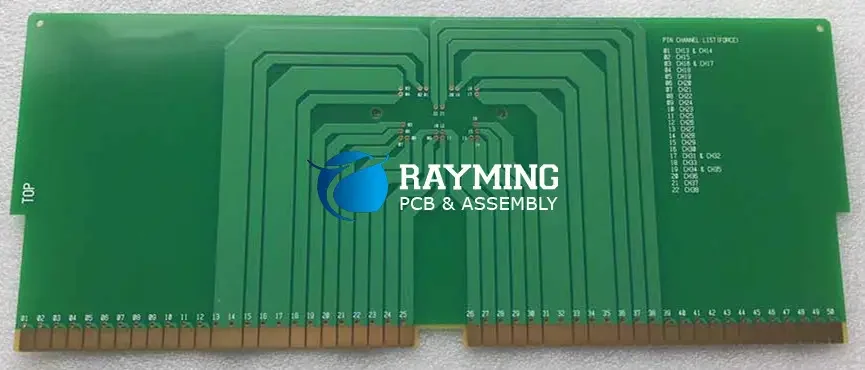
A Shengyi PCB is a printed circuit board manufactured using a specified Shengyi laminate system. The brand identifies the material supplier; the grade, core and prepreg construction identify what the board actually uses. A useful purchase requirement therefore names more than “Shengyi FR-4.” It also defines the finished stackup, copper, dimensions, electrical requirements and evidence needed for acceptance.
This page helps you choose the next material discussion. It covers common rigid epoxy grades and SH260 rigid polyimide, with individual engineering worksheets for dimensional, thermal and insulation questions. If you already have a released drawing, send that drawing directly for review. A calculator is optional, and an unresolved material requirement can be clearly marked as an open item in your enquiry.
Choose the page that matches your engineering question
Begin with the characteristic that can change your design or qualification plan. A compact controller may be limited by its connector thickness. A power board may be limited by insulation geometry. A dense multilayer may need a carefully qualified drilled-hole structure. Those are different decisions even when every purchasing description includes the same laminate brand.
| Engineering task | Material page | Useful next decision |
|---|---|---|
| Repeatable mid-Tg multilayer thickness | S1000H PCB and S1000HB | Reconcile pressed construction and dimensional tolerances |
| High-Tg multilayer thermal review | S1000-2M PCB | Compare expansion data using the same test interval |
| Surface tracking and insulation layout | S1600 high-CTI PCB | Separate CTI from required creepage and clearance |
| Inner heavy copper or dense hole patterns | S1190 PCB construction | Review resin demand, geometric web and qualification |
| Rigid polyimide thermal mission | SH260 PCB | Reconcile thermal exposure, HB and the specified build |
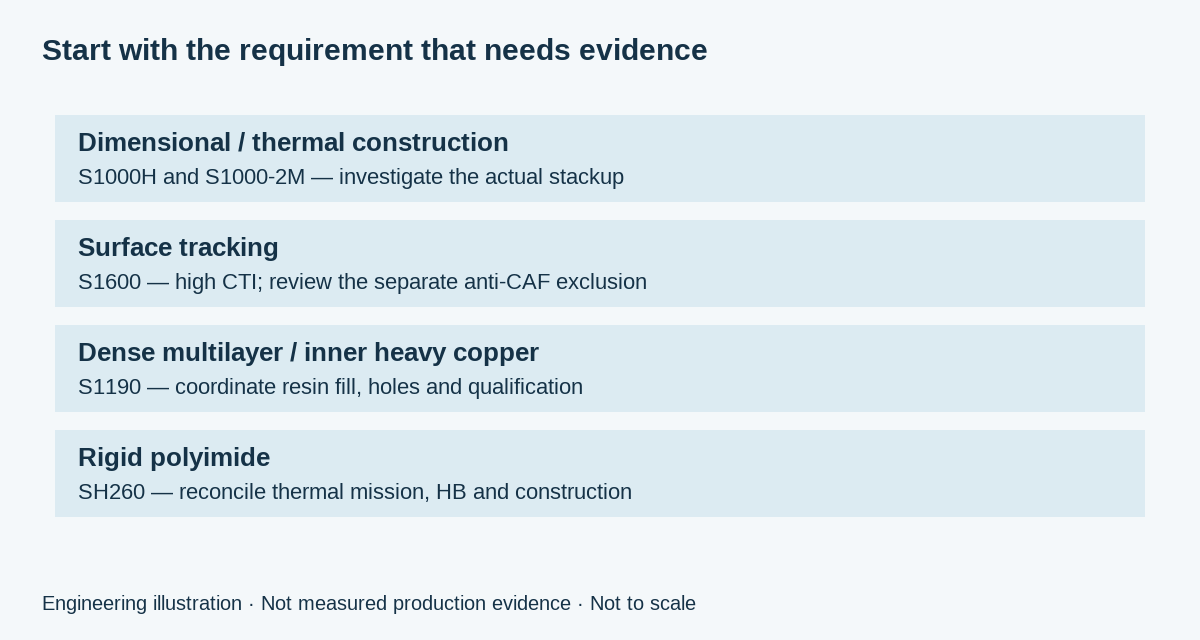
These routes are a shortlist for discussion, not a list of interchangeable materials. Changing a grade can affect the approved stackup, processing, electrical design and qualification scope. Keep the chosen requirement and its reason together so a later cost review does not silently remove the characteristic that mattered.
Compare Tg values without mixing test methods
The selector below keeps DSC, DMA and TMA separate. Select two grades, choose one method and enter a comparison reference. It reports the documented typical value or explicitly says that the selected reference does not report that method. It never fills a missing value by borrowing a number from another method. SH260's reported lower bound remains a lower bound.
RAYPCB ENGINEERING
Shengyi Material EngineeringShengyi PCB Engineering Planner
Loading Shengyi PCB Engineering Planner…
For example, changing a comparison from DMA to DSC can remove a reported S1190 value. That is useful information: the purchasing requirement needs clarification or additional evidence. It does not mean the material has failed a test. Likewise, a typical value above your reference does not establish a guaranteed minimum for the material you will buy.
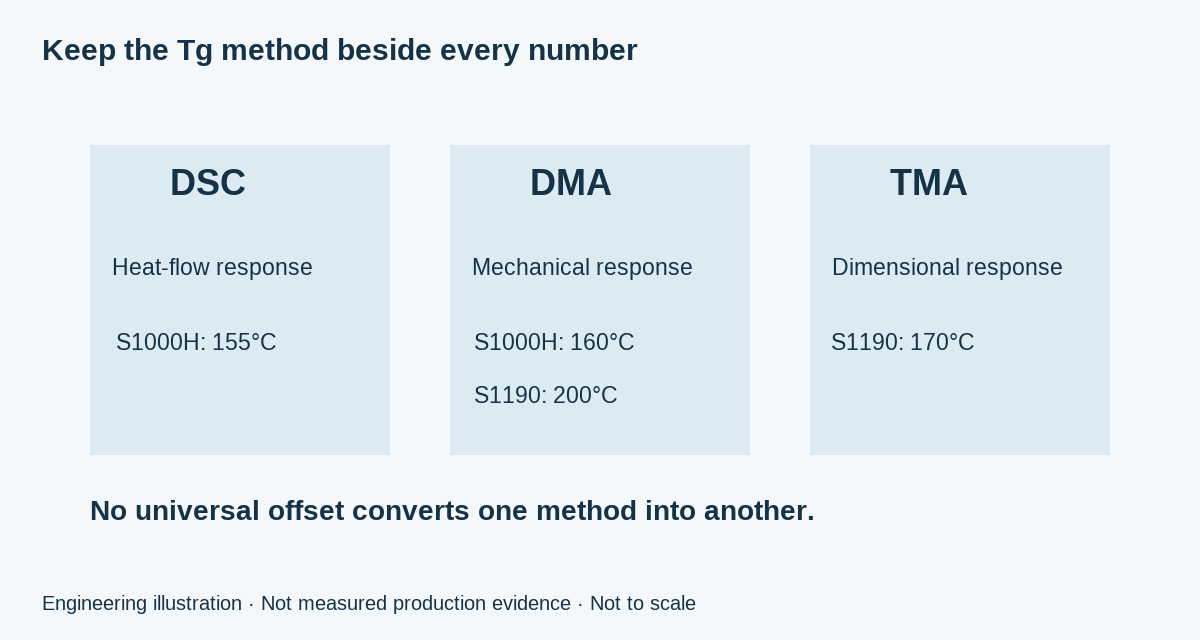
The linked S1000H data sheet and S1190 data sheet identify their methods and reference specimens. Use those documents when specifying a value. For a broader explanation of transition, decomposition and time-to-delamination, continue to high Tg PCB material selection.
Turn the chosen grade into an actual stackup
Prepare a top-to-bottom layer map. Each copper layer needs an intended finished thickness and function; each dielectric gap needs the selected core or bonding construction. Include reference planes for controlled-impedance routes and identify which dimensions the circuit designer can change. This gives the fabricator a meaningful starting point for a pressed-stackup proposal.
Prepreg is not identified by glass style alone. Resin system, resin content and the copper pattern being filled also matter. A fabric label copied from a previous job is insufficient evidence that the next board will reach the same thickness. Review the proposed construction against both the mechanical drawing and the electrical requirement before freezing the layout.
For a connector board, specify the local thickness and tolerance at the mating area. For a dense multilayer, show finished-hole requirements separately from a suggested drill size. For inner heavy copper, flag the most demanding resin-fill region. These small annotations often resolve more uncertainty than adding another row of typical material values to the drawing.
Use the multilayer PCB planning page when layer allocation is still open. Once an electrical geometry is proposed, the controlled-impedance workflow helps frame the reference-plane, dielectric and coupon discussion. Material selection and routing geometry should converge on the same released construction.
Follow the material-to-release sequence
RAYPCB ENGINEERING
Shengyi Material EngineeringShengyi Construction Review Explorer
Loading Shengyi Construction Review Explorer…
The four-step explorer follows material identity, construction, fabrication planning and retained evidence. Use it to identify the next unresolved record in your project. It is a conceptual explanation; it does not simulate lamination, drilling, plating or an actual factory run. The animation starts only when you choose to play it, and every stage remains available as text.
A repeat order should reference the approved fabrication revision and any material deviations. If a substitute is proposed, ask which original requirement changes and who must approve it. A substitute may require a new impedance calculation, a different construction or additional qualification. The review should compare those consequences before comparing the unit price.
Know when this family overview is not enough
S1600 needs particular care in a high-voltage discussion. Shengyi identifies its tracking performance separately from internal electrochemical reliability and explicitly excludes anti-CAF applications. Its official product information should accompany a review that proposes it. A high CTI does not turn a board into an approved insulation system.
SH260 requires a different conversation about rigid polyimide construction and the product's thermal mission. The official SH260 table lists HB flammability. An application that requires V-0 needs that mismatch resolved before material approval. Do not use a high transition temperature to erase a separate flammability requirement.
For a high-speed design, the existing Shengyi S7439 material guide addresses a low-loss multilayer material separately; its historical URL is not evidence that it is PTFE. For an RF comparison involving another brand, use the Shengyi and Rogers material comparison and compare actual grades, frequency-specific data and qualified constructions.
Ask for evidence that answers the actual concern
| Concern | Record to request | What the record does not establish by itself |
|---|---|---|
| Correct material supplied | Agreed laminate/prepreg identity and traceability | Finished-board performance in the application |
| Correct construction | Approved stackup and relevant dimensional inspection | Channel compliance across every interconnect |
| Holes survive the specified exposure | Agreed representative qualification and microsection scope | Unlimited rework or service life |
| Board matches the circuit netlist | Specified bare-board electrical test | Long-term insulation reliability |
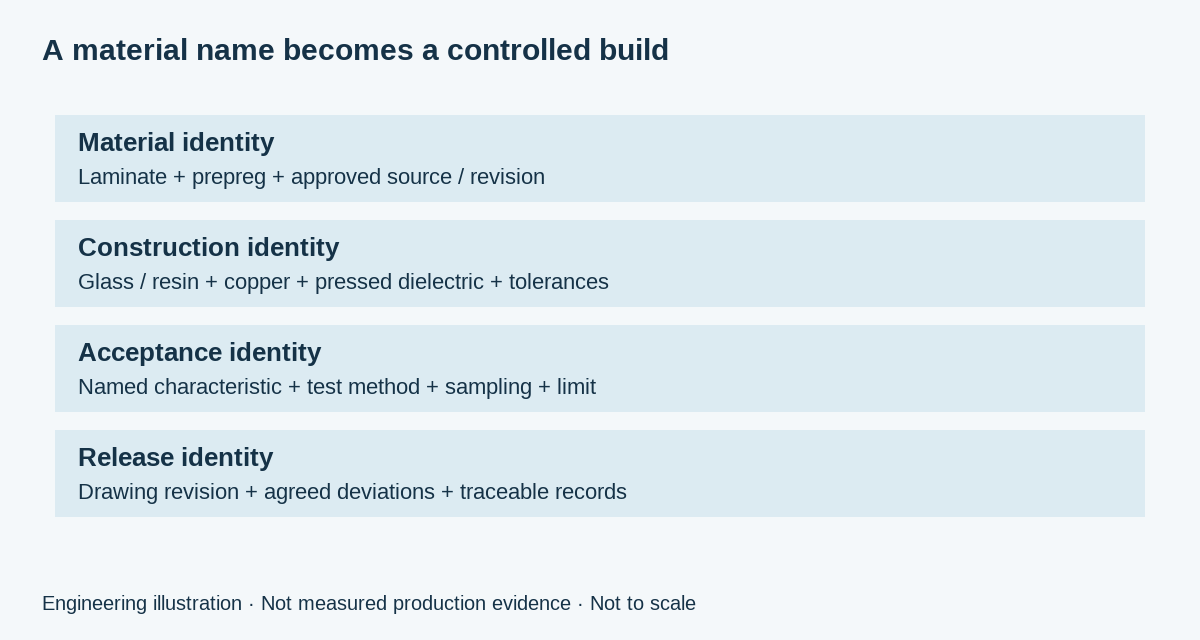
Define the acceptance characteristic, method, extent and record before production. The material supplier's typical property table and the fabricator's production record serve different purposes. This distinction is particularly useful when a sourcing team compares quotations with different inspection packages. Lower test cost may simply mean a different acceptance scope rather than a more efficient build.
The PCB quality-control planning page can help organize that discussion. Ask which evidence is included in the quotation, which needs a separate agreement and which will come from your own product qualification. Keep these responsibilities visible so a prototype success does not become an unsupported production claim.
What changes the cost of a Shengyi PCB?
Cost depends on the specified construction, available material formats, fabrication complexity, order quantity and acceptance work. A brand name is not a price model. Two boards using the same resin system can have very different costs because their layer counts, panel utilization, holes, copper distribution and required records differ.
For a useful comparison, request the same quantities and delivery basis for each alternative. Keep the bare-board scope separate from components and assembly. State whether the quote includes engineering setup, test tooling, coupons, material evidence, packaging, freight and tax. This makes a unit-price difference traceable to a defined change rather than an unspecified “premium material” multiplier.
RAYPCB ENGINEERING
Shengyi Material EngineeringShengyi PCB Budget Brief
Loading Shengyi PCB Budget Brief…
The budget worksheet starts without rates. You can create a technical RFQ brief with every cost blank, or enter all three allowances with their dated source and scope. The arithmetic allocates setup and verification across the requested quantity; it does not search supplier inventory or estimate an unknown market price. Changing the construction or quantity clears the earlier allowances so an old price does not silently follow a new design.
Shengyi PCB questions
Is “Shengyi FR-4” enough for a fabrication drawing?
Usually it leaves important decisions open. Identify the exact grade, acceptable alternatives, construction and required properties. If the choice is intentionally delegated to manufacturing, describe the requirements and the approval process for the proposed material. The drawing can then record the accepted result instead of relying on an informal email description.
Can the material with the highest Tg replace every lower-Tg grade?
No. Thermal transition is only one characteristic. Insulation requirements, dielectric behavior, resin flow, mechanical construction, flammability, processing and commercial availability may all affect the decision. Compare the complete requirement set and the cost of qualifying a change; a single higher number does not establish interchangeability.
Does the selector approve a material for my product?
No. It organizes a small set of source-specific typical Tg values by method and shows missing information. It does not assess the entire material portfolio, production distributions, circuit performance or equipment safety. Download the result as a discussion note and keep the authoritative material and qualification documents with your project.
What should I send when the stackup is still provisional?
Send the board outline, target layers, dimensions, copper requirements, expected environment and critical electrical or mechanical constraints. Mark proposed values as provisional and identify who will approve changes. Include the quantities you want quoted. RAYPCB can then review a coherent manufacturing requirement even before every construction detail is fixed.
Request a Shengyi material review
Send the named laminate and prepreg, drawing revision, stackup, quantities and required evidence. Identify open material, construction or qualification questions so engineering can prepare a useful manufacturing proposal.
Attach a downloaded tool brief manually. Contact does not automatically receive these inputs. References reviewed September 2026. Illustrations use planning examples; photographs do not establish prices, delivery times or project-specific acceptance.