
RAYPCB · ENGINEERING REFERENCE
Flex PCB Cost Estimator: Panel Use, Yield & Budget
Estimate flex PCB panel use and cost from your documented allowances. Compare yield scenarios, setup and recurring scope before requesting a formal quote.
Original engineering guidance · References checked September 27, 2026
Flex PCB cost starts with an equivalent manufacturing scope
Flex PCB cost depends on the construction being purchased, how it occupies a production panel, the required quantity and the processes needed to deliver acceptable circuits. A small outline can still require expensive handling or inefficient panel use. A low unit price can exclude setup, supports, testing or qualification. Compare the complete scope before comparing the number. This page helps turn engineering assumptions and documented allowances into a transparent budget, not an instant binding quotation.
The flexible PCB manufacturing page remains the service and direct enquiry owner. Use this estimator when you want to understand panel steps, yield sensitivity and the contribution of fixed versus recurring work. If the design data are incomplete, Contact is available without a calculation. The useful output is a budget basis that a supplier can review, together with the variables most likely to change it.
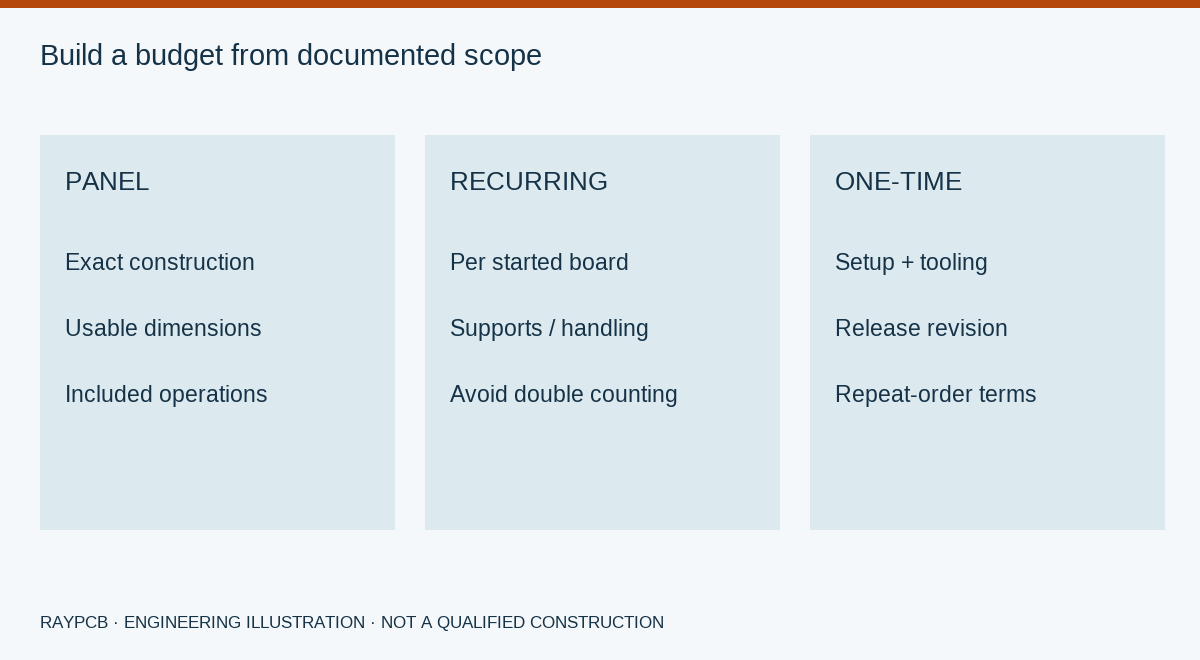
Separate four cost buckets before estimating
| Cost bucket | Possible included work | Record explicitly |
|---|---|---|
| Manufacturing panel allowance | Material, imaging, etching, bonding and other agreed panel operations | Exact construction and usable panel basis |
| Per-started-board allowance | Individual supports, profiling, handling or test not already included | Which pieces incur the allowance, including expected rejects |
| One-time setup | Tooling, programming, dedicated fixtures or agreed preparation | Whether repeat orders need it again |
| Outside this model | Assembly, freight, taxes, qualification and other exclusions | What the final commercial quote adds |
Avoid double counting. If a panel allowance already includes electrical test or profiling, do not add the same operation again per board. Conversely, do not assume a material-only price covers complete fabrication. Ask the person supplying the allowance to state its basis. “Panel cost” can mean a raw laminate sheet, a processed working panel or a delivered array; those are different objects with different waste and labor conditions.
Quantity also needs a definition. The number of acceptable delivered circuits is not necessarily the number started in manufacture. Expected yield can be useful for planning, but it is not a guarantee of enough good boards from a given panel count. The estimator shows both panel-rounded started quantity and expected good quantity. Procurement commitments still depend on the supplier's accepted order scope and production controls.

Understand why panel use changes the price
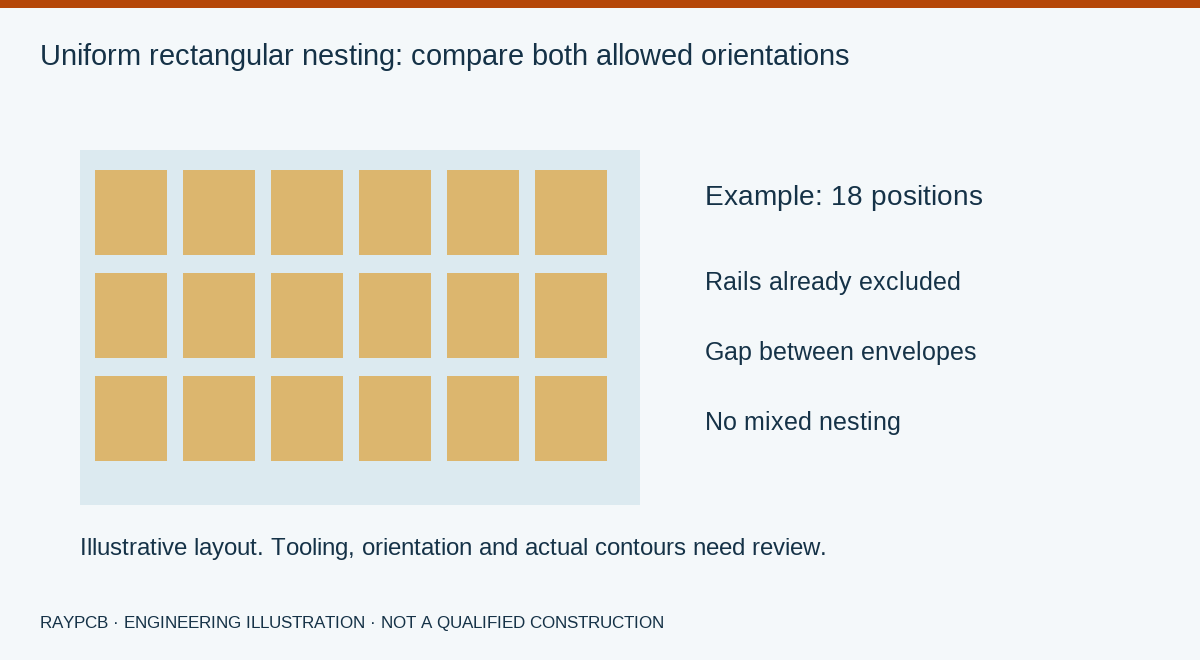
The worksheet uses a rectangular board envelope inside an entered usable panel. Usable dimensions exclude the rails or other areas you have already reserved. A gap separates adjacent board envelopes. The model tries the two uniform orientations when rotation is permitted and reports the higher count. It does not perform mixed-orientation nesting or exploit interlocking contours. For irregular flex shapes, a manufacturing panel layout may achieve a different count and must be reviewed separately.
For each orientation, the count along an axis is the whole-number floor of (usable dimension + gap) / (board dimension + gap). This counts the gaps between items without adding an unnecessary gap after the last item. Multiplying the two axis counts gives the panel count for that uniform layout. If even one circuit does not fit, the tool stops instead of returning an optimistic cost based on a fractional board.
Orientation is not merely a mathematical convenience. Material direction, handling, tooling, registration and assembly requirements may restrict rotation. The tool provides an explicit choice and does not rotate a project silently. The rectangular envelope also needs to include the geometry actually reserved for each circuit. If tabs, coupons or local tooling consume additional space, either include them in that envelope or subtract their controlled allocation from the usable panel.
Calculate panel-rounded budget and yield sensitivity
Enter board-envelope and usable-panel dimensions, gap, whether rotation is allowed, desired delivered quantity and an expected good-board fraction. Then enter documented panel, per-started-board and one-time setup allowances in a single currency, with a dated source and construction description. No price is prefilled in project mode. The sample mode is explicitly illustrative. The tool does not fetch current prices or use hidden layer-count multipliers.
RAYPCB ENGINEERING
Flex EngineeringFlex Panel Use and Cost Sensitivity
Loading Flex Panel Use and Cost Sensitivity…
The model divides required delivered quantity by expected good fraction and rounds upward to a planned starting quantity. It then rounds upward again to complete panels. Total budget is whole panels multiplied by the panel allowance, plus actual panel-rounded starts multiplied by the per-start allowance, plus one setup allowance. Dividing that total by requested delivered quantity provides a budget allocation per ordered board. It is not a quoted selling price or a forecast production yield.
A second calculation lowers the entered expected yield by five percentage points, within the tool's allowed range, and reports the corresponding panel count and total. It is a sensitivity scenario, not a probability interval. Costs can stay unchanged until another whole panel is required, then step upward. That discontinuity is useful information: a smooth per-square-centimetre estimate can hide it. The export includes both scenarios and all assumptions.
A complete worked budget without a market-price claim
Consider an illustrative 300 × 200 mm usable panel, a 60 × 40 mm rectangular board envelope, a 5 mm gap and permission to rotate uniformly. One orientation fits four by four boards, or sixteen. The rotated orientation fits six by three, or eighteen. This model therefore selects eighteen, while recording that the actual manufacturing layout still needs approval. It does not claim eighteen will fit after unentered tooling features are added.
For an order of 100 good boards at an assumed 90% expected yield, the planned starting requirement is 112. Seven panels provide 126 starts and 113.4 expected good boards. With illustrative allowances of 80 currency units per processed panel, 1.5 per start and 120 setup, total budget is 869. The allocation is 8.69 per ordered board. These numbers demonstrate the formula only and are not RAYPCB rates or a current market price.
At an assumed yield of 85%, the starting requirement is 118, so seven panels still suffice in the planning arithmetic. Expected good quantity becomes 107.1 and cost remains 869. For a larger requested quantity or a lower assumed yield, the next panel can change cost abruptly. Expected output is not a delivery guarantee: the real distribution, lot variation and any scrap recovery are outside this simple deterministic model.
Which design choices should trigger a new budget basis?
Changing copper count, core construction, coverlay, supports or shielding can change the manufacturing route. Do not retain a price simply because the outline stays the same. An adhesiveless core, a multilayer bonding scheme and an unusual support combination may require a different documented allowance. A reviewed flex stackup gives the estimator an identifiable construction instead of an ambiguous material label.
Finished copper, feature dimensions and opening registration can also change the scope. A line-and-space requirement must be reviewed with the actual copper and process, rather than assigned a universal percentage surcharge. The same is true of plated holes and local thickness constraints. Use the flex capability reference as a discussion entry, then confirm which requirements can be combined in the actual board. Independent limits are not necessarily simultaneously available.
Support pieces add their own geometry and attachment work. A more elaborate support can be justified if it simplifies downstream assembly or avoids a separate mechanical part, but those savings belong in a broader system comparison. The bare-board model cannot automatically credit reduced harness assembly or improved serviceability. Keep the PCB cost calculation and the product-level business case separate so neither hides an unverified assumption.

Compare quotations with an explicit inclusion matrix
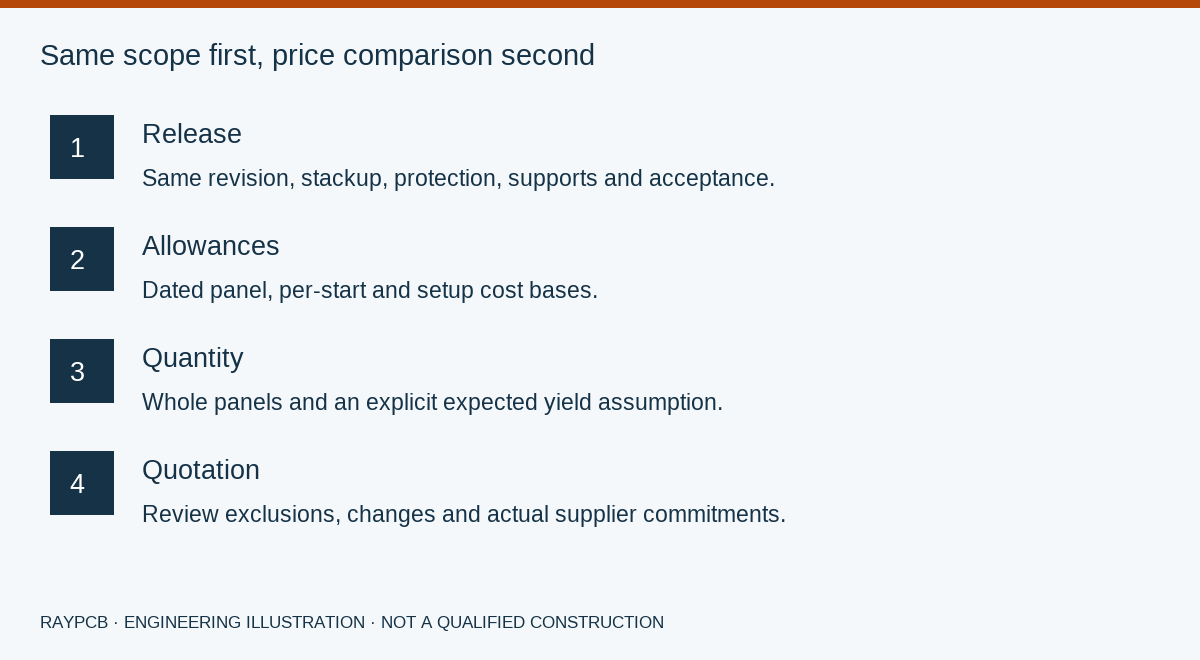
Create one row for each required deliverable: released circuit revision, material system, copper, protection, supports, finish, test, traceability, packaging and quantity. Record whether each supplier has included it, excluded it or requested clarification. Compare tooling ownership and repeat-order conditions separately. A quotation with a lower recurring price and a new setup charge on every revision may behave differently from one with a larger initial tooling investment.
State the timing basis without assuming an advertised prototype lead time applies to every flex construction. Procurement, engineering clarification and special qualification can occur outside a simple fabrication interval. If expedited work is needed, identify which event starts the agreed clock. This page does not invent a rush multiplier because the actual constraint may be material availability, process capacity or unresolved files rather than board area.
For repeat orders, preserve the accepted construction and exception list. If a material, tool or process changes, check whether the prior price and evidence still apply. A familiar part number does not guarantee an identical build when its documents have changed. The budget export should carry the revision and dated allowance source so purchasing and engineering can compare the same object at the next review.
Reduce cost by removing avoidable work
Start with panel fit and the actual functional outline. A small change to an unused extension can sometimes add another circuit to the panel, while shrinking a critical bend length can create a larger reliability problem. Compare both with the mechanical owner. Similarly, combining support pieces or simplifying an opening may reduce work only if the assembly and protection requirements still hold. Cost reduction is useful when it preserves the accepted task.
Next review requirements that were copied from an unrelated drawing. An unnecessarily narrow thickness band or unsupported material brand restriction may constrain sourcing. Do not remove those notes automatically; identify their origin and confirm whether they protect a real interface. For connector fit, the flex thickness guide provides an interval check. For moving regions, the design guidelines keep the motion and verification scope visible.
Finally, improve the release package. Clear support layers, opening drawings, regional stackups and revision control reduce clarification and requote loops. They do not eliminate necessary engineering review, but they make each question specific. Submit unresolved conditions honestly so the quotation can include the right work. A low preliminary estimate built on hidden omissions is less useful than a transparent range that identifies the decisions still required.
Flex cost questions
Is this an instant RAYPCB quotation?
No. It is a planning worksheet using your documented allowances and geometric assumptions. RAYPCB needs the actual files, construction, quantities and acceptance requirements to provide a project-specific commercial quotation.
Why not publish a universal price per layer?
Layer count alone does not describe material, panel fit, protection, supports, features or testing. A universal multiplier would hide those differences and imply a pricing calibration that this worksheet does not have.
Does the panel result guarantee the manufacturing yield?
No. The layout model is rectangular and the yield is an entered expected fraction. Manufacturing must review the real nesting, tooling and process. Expected good quantity is arithmetic, not a promised shipment count.
Can I budget assembly in the same allowance?
Only if its inclusion is expressly documented in your source, but this model is organized around bare flexible-board production. Keep component sourcing, assembly fixtures and functional testing separate where possible, and submit them with the complete assembly requirement for an accurate quotation.
Bring the requirement and the drawing together
Send the board revision, construction, quantity and the standard or engineering question you need reviewed. Identify unresolved requirements so the response can address them.
Send requirements for reviewOptional: attach the downloaded worksheet manually. This guidance does not certify a design, approve a shipment or replace the applicable authorized standards.