
RAYPCB · Material selection & fabrication
Tg260 PCB: Rigid Polyimide Materials & Design
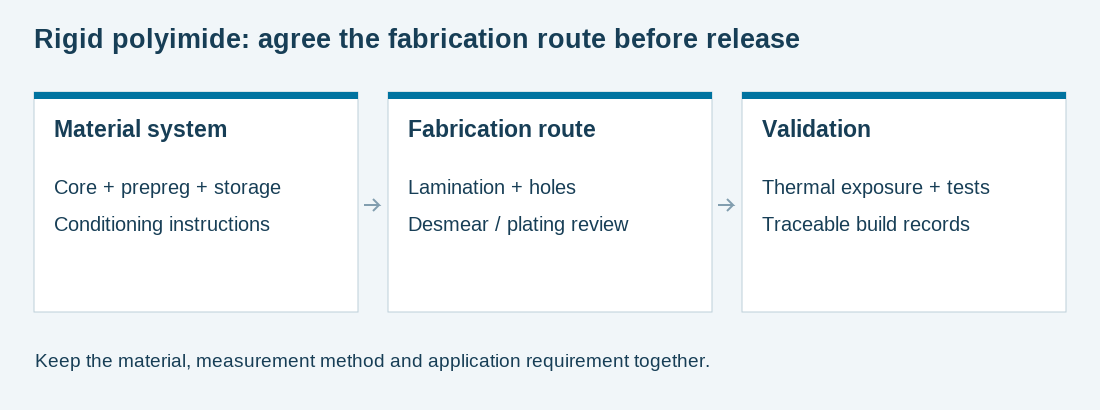
Treat a Tg260 requirement as a material-system decision. Review rigid polyimide core and prepreg, thermal exposure, moisture handling and the fabrication route before releasing the board.
Send files for a material & fabrication quotePreliminary files welcome. Identify the grade, test method and unresolved requirements.

What does Tg260 PCB mean?
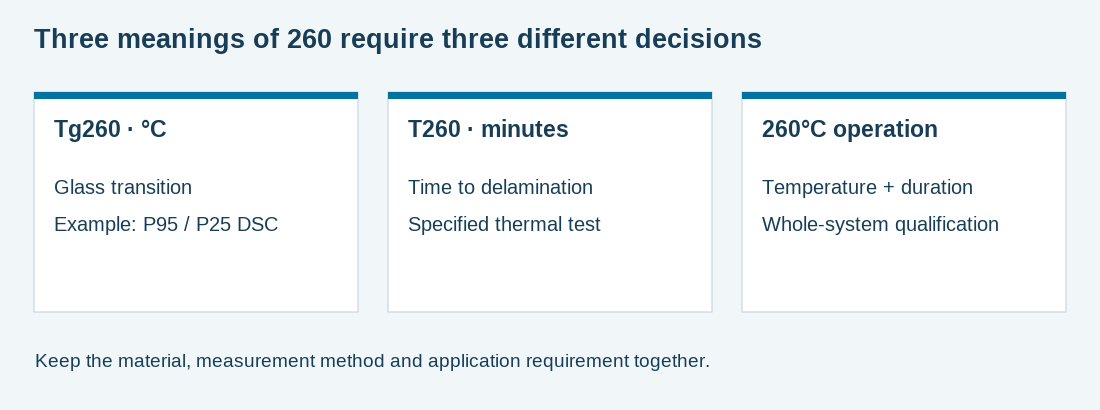
A Tg260 PCB typically refers to a high-temperature laminate system reporting a glass transition near 260°C under a stated method. Isola P95/P25 is a rigid polyimide example with a published 260°C DSC Tg. This is different from a T260 delamination test or 260°C service.
Do not specify this as ordinary FR-4 with a larger temperature number. The resin, compatible prepreg, lamination, hole preparation and moisture controls need material-specific review. A flexible polyimide film is also a different construction from a glass-reinforced rigid polyimide laminate.
For the complete grade map and temperature-test definitions, use the High Tg PCB material selection guide.
P95/P25 and SH260 are not interchangeable labels
The cited P95/P25 datasheet identifies P95 as laminate and P25 as prepreg, with Tg260°C by DSC, Td416°C at 5% mass loss and 1.5% total Z expansion from 50–260°C. Its published flammability rating is HB, not V-0. If a project requires V-0, specify and verify a suitable recognized system instead of assuming all polyimides share the same rating.
Shengyi SH260 reports Tg greater than 250°C by TMA and T300 greater than 60 minutes. Neither its product name nor its T300 result establishes an exact Tg260 DSC value or Tg300. The material comparison must retain these different methods and limits.
| Candidate / RAYPCB guide | Tg and method | Td, 5% mass loss | Z expansion, 50–260°C | Evidence |
|---|---|---|---|---|
| Isola P95 / P25 | 260°C · DSC | 416°C | 1.5% | Supplier data |
| Shengyi SH260 | >250°C · TMA; >250°C | 429°C | 1.2% | Supplier data |
Typical published data, not purchase minima or a stock list. Methods, specimen construction and conditioning may differ. Confirm the supplier revision and the exact supplied construction. A missing entry is not zero.
Where rigid polyimide review can add value
| Application / concern | Useful review inputs | Evidence to agree |
|---|---|---|
| Burn-in and test fixtures | Actual fixture temperature, dwell, cycles, connections and component limits. | Thermal/electrical stability and the defined fixture life test. |
| Hot industrial environments | Board hot spot, atmosphere, time, cycles and mechanical loads. | Material and finished-product qualification under the stated duty. |
| Demanding multilayer interconnects | Stackup, hole geometry, copper and assembly/rework exposures. | Construction-specific coupons, cross sections and agreed thermal tests. |
| Insulation or flammability requirements | Required recognition, material thickness and electrical environment. | Current supplier/recognition scope and the product acceptance basis. |
These are application review contexts, not claims of certified RAYPCB projects. Ask for evidence relevant to your actual construction and service requirement.
Processing, moisture and cost need a dedicated quote
Follow the actual supplier processing instructions for storage, drying, lamination and hole preparation. Do not reuse a universal bake temperature or press cycle across polyimide systems. Moisture handling and resin behavior remain relevant even when Tg is high. Board finish and assembly components must also fit the exposure.
The quote should separate material procurement, stackup/lamination, drilling/desmear, plating, inspection and any thermal validation. The planner prepares a polyimide enquiry and intentionally does not generate a price from ordinary FR-4 allowances. See P95/P25 material detail and SH260 material detail alongside their original supplier data.
If the specification actually means a 300°C test or service condition, continue to the Tg300 requirement guide. For lower-temperature epoxy alternatives, return to Tg200 method and material review after checking what the application truly requires.
Prepare a Tg260 PCB fabrication enquiry
Enter the requested construction and material. The chosen grade remains a request until it is agreed for your build. You may skip the planner and send files directly. Material changes clear previously entered cost allowances.
RAYPCB ENGINEERING
High Tg MaterialsTG260 Quotation Planner
Loading TG260 Quotation Planner…
Resolve the engineering question before choosing a grade
RAYPCB ENGINEERING
High Tg MaterialsTG260 Engineering Workbench
Loading TG260 Engineering Workbench…
RAYPCB ENGINEERING
High Tg MaterialsGlass Transition Explanation
Loading Glass Transition Explanation…
Release requirements and evidence
Keep the approved laminate, compatible prepreg, supplier revision and permitted alternatives with the fabrication drawing. Add the finished stackup, copper, holes, finish, quantity and any assembly thermal profile. Specify the applicable bare-board standard/class/revision, electrical and construction checks, and additional thermal tests when required.
Review the quality and acceptance requirements and rigid manufacturing capability table for the actual construction. Supplier datasheet values are not a RAYPCB test report or a substitute for agreed inspection evidence. For populated samples, coordinate prototype assembly and validation with the same approved material.
Tg260 PCB questions
Is Tg260 the same as T260?
No. Tg260 means a glass transition around 260°C under a defined method. T260 is a time-to-delamination result measured in minutes at 260°C.
Is P95/P25 a standard FR-4 epoxy?
The cited Isola datasheet describes a polyimide system. P95 laminate and P25 prepreg require their own approved processing route.
Is P95/P25 automatically UL 94 V-0?
No. The cited datasheet lists HB. Verify the required flammability and recognition scope for the chosen system and thickness.
Does SH260 prove Tg260 by DSC?
The cited Shengyi data report Tg greater than 250°C by TMA. Do not convert that into an exact 260°C DSC requirement without appropriate evidence.
Does low total expansion approve via life?
No. Geometry, copper plating, material construction, processing and thermal duty also matter. Define the finished-board validation plan.
Why does the planner request an engineering quote?
Rigid polyimide material supply and processing differ from ordinary FR-4. A shared area-price multiplier would conceal important manufacturing and test costs.
Technical references
Manufacturer sources reviewed on 17 September 2026. Preserve the stated method and revision; confirm current data and supply before approving the build.
Send the material requirement with the board files
Attach fabrication/drill data, outline and stackup. State the thermal exposure, quantity, tests and required delivery date. If the grade or method is unresolved, mark it for engineering review. Downloaded tool notes must be attached manually.
Request a Tg260 PCB review