
Nan Ya · Directory guide
Nan Ya RF Laminates: PTFE, Hydrocarbon and PPE
Identify the chemistry of the exact NP or NPG grade.
Nan Ya uses different resin systems across its high-frequency and high-speed portfolio. Its 2021 official material poster classifies NP-822 and NP-930 under PTFE and NP-530/535/536 under hydrocarbon; NPG grades include PPE systems.
Send preliminary files or a released drawing. Identify the material, quantity and open decisions.
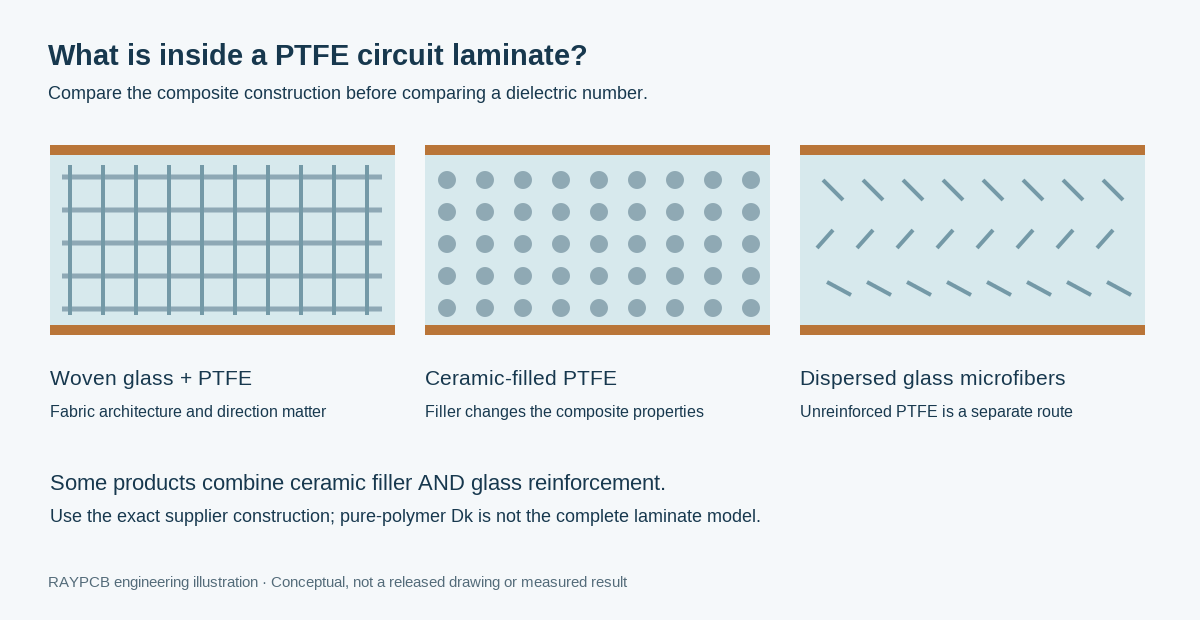
Decision first. The NP prefix does not prove PTFE chemistry. The dated poster is an identification reference, not confirmation of current availability or the latest revision. Obtain the selected grade datasheet before release.
01 / Material evidence
What to know about Nan Ya RF Laminates: PTFE, Hydrocarbon and PPE
| Review item | What to use |
|---|---|
| Material / subject | Nan Ya RF Laminates: PTFE, Hydrocarbon and PPE |
| Primary decision | Identify the chemistry of the exact NP or NPG grade |
| Document basis | Nan Ya 2021 portfolio; current exact-grade sheet required |
| Numerical design preset | Not assigned from a dated family overview |
| Application task | Nan Ya RF material selection |
| Useful next step | Send the drawing and material requirement |
Resin classification has been checked against the official family table. This reference does not establish present availability, a current tolerance or a frequency-dependent model.
Reference: Nan Ya — material portfolio and resin-system table (2021).
Choose a focused material or design route
| Topic | Visitor task | What the page explains |
|---|---|---|
| Nan Ya NP-530 PCB Laminate | Correct the resin classification before using process assumptions | Nan Ya identifies NP-530 as a hydrocarbon material in its official 2021 poster. The retained legacy URL contains “PTFE”, but the page must not use that wording as a material specification. |
| Nan Ya NP-535 PCB Laminate | Review the NP-535 core independently of NP-535B bondply | NP-535 is classified as hydrocarbon in the cited Nan Ya portfolio. NP-535B is a separate bonding material; the two names describe different roles in a multilayer construction. |
| Nan Ya NP-535B Bondply | Specify a hydrocarbon bonding layer by cured construction | Nan Ya describes NP-535B as hydrocarbon bondply in its official poster. It is not a PTFE core, and its function is to join layers in a specified multilayer construction. |
| Nan Ya NP-536 PCB Laminate | Review an RF hydrocarbon material without transferring PTFE assumptions | NP-536 is listed under hydrocarbon in Nan Ya’s official 2021 portfolio. Its material selection should use exact construction data rather than the PTFE wording retained in this older page address. |
| Nan Ya NP-536HC PCB Review | Verify the HC variant and the intended copper construction | NP-536HC appears as a separate hydrocarbon grade in the Nan Ya portfolio. The suffix must be preserved, but it should not be expanded into an unsupported universal copper-weight capability. |
| Nan Ya NP-822 PTFE PCB | Use the documented PTFE classification for NP-822 | Nan Ya’s official poster identifies NP-822 as PTFE with glass fabric, not a PPE laminate. Its construction and source data should control the description even though this legacy URL says PPE. |
| Nan Ya NP-930 PTFE Laminate | Define the mmWave design and validation conditions | NP-930 is identified as PTFE in Nan Ya’s official portfolio and presented for millimeter-wave applications. That positioning does not replace a frequency-specific circuit model or the selected thickness and foil information. |
02 / Your engineering task
Turn the design selection into a repeatable material order
Write a material line that includes manufacturer, complete designation, document revision, thickness and foil. Add any required test basis or traceability record. A supplier should be able to distinguish the approved construction from a nearby grade without interpreting a marketing name.
Separate approved alternatives from candidates under evaluation. If substitution is permitted, define the approval process and which properties must be compared. Do not let a similar dielectric constant or an old cross-reference override the released drawing.
For repeat orders, retain the actual supplied material record and any agreed compensation or deviation. Compare changes in lot, construction, copper or process route against the first-build evidence. The aim is not to collect paperwork for its own sake, but to make the next order reproducible and an unexpected electrical change traceable.
| Continue when you need… | Next page |
|---|---|
| Correct the resin classification before using process assumptions | Nan Ya NP-530 PCB Laminate |
| Review the NP-535 core independently of NP-535B bondply | Nan Ya NP-535 PCB Laminate |
| Specify a hydrocarbon bonding layer by cured construction | Nan Ya NP-535B Bondply |
| Review an RF hydrocarbon material without transferring PTFE assumptions | Nan Ya NP-536 PCB Laminate |
| Verify the HC variant and the intended copper construction | Nan Ya NP-536HC PCB Review |
| Use the documented PTFE classification for NP-822 | Nan Ya NP-822 PTFE PCB |
| Define the mmWave design and validation conditions | Nan Ya NP-930 PTFE Laminate |
03 / Engineering calculations
RF design workbench: width, phase and loss
Work with Nan Ya RF Laminates: PTFE, Hydrocarbon and PPE using the exact construction data. Select a line model or a planar passive calculation. Results explain the assumptions and can be downloaded with the entered values.
RAYPCB ENGINEERING
PTFE EngineeringPTFE RF Design Workbench
Loading PTFE RF Design Workbench…
Read dielectric data in the right context
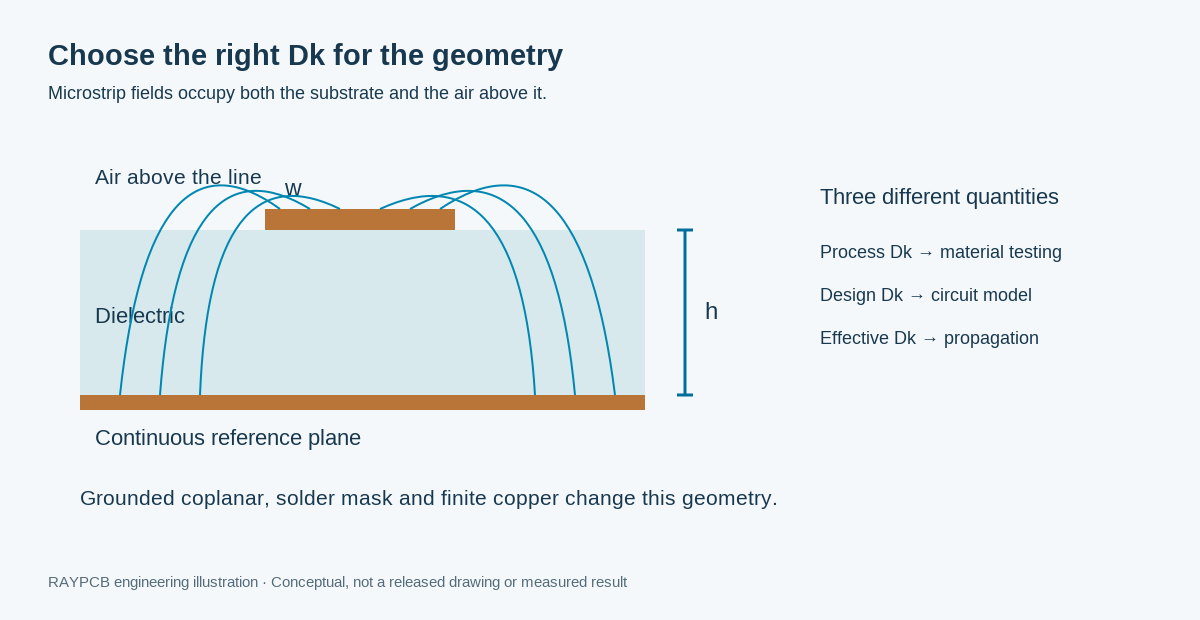
A material data table and a circuit simulation answer different questions. Process Dk is used in a defined material measurement. Design Dk is a supplier modeling reference. Effective permittivity belongs to the transmission-line geometry and includes how its fields occupy the surrounding media. Keep those labels attached when copying values into a drawing, a calculator or an RF model. An unlabeled number is difficult to audit later.
For a microstrip, identify the distance between the trace and its continuous reference plane. Do not enter total board thickness unless that dimension really is the dielectric height. For centered stripline, this workbench asks for total ground-plane spacing. An asymmetric stripline, a coplanar line with backside ground, solder mask over the trace or a mixed-dielectric stack requires a model that actually represents those features.
Use the calculation to establish scale and sensitivity. The workbench uses a zero-thickness, quasi-static line model, so it does not compensate for finished copper, etch shape, roughness, dispersion or transitions. A narrower nominal trace is not automatically a better layout. Check routability and tolerances, then correlate the chosen geometry with a field solver and an agreed fabrication coupon.
04 / Scope and budget
Cost planning and a usable quotation brief
Use this form when preparing a Nan Ya RF Laminates: PTFE, Hydrocarbon and PPE enquiry. You can also go straight to Contact without calculating. The budget is optional and uses your own board-specific cost allowances.
RAYPCB ENGINEERING
PTFE EngineeringPTFE Fabrication & Budget Brief
Loading PTFE Fabrication & Budget Brief…
Compare cost using the same construction and acceptance scope
The laminate price is only one part of a finished RF board quotation. Ordered sheet format, panel utilization, copper, layer count, holes, bonding, handling and inspection all affect the manufacturing plan. Small quantities can carry a larger share of setup and test-fixture effort. An apparent material saving may disappear if it requires a new layout, additional coupons or a repeat qualification build.
For a meaningful comparison, hold the board outline, quantity, acceptance criteria and deliverable constant. Ask which material grade, thickness, foil and bond system each proposal assumes. Separate bare-board fabrication from component purchasing and assembly. Also separate continuity testing from impedance or RF measurements so that a lower price is not simply a smaller test scope.
The quotation tool generates a project brief by default. Optional budget numbers use your entered allowances, not a RAYPCB tariff or current market price. Its scenario range is not a statistical confidence interval. Complex hybrids, metal-backed structures, unresolved grades and special qualification work go to engineering quotation. Freight, tax and any work not explicitly entered remain outside the calculation.
05 / Review the construction
Design-to-build review for Nan Ya RF Laminates: PTFE, Hydrocarbon and PPE
Allocate the complete RF loss and phase budget
Begin with the ports and the allowed electrical behavior between them. State the operating band, reference impedance, loss limit and any phase-matching requirement. Include transmission lines, vias, connectors, soldered interfaces, filters and other structures that are inside the measurement reference planes. Without that definition, two apparently different board results may simply include different parts of the signal path.
Dielectric-only attenuation is one contribution to insertion loss. Copper conductivity, conductor profile, surface roughness, finish, radiation and mismatch can also matter. A loss-tangent value measured at one frequency is not a measured loss curve over a whole band. The tool deliberately identifies its constant-Df assumption and excludes these other contributions; it should not be used to promise finished-board performance.
For phase-sensitive paths, preserve the material model, geometry and temperature assumptions together. Equal drawn lengths can still have different electrical lengths when their reference structures differ. A layer change, a ground interruption or a different connector launch deserves review. Define whether the acceptance requirement concerns absolute delay, phase at one frequency or tracking over a band and temperature range.
What to send for an engineering quotation
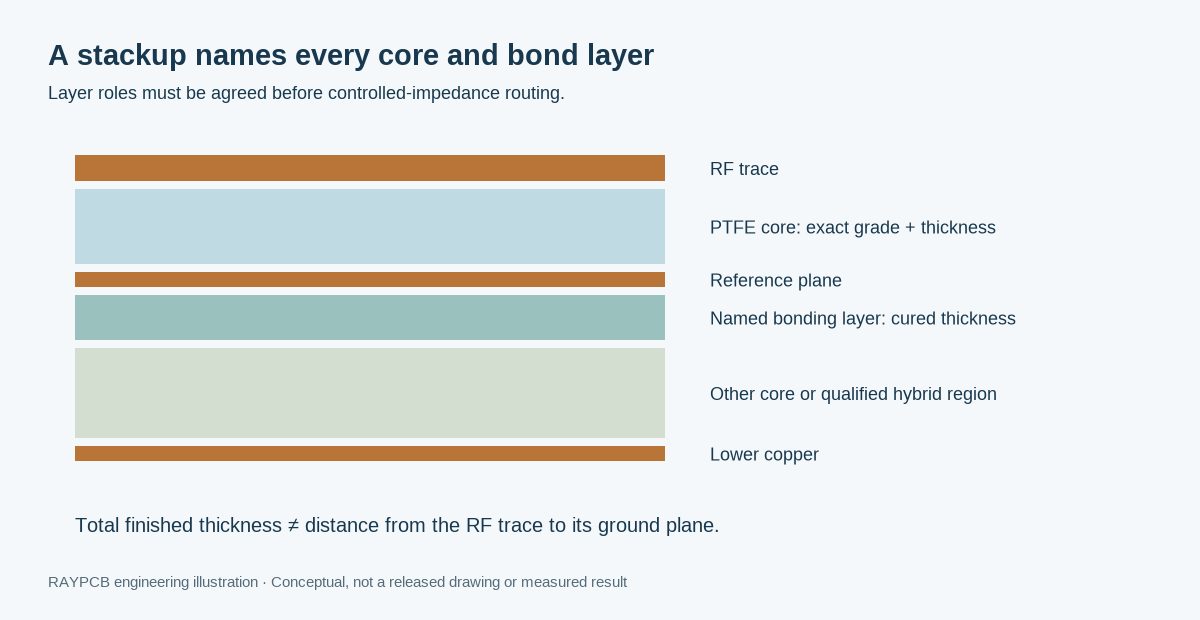
Send the circuit artwork in the agreed fabrication format, drill data, board outline, mechanical notes, quantity and revision. Add a stackup that names every core and bonding layer, dielectric thickness, copper requirement and surface finish. Identify open decisions clearly; a preliminary drawing can start a discussion, but it should not be mistaken for an approved production release.
For controlled impedance, list each target, tolerance, signal layer and reference layer. State whether the requirement is single-ended or differential and provide any intended coupon or test method. For a material-controlled build, include the exact manufacturer designation and the document revision used in design. Describe approved substitutions explicitly, or say that changes require written engineering approval.
If the order includes assembly, supply the BOM with manufacturer part numbers, placement data, assembly drawing and test expectations. Discuss connector attachment, thermal exposure and any fragile or thin RF regions before fabrication. The board material, bonding film and subsequent assembly profile must be reviewed as a system. Sending these details early makes quotations easier to compare and reduces ambiguous assumptions.
06 / Evidence and release
Prepare the next engineering review
Approve the first build and control the next revision
Agree the first-build acceptance plan before the order enters fabrication. Useful records can include material identity, stackup confirmation, dimensional checks, connectivity results, impedance measurements and application-specific RF evidence. The actual list depends on the project. Do not assume that a laminate datasheet, a supplier certificate or a photograph substitutes for finished-board inspection.
When a coupon result differs from the model, compare the same reference structure and test method before changing the material value. Check finished geometry, dielectric height, foil assumptions, fixture influence and calibration. Record any agreed compensation with the drawing revision so that a repeat order does not inadvertently revert to the original nominal dimensions.
Keep an approved build record containing material designation, laminate revision, stackup, circuit revision, permitted substitutions and test limits. Review changes to foil, bond material, panel orientation, assembly exposure or supplier route before treating the next lot as identical. A successful prototype demonstrates that particular build under its test conditions; it does not eliminate the need for controlled production changes.
RAYPCB ENGINEERING
PTFE EngineeringPTFE Stackup Explorer
Loading PTFE Stackup Explorer…
The layer sequence is a conceptual explanation. It does not assign an adhesive to this material or approve a press cycle. For detailed construction planning, use RF Multilayer PCB Design with PTFE.
07 / Practical answers
Questions engineers ask before releasing Nan Ya RF Laminates: PTFE, Hydrocarbon and PPE
What is the most important decision for Nan Ya RF Laminates: PTFE, Hydrocarbon and PPE?
Nan Ya uses different resin systems across its high-frequency and high-speed portfolio. Its 2021 official material poster classifies NP-822 and NP-930 under PTFE and NP-530/535/536 under hydrocarbon; NPG grades include PPE systems. The NP prefix does not prove PTFE chemistry. The dated poster is an identification reference, not confirmation of current availability or the latest revision. Obtain the selected grade datasheet before release.
Which Dk should I enter in the calculator?
Use the approved design/model Dk for the exact construction. Process Dk is a supplier material-test value; effective permittivity is geometry-dependent. Where this page has no verified single design value, the field remains blank. An example calculation does not establish a product specification.
Does this page confirm current stock or a guaranteed build limit?
No. Material documentation describes a product; it does not confirm current RAYPCB inventory, procurement lead time or the manufacturability of every geometry. Send the grade, drawing, quantity and required acceptance conditions for a project-specific review.
How should I compare a proposed material substitution?
The NP prefix does not prove PTFE chemistry. The dated poster is an identification reference, not confirmation of current availability or the latest revision. Obtain the selected grade datasheet before release. Compare the exact core, bond system, thickness, foil, electrical model, thermal conditions and first-build evidence. Preserve the approved drawing until the proposed change is accepted.
Does the loss calculator predict measured insertion loss?
It estimates the dielectric contribution of a simplified microstrip with an entered constant loss tangent. Conductor, roughness, radiation, mismatch, connectors and test fixtures are excluded. Use a complete circuit model and an agreed RF measurement when total insertion loss is an acceptance requirement.
Can I ask for a quote before every parameter is finalized?
Yes. Send the available files, quantity and intended use, and identify which decisions remain open. State whether you want bare boards or assembly. A preliminary enquiry can establish the next engineering questions without being treated as a released production order.
Original material references
Technical sources identify the material and explain supplier methods. They do not certify a finished RAYPCB board or confirm stock. Check the current exact-grade revision for a production order.
Send the material requirement with the board files.
The NP prefix does not prove PTFE chemistry. The dated poster is an identification reference, not confirmation of current availability or the latest revision. Obtain the selected grade datasheet before release.
For a broader fabrication project, see PCB Manufacturing services.