
RAYPCB · ENGINEERING REFERENCE
PCB Delamination: Symptoms, Causes & Investigation Evidence
Separate an observed separation from its possible causes. Preserve board identity, process history and representative evidence for a controlled investigation.
Original engineering guidance · References checked September 29, 2026
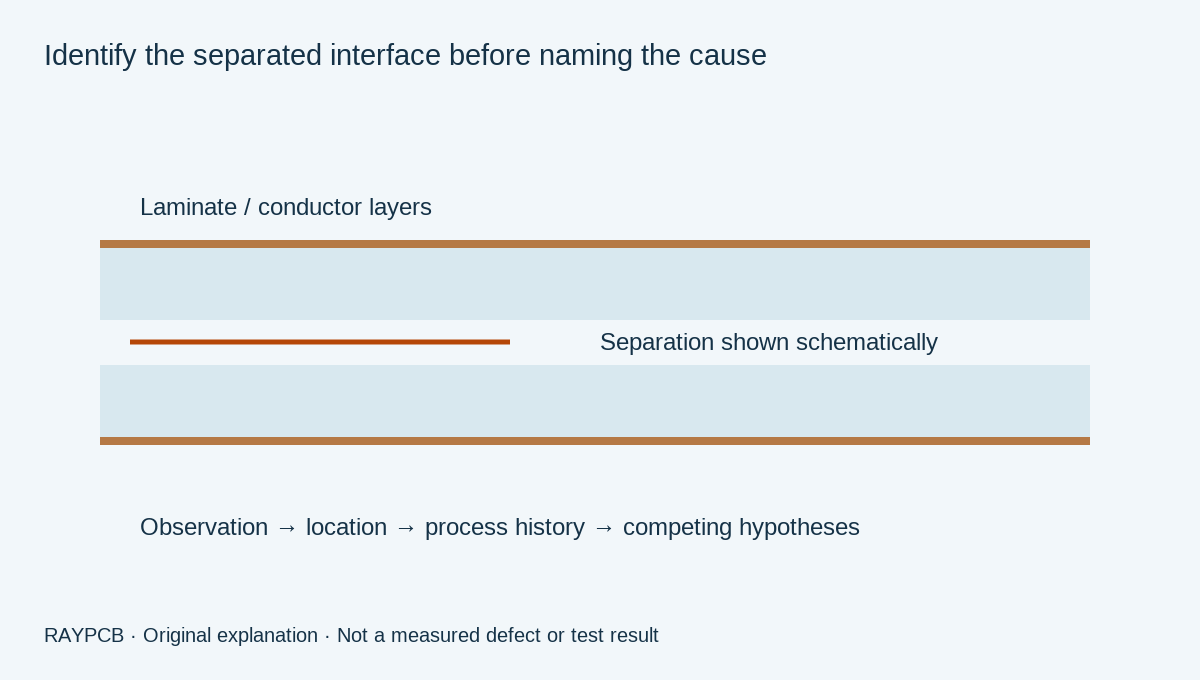
PCB delamination needs an investigation, not a guessed repair
PCB delamination is separation within a printed-board material system or at a bonded interface. A raised surface, exposed split or internal discontinuity may justify investigation, but appearance alone does not establish which interface failed or why. The first useful response is to identify the affected construction, preserve representative specimens and reconstruct when the condition appeared. Reheating an unknown board until it looks flatter is not evidence that its interconnections or insulation have recovered.
This guide addresses laminate and bonded-layer separation in fabricated boards. It does not treat every lifted solder mask, conformal-coating blister or damaged component package as the same defect. Those materials have different interfaces, processing histories and acceptance requirements. For a procurement review, start with the agreed drawing and the quality assurance evidence framework. For a new build, send the construction and intended assembly exposure before requesting a material substitution.
Describe what is visible before assigning a cause
Use an observation record that another engineer can understand without holding the board. Include both sides, the region relative to a connector or fiducial, the direction of the feature and a scale. Record whether the condition was found on an incoming bare board, after a specific assembly pass, during rework or after service. “Found after reflow” identifies a discovery stage; it does not prove the oven initiated the damage.
| Observed condition | What the record should establish | What remains unresolved |
|---|---|---|
| Raised surface region | Location, extent, surface material and change with inspection angle | The internal interface and initiation mechanism |
| Exposed separation at an edge | Layer relationship, machining history and specimen condition | Whether the edge represents the board interior |
| Local electrical failure | Affected net, intermittent behavior and test conditions | Whether laminate separation caused the electrical symptom |
| White or discolored feature | Lighting, magnification, repeatability and comparison specimen | Whether it is a structural separation, material feature or surface residue |
Do not combine these observations into a single defect count before defining the classification. A photograph taken through a protective film can look different from one taken after film removal. Preserve that detail. If the suspected region is near a plated interconnect, record the net and layer connection, but leave the physical failure conclusion open until appropriate analysis is available.
Build competing explanations from the construction and history
Moisture exposure, thermal excursions, inadequate bonding, contamination at an interface and mechanical loading can be relevant hypotheses. More than one may contribute. The practical question is what evidence would distinguish them in this specific board. A storage record without environmental conditions cannot quantify absorbed moisture. An oven recipe without measured board temperatures cannot establish the actual thermal exposure. A laminate trade name without the approved stackup leaves important construction details unknown.
Ask for material identity and lot records, core and prepreg construction, copper distribution, lamination sequence and any sequential processing. Then align these records with receiving inspection, assembly passes, rework and handling events. For context on how bonded layers are formed, use the PCB lamination process guide. This investigation page owns the failure question; the process page owns the normal manufacturing sequence and its controls.
Compare affected and unaffected samples from a meaningful population. Same part number is not always enough: revisions, materials, panel positions or thermal histories may differ. A useful comparison might involve the same construction before assembly and after the first documented heating pass. Another might compare affected and unaffected positions in one fabrication panel. Neither comparison automatically identifies a root cause, but each narrows the next test more effectively than an isolated damaged sample.
A higher Tg label is not a complete corrective action
Material selection should retain the exact grade, construction and applicable data-sheet methods. Glass transition temperature, decomposition behavior, thermal expansion and resistance to specified heat exposure describe different properties. Do not substitute one number for the entire material assessment. The Isola material resource library provides manufacturer documentation for identifying relevant properties and processing guidance. Its published values do not independently certify an unknown finished board.
When a change is proposed, ask what mechanism it is intended to address and what evidence will demonstrate improvement. A replacement laminate can change pressing requirements, resin flow, thickness availability, drilling behavior or electrical properties. If controlled impedance matters, the electrical stackup must remain part of the review. The High Tg PCB material guide is the appropriate next step for comparing thermal-property definitions rather than using this defect page as a material catalogue.
The cost of a material change includes more than laminate purchase price. It can require a new stackup approval, process trials, coupons and first-build evaluation. Conversely, repeating the same build without understanding a confirmed separation can create further scrap and delay. Separate the price of the next fabrication run from the investigation and qualification scope so that the quotation does not hide either task.
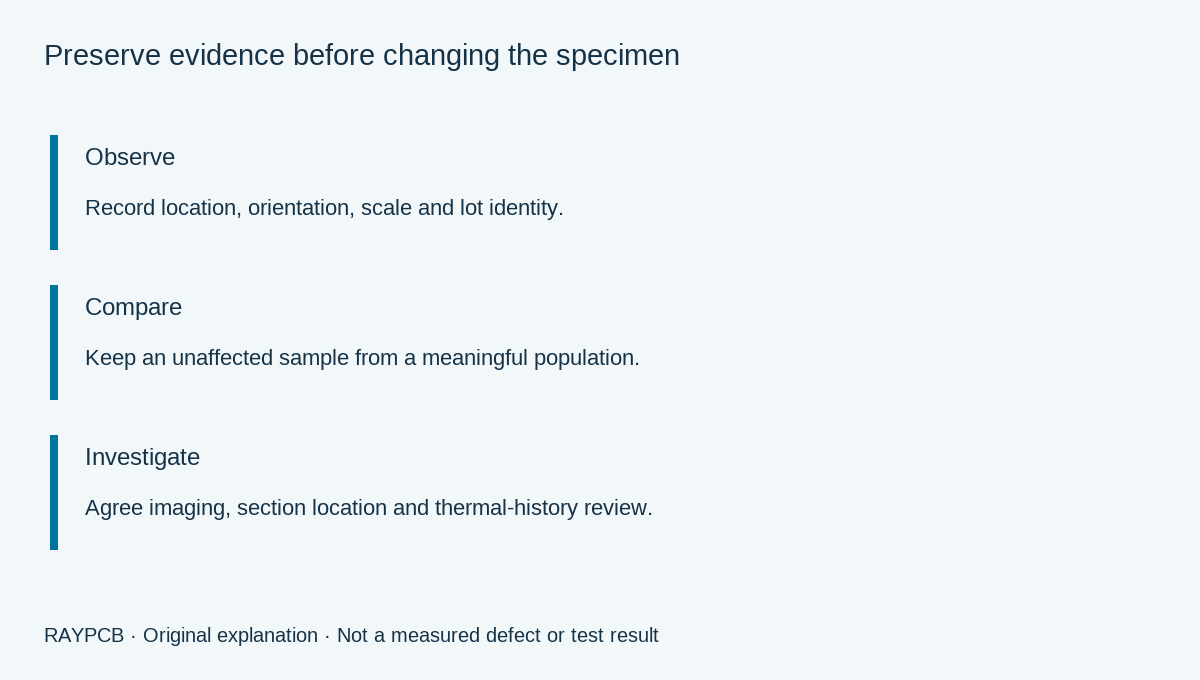
Preserve specimens and choose analysis locations deliberately
Retain an untouched affected specimen when possible. Record how it was packed, transported and stored after the finding. Avoid cleaning, peeling, bending, sanding, baking or repeated reflow on that retained specimen before agreeing the analysis plan. Each action can change a surface or extend a separation, making it harder to distinguish the original condition from handling damage. A separate specimen may be used for an approved trial, with that distinction recorded.
Non-destructive inspection and destructive sectioning answer different questions. A section can show the local relationship between layers and interconnects, but one cut does not map an entire board. Select the location and orientation from the observed feature and the investigation question. Photograph the sample before preparation, retain orientation marks and identify the preparation procedure. A polished image without specimen identity, location or scale is weak evidence for a lot-level conclusion.
Electrical continuity may be useful for locating an affected connection, but a passing continuity check cannot show that every bonded interface is sound. Likewise, a visible separation away from a conductor does not by itself establish its service consequence. Agree which structural, electrical and application requirements are relevant. If accelerated exposure is proposed, use a PCB reliability qualification plan rather than treating extra heating as an informal proof of recovery.
Prepare a delamination investigation brief
RAYPCB ENGINEERING
Reliability DefectsDelamination investigation brief
Loading Delamination investigation brief…
The worksheet organizes the observed condition, discovery stage, specimen identity, thermal history and planned evidence. It deliberately keeps “electrical failure without visible separation” separate from a directly observed split. Open items remain visible in the result; the tool does not convert a complete checklist into a diagnosis or permission to use the board.
Start with your project reference and sample identifiers. If a history is missing, select the unresolved option instead of inventing a temperature or storage interval. Download the text record and attach it manually to the enquiry with relevant photographs and documents. The Contact page does not automatically receive worksheet entries, and the email action opens a draft rather than sending information. You can request an engineering review without completing the worksheet.
Example: a blister discovered after a second assembly pass
Consider an illustrative case in which a small group of boards shows raised areas after the second assembly pass. The remaining boards have no visible change. An efficient first report would identify board lots, panel positions, both assembly passes and whether the same inspection was performed after the first pass. It would not immediately state that moisture or an excessive peak temperature was proven.
A controlled investigation could retain affected boards, comparable unaffected boards and any available unassembled material. The team could then compare measured thermal records, material traceability and local structural evidence. If only one panel region is involved, that distribution deserves investigation alongside the thermal history. If every sample was subsequently baked before analysis, the report should acknowledge that the original specimen condition has changed.
This example describes a reasoning sequence, not a RAYPCB customer case or a promised laboratory service. Specific analysis availability, sample quantities, preparation cost and turnaround must be confirmed for the enquiry. A useful conclusion states what was observed, which explanation is supported, which alternatives remain possible and who authorized the disposition.
Connect containment, corrective action and the next build
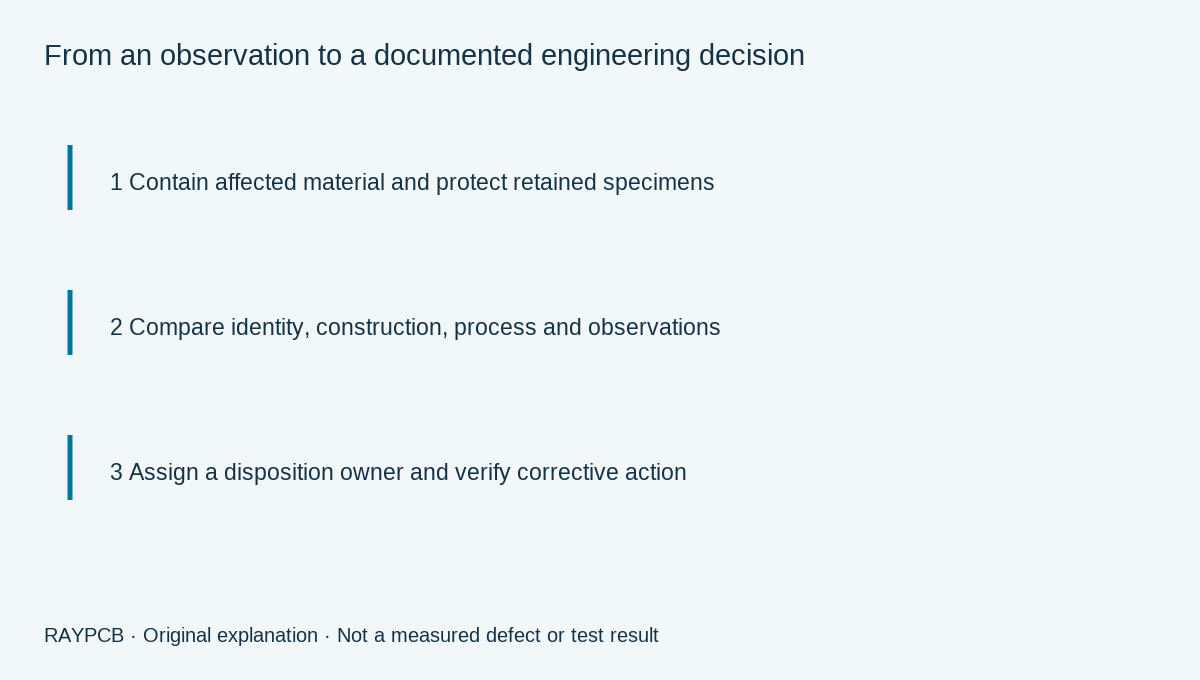
Containment identifies which material is held and which shipments may be affected. Corrective action addresses a supported cause and includes evidence that the change works. These are different records. A replacement shipment can solve an immediate supply problem while leaving the investigation open. Keep the responsibilities and decision dates visible so purchasing, fabrication and assembly do not interpret the same email differently.
For the next build, define the approved construction, assembly exposure, required coupons or reports and acceptance reference. If the investigation changes a material or pressing sequence, make that change explicit in the released documentation. Avoid a purchase-order note that merely says “prevent delamination”; it gives no reproducible requirement or verification route. A requirement should identify the object, condition, method and responsible reviewer.
To discuss a new fabrication or a documented failure review, contact RAYPCB with the drawing revision, board quantity, observed stage and evidence available. The PCB manufacturing service remains the commercial route for a revised build. Do not ship samples for destructive examination until the scope, handling and authorization are agreed.
Questions about PCB delamination
Can a delaminated PCB be repaired by baking?
Baking is not proof that a separated interface has rebonded or that an interconnect is reliable. Any proposed recovery needs a defined procedure, acceptance basis and authorized disposition. Preserve investigation specimens before treatment.
Does a passing electrical test rule out delamination?
No. Continuity and isolation tests address their specified electrical conditions. Structural separation may require different evidence, and a passing result should not be expanded beyond the test's scope.
Is every blister a laminate failure?
No. First identify whether the feature involves laminate, solder mask, coating or another material. The relevant interface and process history determine the next investigation step.
What should accompany a failure-review enquiry?
Provide sample and lot identity, drawing revision, photographs with scale, discovery stage, storage and thermal history, comparison specimens and the acceptance document. Clearly separate observed facts from suspected explanations.
Bring the observation and supporting evidence together
Send the board revision, construction, quantity and the quality or reliability question you need reviewed. Identify unresolved requirements so the response can address them.
Send requirements for reviewOptional: attach the downloaded worksheet manually. This guidance does not certify a design, approve a shipment or replace the applicable authorized standards.