
RAYPCB · ENGINEERING REFERENCE
OSP vs ENIG: Handling, Assembly & Total Cost
Compare the complete assembly route, including storage, probing and later soldering. Identify which evidence is needed before changing between OSP and ENIG.
Original engineering guidance · References checked September 27, 2026
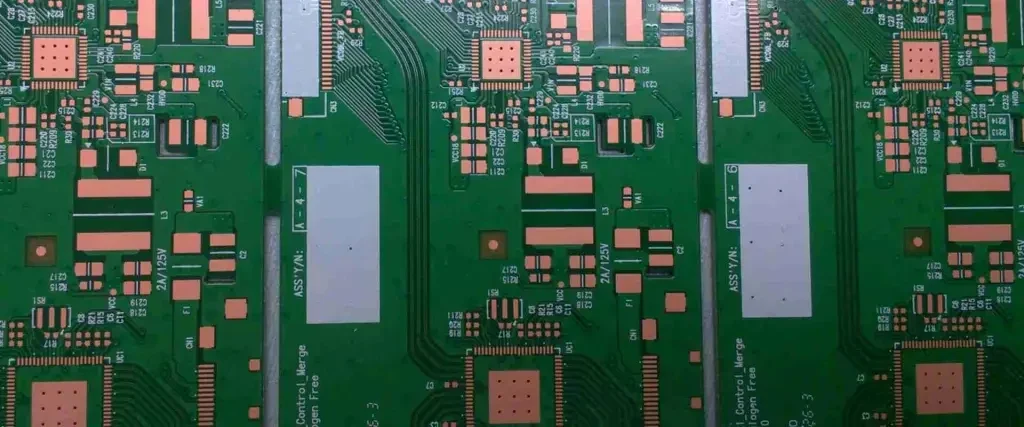
OSP vs ENIG is a comparison of the complete assembly route
OSP protects copper with an organic film; ENIG presents a nickel layer capped with immersion gold. Both can support a flat soldering surface, but they behave differently in handling, probing and the sequence before the final solder joint is made. A useful decision considers when the board will be assembled, which operations it will see, and whether any exposed land must remain an electrical contact after assembly.
Choose neither finish from color or an assumed shelf-life number. A controlled production flow with defined packaging and soldering operations is a different problem from a spare-board program with uncertain open storage and later rework. Document those differences before asking for a price comparison. A lower initial board price is not a demonstrated lower total cost if additional handling, trials or reprocessing were omitted from the offer.
This comparison addresses selection between two routes. Use the OSP process guide for that finish's fabrication and handling context, and the ENIG PCB guide when specifying a nickel/gold construction. The broad surface finish guide remains the owner when more than two finish families are being considered.
Compare requirements under matching conditions
| Project condition | OSP review question | ENIG review question |
|---|---|---|
| Soldered SMT lands | Is the full soldering route supported for this coating? | Is the specified metal finish supported by the assembly route? |
| Multiple heat exposures | What happens to unsoldered lands through each step? | What evidence covers the planned sequence and rework? |
| Electrical probing | Does the probe strategy account for the organic film? | Are the pad geometry and probing process defined? |
| Exposed contact after assembly | Is this retained function actually qualified? | Is the contact function qualified, including any wear? |
| Storage | What packed and open conditions are allowed? | What packed and open conditions are allowed? |
| Cost | Which handling and process controls are included? | Which deposited-layer controls and evidence are included? |
The comparison should use the same component set, board revision and delivery condition. If one supplier quotes bulk-packed boards and another includes controlled packing or extra inspection, the figures are not directly comparable. Resolve those scope differences first. The objective is not to make both offers identical at any cost; it is to understand which requirements and responsibilities each price actually covers.
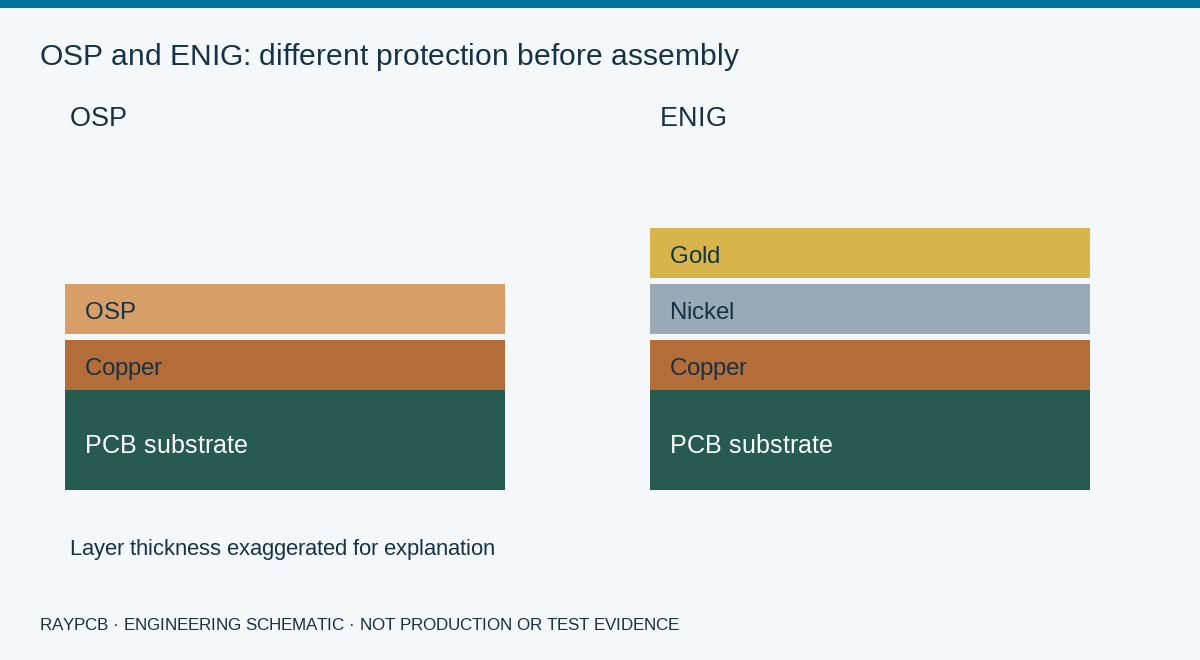
The section drawing separates organic protection from metallic layers. It is an explanatory schematic, not a scaled depiction of coating thickness. Once soldering occurs, the joint is a new interface; the original finish label alone does not describe its resulting metallurgical structure or lifetime. For design decisions, connect the incoming board condition with the real assembly process rather than treating them as separate purchases.
Track unsoldered pads through every operation
Begin with a route sheet that lists receiving, storage, unpacking, first-side reflow, second-side processing, selective soldering, cleaning, testing and expected rework. Not every project uses every step. Identify which copper lands remain unsoldered at each point, because those are the surfaces that must still function later. A count such as “two reflows” is less informative than the actual sequence and conditions surrounding those reflows.
The IPC-4555 public scope covers high-temperature OSP for lead-free soldering and emphasizes controlled deposition and measurement. It is not evidence that every OSP chemistry tolerates any number of reflows or any storage environment. Confirm the actual coating system and qualified route. For ENIG, similarly use the contracted requirements rather than assuming that gold appearance removes all handling constraints.
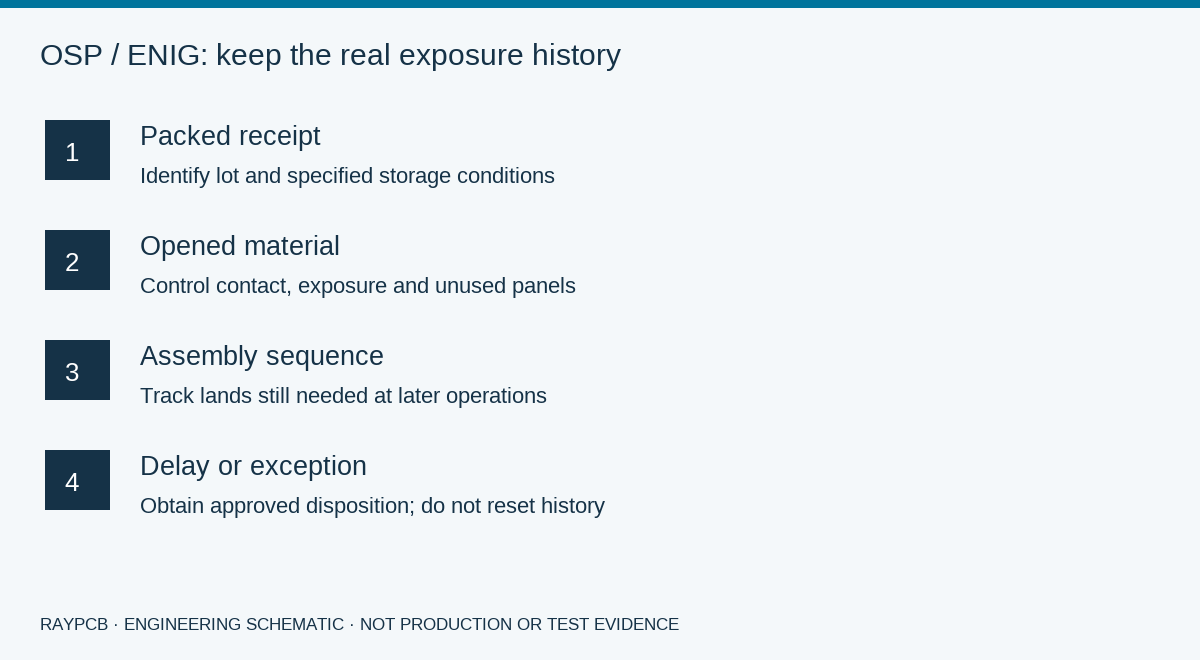
An illustrative double-sided assembly may solder most lands during reflow while leaving connector holes for a later operation. Review the condition of those remaining lands at that later step, including intermediate cleaning or storage. If the connector is installed weeks after the main build, that delay belongs in the qualification discussion. The finish decision should follow that real route, not a simplified diagram showing immediate uninterrupted assembly.
Review handling, probing and assembly evidence
This worksheet records the planned route and makes uncertainty explicit. It does not predict months of shelf life or select a finish by adding arbitrary scores. You can identify a controlled storage plan, uncertain open exposure, probing needs and a retained contact function. The result tells you which requirement needs evidence before you release the board or compare complete costs.
RAYPCB ENGINEERING
Finish ComparisonOSP / ENIG assembly-route review
Loading OSP / ENIG assembly-route review…
For example, selecting multiple operations and uncertain storage produces an open requirement to document the route and storage conditions. It does not claim that ENIG automatically solves the uncertainty. If a retained contact is selected, the output requests a contact-system review. That prevents a solderability comparison from accidentally approving a repeatedly mated pad. Downloaded briefs describe your entries and assumptions; attach them manually to any enquiry.
Storage and handling are specifications, not slogans
Define the packing condition, storage environment, allowed time after opening and disposition of unused panels. Identify how operators may handle the board and how material is tracked between operations. Both finishes deserve a controlled process. Avoid language that encourages touching ENIG pads merely because they are more visually durable than an organic film. Contamination can be relevant to either assembly route.
Where the schedule is uncertain, ask for instructions covering that uncertainty. Do not improvise a bake, cleaning treatment or reapplication process from a generic web article. Such actions can change the surface or the board and should follow an approved procedure appropriate to the finish and laminate. If a lot has unknown exposure history, record it and request a disposition instead of resetting its shelf-life clock in a spreadsheet.
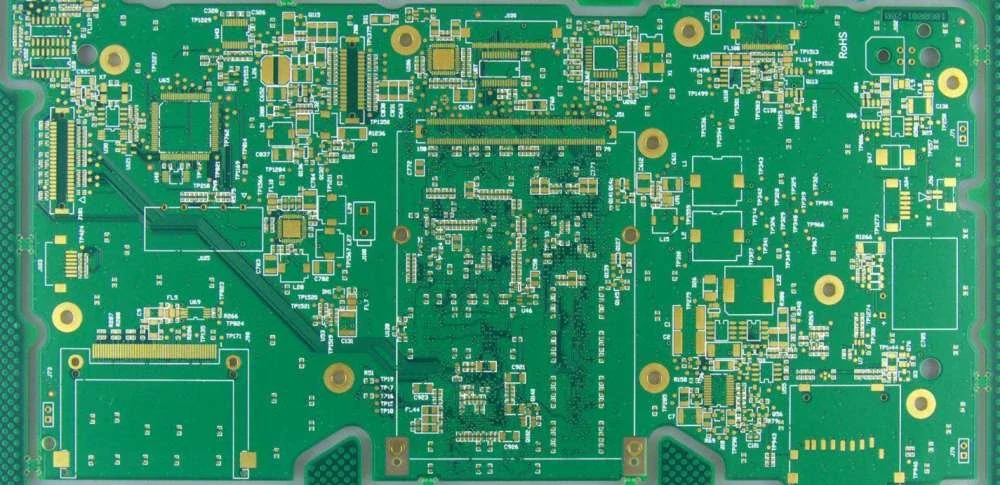
This ENIG image is a physical-board reference from the existing library. The visual difference from exposed copper helps explain the two routes, but it cannot prove remaining solderability or storage life. An incoming check should use identification, records and the agreed inspection plan. A photograph is useful for documenting damage or unexpected appearance, yet it is not a substitute for a defined test where one is required.
Probes and retained electrical interfaces need separate attention
An OSP-coated test land has an organic surface layer that must be considered in the probe strategy. Whether that is acceptable depends on the test method, probe, force, pad geometry and approved process. Record the intended test access at design review. Moving a probe onto an unplanned land late in production can create a new requirement that the original finish selection never addressed.
ENIG also requires a defined test and contact arrangement. A thin immersion-gold surface is not automatically a long-life sliding contact. Distinguish one-time or limited production probing from a connector used repeatedly in service. If the design contains a wearing contact zone, compare appropriate selective gold processing using the immersion gold versus electroplated gold guide. The rest of the board can retain its independently specified solderable finish.
RF conductors introduce another distinction: changing the exposed surface may change the physical conductor system. Do not infer the electrical impact from a finish cost chart. Preserve the RF requirement and request an appropriate analysis or measurement when the exposed trace matters. The lack of a nickel layer in one candidate is a structural fact, not a universal frequency threshold or a guarantee of a particular insertion-loss improvement.
Compare complete allowances without invented yield savings
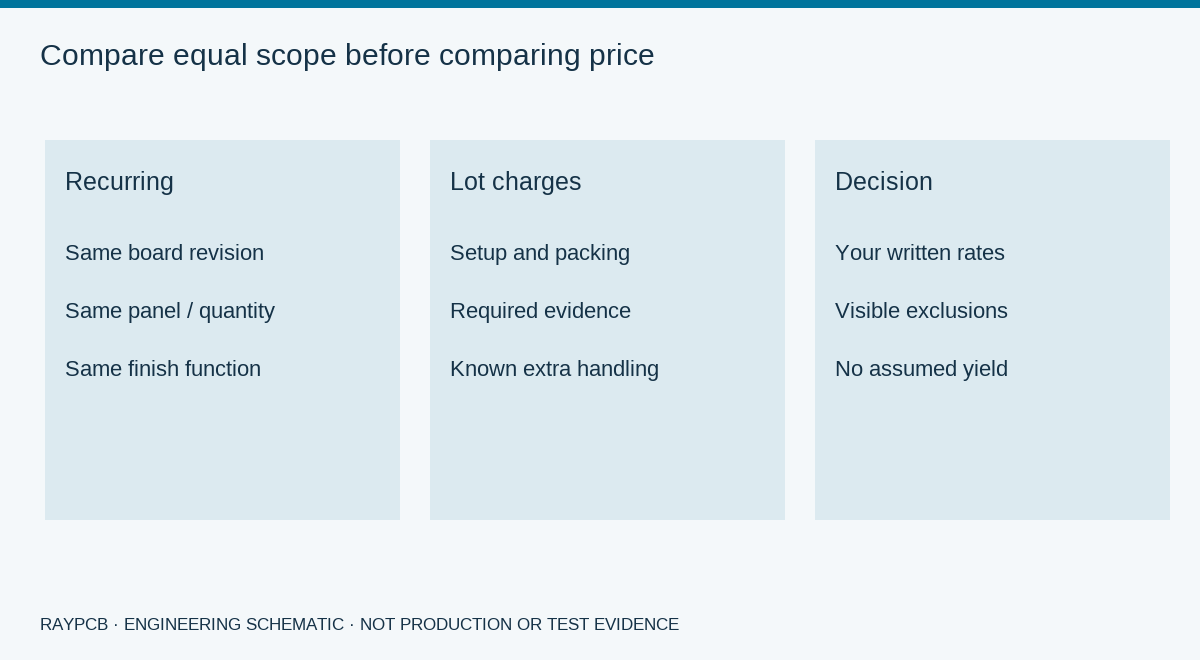
A useful cost sheet separates the board or finish allowance, setup, packing, documented testing and any route-specific handling. Keep the same quantity and panel definition in both columns. Use current written figures when available and label assumptions where they are not. Do not multiply a generic FR-4 cost by an unsupported OSP or ENIG factor and present that number as a quote.
The two-option finish allowance worksheet accepts OSP and ENIG as alternatives. Its arithmetic is deliberately simple: recurring allowance times ordered quantity, plus one-time and other lot charges. It neither predicts yield nor assumes a finish-related failure rate. If you have measured rework data, review that data separately with its sample conditions and process history before deciding how it affects a commercial estimate.
Suppose one option needs an extra approved inspection costing 80 currency units per lot, while the other already includes equivalent evidence. Enter the additional charge only where it is excluded. Do not add it to both options or omit it because it is not a bare-board charge. This example is bookkeeping guidance, not a statement that either finish inherently requires that inspection or that its price is 80.
A useful release and change-control example
Consider a high-volume assembly already running with a documented OSP route. A proposal to change to ENIG because it “looks more reliable” should identify a concrete problem and the expected benefit. Ask whether there is an actual storage issue, a new package, a retained-contact requirement or an assembly defect with supporting evidence. If none has changed, the proposed substitution still needs review; it is not justified by appearance alone.
Now consider the same product moving to irregular low-volume builds with partial panels stored after opening. That is a meaningful route change. Document the revised storage and handling needs, then compare finish candidates and their qualified conditions. The outcome could involve a different finish, different lot scheduling, better packing or a combination. The key is to solve the new production requirement instead of treating the chemistry name as the entire solution.
Send the board revision, intended assembly sequence, test access, storage expectations and candidate finishes through Contact. If no coating chemistry has been approved, identify that as an open question. A well-framed enquiry helps the fabrication and assembly teams respond to the actual risk while keeping exact price and manufacturability subject to the supplied files.
OSP / ENIG questions
Is OSP limited to one reflow?
Do not use a universal count. The chemistry and qualified process route matter, including time, temperature, atmosphere and the condition of lands needed later. Request evidence for the actual sequence.
Does ENIG eliminate storage controls?
No. Packing, contamination, environmental exposure and lot history remain relevant. Specify the required conditions and use the supplier's agreed handling and disposition instructions.
Which finish has the lowest total cost?
That depends on equal-scope quotations and the documented manufacturing route. Compare recurring and lot charges without inventing yield, rework or shelf-life savings.
Can I use the calculator instead of a fabrication review?
No. It organizes requirements and arithmetic. It does not read Gerber data, qualify a coating or approve a finish substitution. You may enquire directly if information is incomplete.
Bring the requirement and the drawing together
Send the board revision, construction, quantity and the standard or engineering question you need reviewed. Identify unresolved requirements so the response can address them.
Send requirements for reviewOptional: attach the downloaded worksheet manually. This guidance does not certify a design, approve a shipment or replace the applicable authorized standards.