
RAYPCB · ENGINEERING REFERENCE
PCB copper foil: specify the foil, surface and evidence
Compare electrodeposited and rolled foil, treatment surfaces and procurement data. Build a specification comparison that keeps starting copper separate from finished board copper.
Original engineering guidance · References checked September 30, 2026
What does PCB copper foil actually specify?
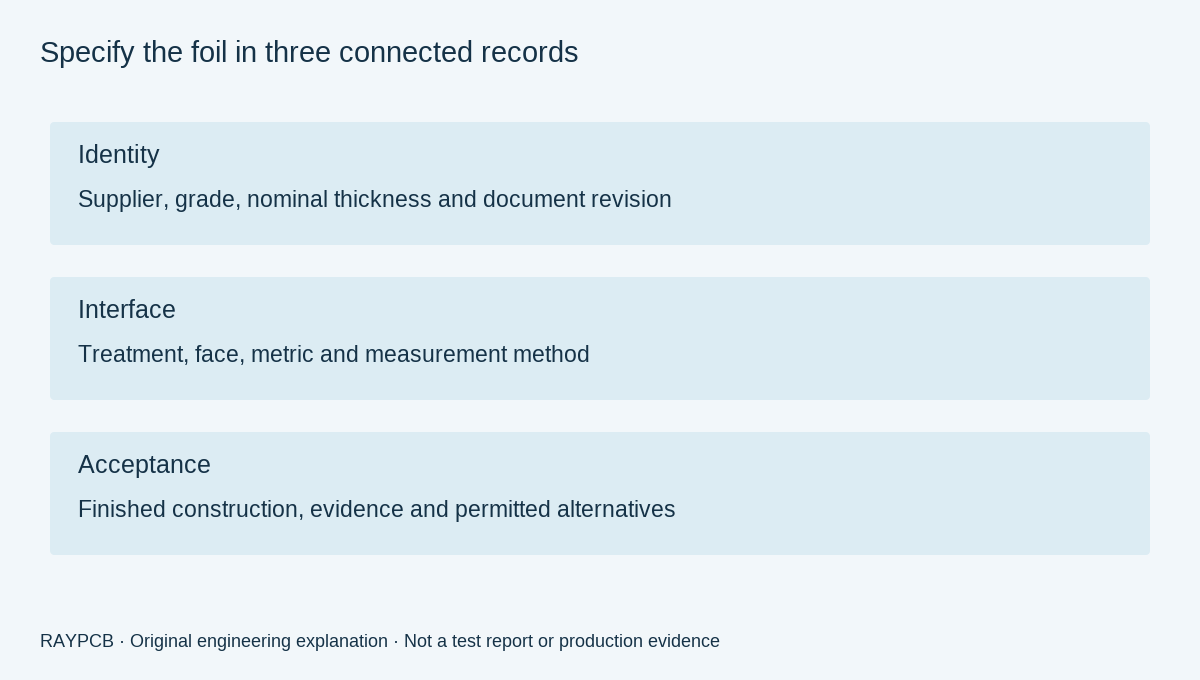
PCB copper foil is the starting conductive sheet used to form circuit features. Its purchase description needs more than copper weight: identify the manufacturing route, nominal thickness, treatment, bonding surface and supporting specification. The finished conductor can differ from the incoming foil after plating, etching and surface preparation. A statement such as “one ounce copper” therefore leaves important manufacturing and acceptance questions unanswered.
For a rigid multilayer design, the useful question is whether the foil works with the selected resin system and conductor geometry. For a moving flexible circuit, the question includes mechanical behavior after processing and under the specified bend conditions. For an RF transmission line, the copper-to-dielectric interface and the roughness model deserve attention. Those tasks overlap, but they do not justify a universal ranking of foil types.
Start with the function of each copper layer. Then record the proposed supplier product and ask what evidence supports it. This page owns foil selection and purchasing details; the broader PCB material directory helps select the substrate family, while the IPC-4562 guide addresses how a foil standard fits the purchase specification.
Electrodeposited, rolled and treated foil
Electrodeposited copper is produced by depositing copper from an electrolyte onto a rotating drum before further treatment. Rolled foil is produced through mechanical reduction and may receive an annealing treatment. Both descriptions identify a route, not a complete electrical or mechanical specification. The foil thickness, microstructure, treatment and processing history influence what a finished circuit can do.
Do not assume that every electrodeposited foil has the same coarse surface, or that every rolled foil is suitable for every dynamic bend. Suppliers offer specialized products within each route. JX Advanced Metals' circuit-board material overview includes both rolled and electrodeposited products for flexible circuitry. Its product categories are a useful reminder to compare a grade and application instead of rejecting an entire route by name.
| Description | What it identifies | What still needs specification |
|---|---|---|
| Electrodeposited, or ED | Copper production route | Grade, elongation conditions, treatment and roughness |
| Rolled / rolled annealed | Mechanical reduction and stated heat treatment | Rolling direction, bend construction and qualification |
| Reverse-treated foil | Treatment applied to a selected foil surface | Supplier definition, treated side and bonding orientation |
| Low-profile description | A supplier's surface-profile category | Metric, measurement method and actual product data |
| Carrier-supported thin foil | Thin copper handled with a carrier system | Functional copper thickness, carrier removal and process compatibility |
RA, ED, RTF, VLP and similar abbreviations do not sit on one common scale. Some describe production; others describe surface treatment or a product family. A drawing that lists “RA or VLP equivalent” mixes categories and leaves the substitute poorly defined. Replace it with a functional requirement and a named construction, with an agreed substitution process.
Identify the surface that will bond to the dielectric
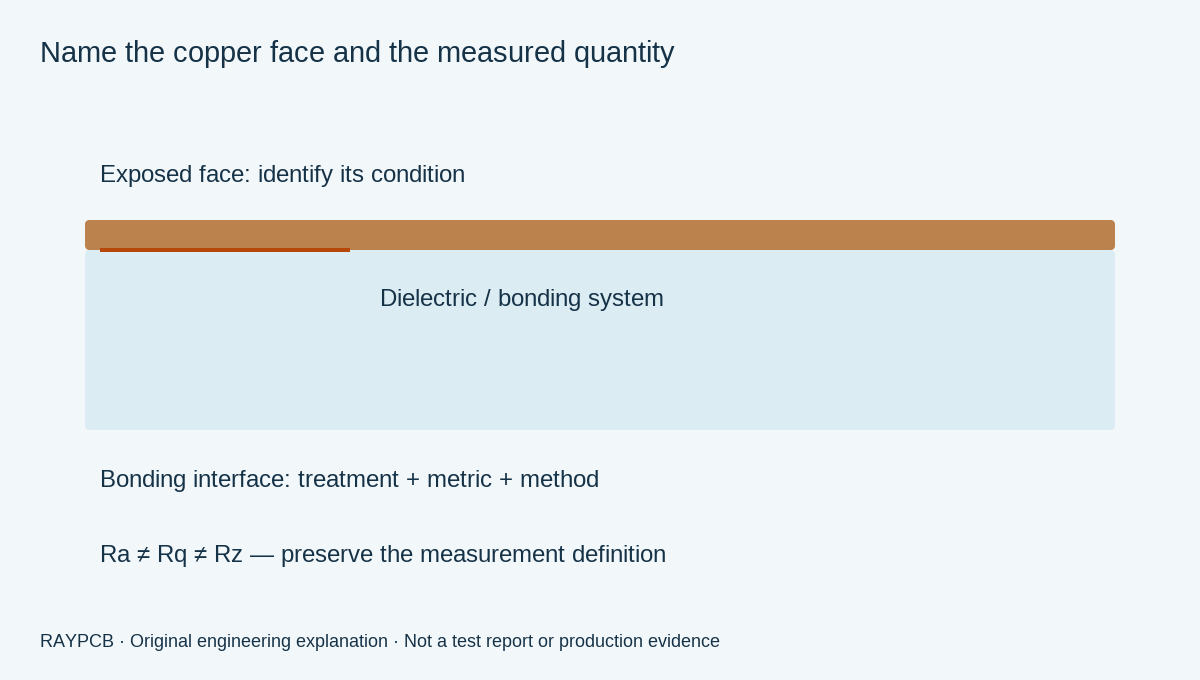
A foil has two faces, and their original and treated conditions may differ. Identify which face is bonded to the dielectric, which faces another bonding layer and which remains exposed during fabrication. This is especially useful when comparing supplier roughness reports: an attractive number for the wrong face cannot characterize the actual RF interface.
Surface treatment has several possible purposes, including adhesion promotion and protection during handling. Its compatibility belongs to the laminate system and fabrication route. Changing only a commercial foil name can change the interface that was used in a previous material qualification. Ask the laminate supplier or fabricator to describe the intended combination rather than selecting treatment solely from a photograph.
Roughness terms must keep their definitions. Ra is an arithmetic profile quantity; Rq describes a root-mean-square profile quantity. Rz depends on the stated measurement definition. Areal quantities such as Sa are not automatically interchangeable with profile quantities. Even two values carrying the same abbreviation require compatible filtering, sampling and measurement conditions before they can support a procurement comparison.
For RF work, continue to the focused copper roughness and skin-depth guide. That guide separates a simple physical calculation from insertion-loss prediction. This purchasing page does not recommend a universal roughness limit or convert between unrelated surface metrics.
Starting copper and finished copper are different requirements
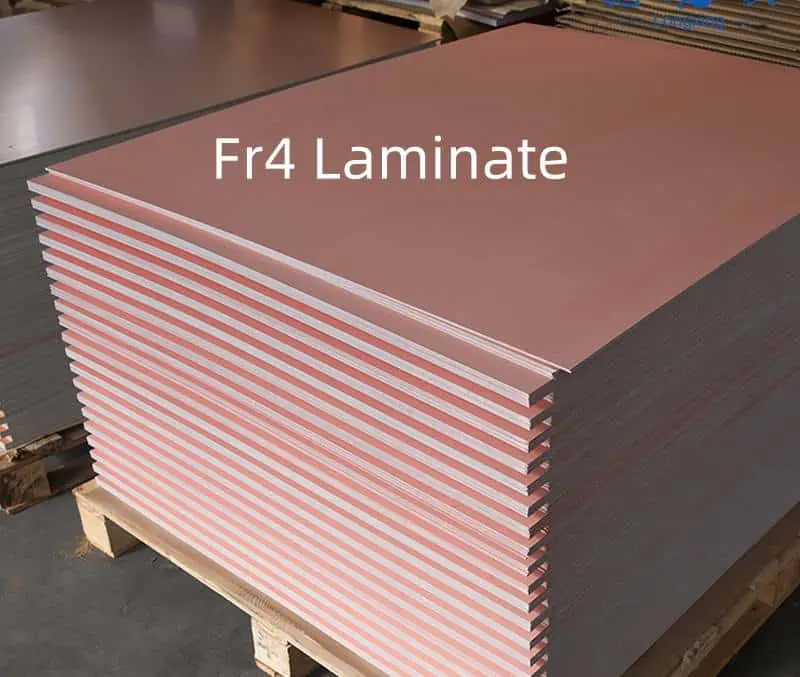
Incoming foil thickness is only one part of the final conductor geometry. Outer layers commonly receive additional copper in a plated-board process. Etching changes the lateral conductor profile, and subsequent preparation may remove copper. Inner and outer layers therefore need explicit, layer-specific requirements instead of a single ambiguous board-wide copper-weight field.
The nominal mass of a uniform copper sheet can be estimated from thickness and density. Using an assumed copper density of 8.96 g/cm³, a 35 µm sheet contains approximately 313.6 g/m². This is an arithmetic reference, not a measured certificate value. It excludes carrier material, treatments and any later deposited copper. A foil supplier's ordering designation and applicable tolerances remain the purchasing authority.
State whether a drawing value describes starting foil, finished conductor thickness, or a minimum verified at an agreed location. A cross-section result from one location is not interchangeable with a nominal roll specification. The report should make it possible to connect the drawing requirement to the measurement performed. Thickness data without this distinction can make two otherwise valid quotations look inconsistent.
Compare foil specifications without inventing equivalence
RAYPCB ENGINEERING
Material EvidenceCopper foil specification comparison
Loading Copper foil specification comparison…
Use the worksheet to enter two proposed foil descriptions, their nominal thicknesses and their reported roughness quantities. It computes nominal areal mass and checks whether the roughness metric and declared measurement context match. A mismatch is a request for better information, not proof that one supplier has an inferior product.
The sample uses fictional candidates so the numbers cannot be mistaken for an approved laminate option. If both suppliers report the same metric and context, the tool shows their numerical difference. It still cannot validate instrument calibration, filtering settings, specimen preparation or the truth of the entered report. Keep the original documents with the exported comparison.
For example, changing the second roughness metric from Rq to Rz should suppress the direct numerical comparison. The thickness calculation remains available because it uses a separately stated assumption. This distinction lets an engineer keep useful information while refusing an unsupported conclusion. Download the current brief or open an email draft when the comparison is ready for discussion; neither action submits a manufacturing order.
Match the foil decision to the circuit task
For a fine-line rigid board, discuss starting thickness, etch compensation and available process routes together. Thicker starting copper can change the geometry challenge, but there is no universal trace-width limit derived from thickness alone. The proposed finished dimensions and tolerances need to be checked against the actual process and inspection method.
For flexible circuitry, describe static installation bends separately from repeated motion. Record the bend axis relative to the foil direction where it matters, local construction, coverlay, copper pattern and installed geometry. Supplier mechanical data and representative tests support that review. A favorable elongation number by itself does not predict the fatigue life of an assembled flex circuit.
For high-frequency circuitry, freeze the laminate grade, foil option, dielectric thickness and surface-finish route used in the electrical model. Reducing one roughness parameter cannot compensate automatically for a different conductor width, dielectric loss or launch structure. A material comparison becomes meaningful when those other variables are controlled or their effects are explicitly modeled.
For multilayer construction, the inner-layer treatment and the bonding resin also matter. The bondply and prepreg comparison explains why the bonding layer should have its own construction record. Copper, resin and treatment should be reviewed as a combination rather than as three unrelated catalog choices.
A foil purchasing record that survives a substitution
| Record item | Useful evidence | Follow-up if missing |
|---|---|---|
| Identity | Manufacturer, exact grade and document revision | Request the current product specification |
| Thickness | Nominal, tolerance and stated copper condition | Resolve starting versus finished copper |
| Surface | Treatment code, face and roughness method | Obtain an oriented construction description |
| Mechanical behavior | Test direction, condition and applicable property | Match the test to the proposed use |
| Laminate pairing | Approved foil / resin combination | Review compatibility with the fabricator |
| Traceability | Lot reference and change-control route | Define records required with the order |
A useful substitution request lists each changed property and which prior evidence remains applicable. “Equivalent copper” is too broad when the board relies on a specified RF interface or repeated bending. Conversely, demanding identical trade names may unnecessarily restrict procurement if the actual engineering requirements can be met and documented by another construction. Agree the level of control before the purchase order.
Cost should be evaluated at board level. Foil availability, material minimums, usable panel area, conductor processing, inspection and qualification can influence the quotation. This article deliberately avoids presenting an unverified market-price table for foil grades. Send the required construction and order quantity to the manufacturing review team to determine what can be supplied for the project.
Worked review: same thickness, different evidence
Suppose two quotations both describe nominal 35 µm copper. Candidate A includes an Rq value for the bonding face, measured under a named procedure. Candidate B lists only “low profile” and a roughness value without identifying the face or metric. The starting thickness is comparable at a descriptive level, but the roughness evidence is not yet comparable. Do not turn that information gap into a numerical supplier score.
Request the missing method and surface designation first. Next confirm whether the proposed resin and foil option match the electrical or mechanical construction already evaluated. Finally, record any necessary coupon or representative-board verification. This sequence separates document completeness, design compatibility and production acceptance, making the approval decision easier to audit later.
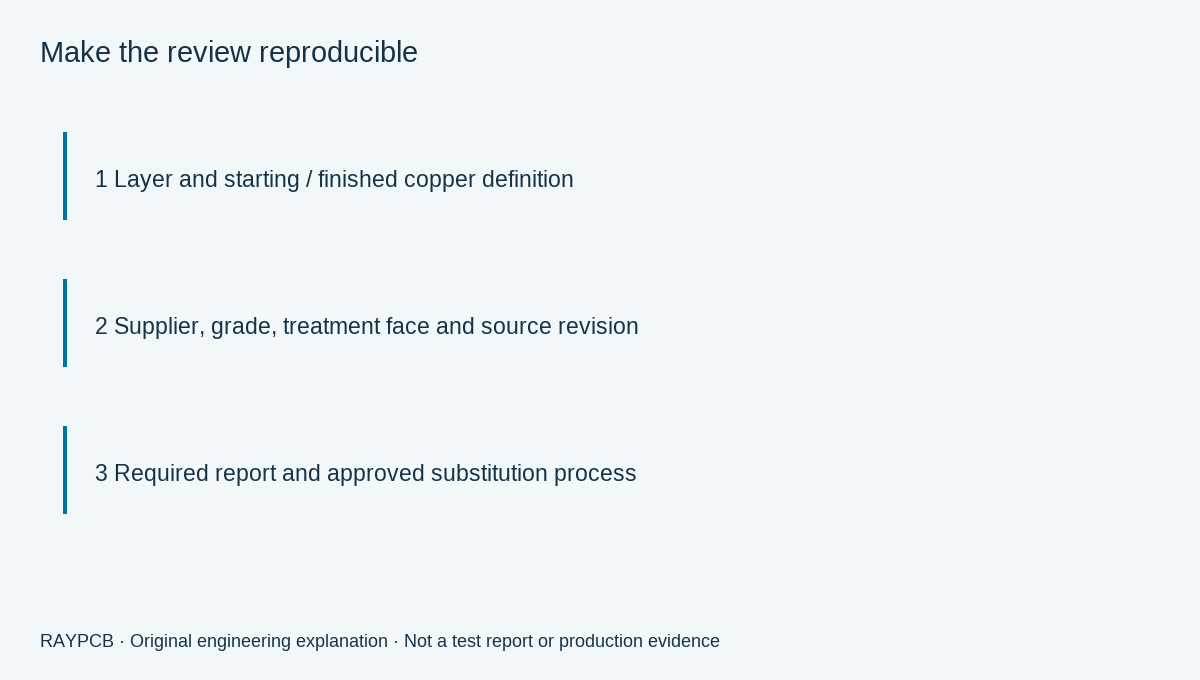
Before releasing the drawing, list the layers affected, foil identity or permitted alternatives, the required finished-copper condition and the evidence expected with the shipment. Keep RF and flex-specific notes attached to the relevant layers. The broader PCB manufacturing service can then be discussed against a coherent construction instead of a collection of isolated material claims.
Copper foil questions
Is rolled copper always better than ED copper?
No. Compare the exact grades for the intended electrical, mechanical and processing conditions. Specialized ED and rolled products serve different requirements. A production route alone does not establish finished-board performance or a permitted bend life.
Can I replace Rq with an Rz value in a model?
Not without the model's required conversion method and evidence that it applies to the actual measured surface. A generic multiplier can conceal incompatible definitions and measurement settings. Obtain the parameter required by the selected model.
Does copper weight prove finished trace thickness?
No. It may describe the incoming foil rather than the conductor after fabrication. State the finished requirement separately, including measurement location and acceptance conditions, and confirm how the fabricator interprets the drawing.
What should I send for a foil-related quotation?
Send the board revision, stackup, quantity, copper requirements by layer and any exact supplier grade or mandatory evidence. Include RF or bend conditions when relevant. If the grade is undecided, explain the task so alternatives can be reviewed deliberately.
Bring the requirement and the drawing together
Send the board revision, construction, quantity and the standard or engineering question you need reviewed. Identify unresolved requirements so the response can address them.
Send requirements for reviewOptional: attach the downloaded worksheet manually. This guidance does not certify a design, approve a shipment or replace the applicable authorized standards.