
RAYPCB / PCBA purchasing
PCB assembly quotes: compare scope first
Align BOM, supply responsibility, setup, programming and test before comparing batch totals. Turn unexplained price differences into specific review questions.
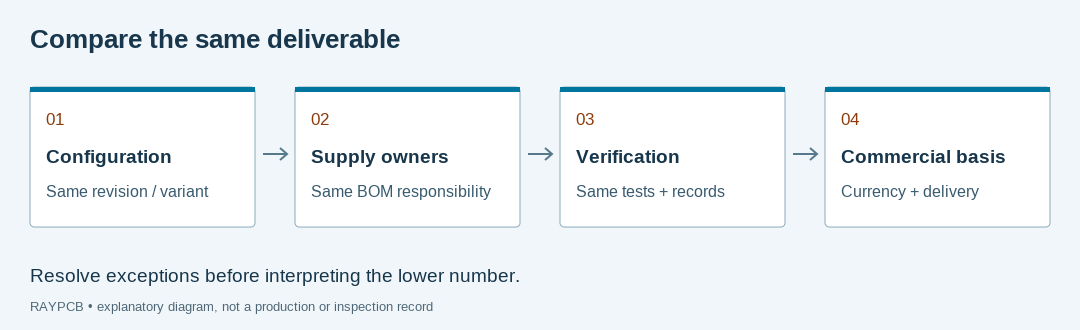
Compare the same assembled product before comparing price
PCB assembly quotes are comparable only when they describe the same board revision, BOM variant, quantity, sourcing responsibility, assembly operations and verification scope. A quotation for placement labor cannot be compared directly with a turnkey offer that includes bare boards, components and testing. The first useful question is “What will we receive?” rather than “Which unit price is lowest?”
This page helps purchasing and engineering teams reconcile two offers. It does not generate a binding quotation or rank suppliers. For the underlying service scope, see PCB assembly services. If you only need unpopulated boards, the separate bare-board quote comparison addresses fabrication-specific requirements.
| Check | Same basis means | Stop and clarify when |
|---|---|---|
| Configuration | Same PCB, BOM, variant, firmware and quantity | One supplier priced an older file package |
| Delivered scope | Same procurement, assembly, test, packaging and records | Testing or components are excluded in only one offer |
| Commercial basis | Understood currency, NRE, excess material and delivery terms | The totals include different liabilities or destinations |
Give every bidder a controlled RFQ basis
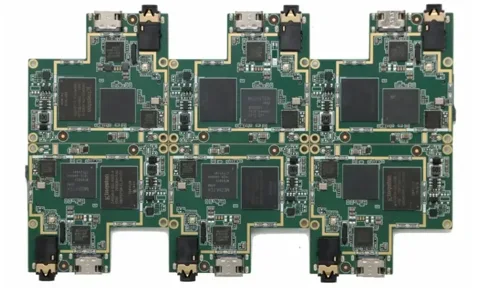
Use one reference for the PCB drawing, fabrication package, BOM, placement data and assembly drawing. Include the intended variant and clearly marked do-not-populate positions. If firmware programming is included, identify the image or release procedure and the required verification. A schematic helps resolve questions but does not replace the released placement and assembly instructions.
Record the requested lot quantity and any alternatives as separate quantity breaks. Clarify whether the quantity is assembled boards, panels or sets of several boards. State the required test outputs and acceptance documents, not simply “test required.” The PCBA file preparation guide explains the complete data handoff; this comparison page focuses on what the resulting offers include.
If an engineering answer changes the scope during bidding, issue the same clarification to each candidate whose offer you intend to compare. Preserve the dated answer with the RFQ reference. Otherwise, the newer quote may appear more expensive simply because it includes work that the earlier quote did not know about.
Read the cost structure without double counting
Ask the offer to distinguish bare-board supply, component procurement, recurring assembly operations and one-time work where practical. One-time work may include stencil preparation, machine setup, fixture development or programming setup. A recurring test-execution charge is different from the cost of developing and approving a test fixture.
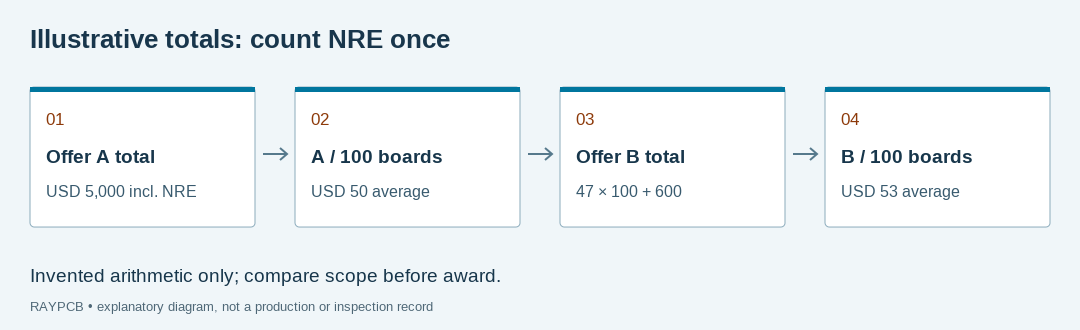
Not every supplier presents the same line-item detail. A combined unit price can still be valid if its scope is unambiguous. Do not add the component cost again when it is already included in that unit price. Similarly, a stated NRE charge must be counted once in a batch total, then divided by quantity only when calculating an average unit cost.
Illustrative arithmetic: Offer A totals USD 5,000 for 100 boards, including USD 500 NRE. Its average is USD 50 per board, with NRE included once. Offer B shows USD 47 per board plus USD 600 NRE, so its batch total is USD 5,300. The headline USD 47 does not make B cheaper on this arithmetic. Neither offer should be selected until their scope and terms also align.
Compare excess-stock liabilities separately. A supplier may need to purchase a minimum pack quantity larger than the build requires. Establish who pays for the excess, who owns it, where it is stored and what happens when a design change makes it unusable. An apparently lower batch charge may leave additional commitments outside the visible total.
Check component sourcing and substitution authority
Confirm the manufacturer part numbers, approved alternatives, sourcing channels and any date-code or traceability requirements. A similar description or package is not sufficient evidence that two parts are interchangeable. Electrical ratings, qualification needs, firmware compatibility and mechanical details can all matter to the design owner.
If the customer supplies some parts, label those lines clearly and ask how incoming inspection, shortages and attrition will be handled. A quote should say whether customer-supplied inventory has been assumed available or actually checked. Purchasing responsibility, physical custody and technical approval may belong to different people.
The component responsibility worksheet provides a way to record those owners. Do not infer a responsibility from the word turnkey alone. An agreed scope can include exceptions, such as a customer-supplied processor, provided the boundaries are explicit and every offer uses the same arrangement.
Inspection, functional testing and records are different deliverables
Ask what will be inspected, what will be electrically exercised, how the test is defined and which records will be supplied. AOI, X-ray, in-circuit testing and functional testing answer different questions. Listing a machine does not define defect coverage or prove that the quoted board will undergo that method. State the relevant assemblies and features, the agreed method and any exceptions.
IPC J-STD-001 and IPC-A-610 have different roles: assembly process/material requirements and acceptance criteria are not identical documents. Specify the agreed revision and product class where applicable. Do not use “IPC compliant” as a replacement for a test plan or for application-specific acceptance criteria.
Functional testing needs inputs, limits and a defined expected result. Establish who supplies firmware, fixtures, cables, loads and any protected credentials. Separate developing the test from running it. If a fixture is not ready, keep that dependency visible in both the schedule and the cost comparison rather than calling the board fully tested.

Compare two quote scopes
Mark each row aligned only when both quotations match the same common requirement, including the same agreed exclusion. Add the common scope reference and unresolved exceptions. Different quantities, currencies, revisions or unconfirmed scope rows withhold the numerical comparison. The worksheet does not read uploaded offers or verify what suppliers agreed.
RAYPCB ENGINEERING
Procurement and HandoffPCBA quote scope comparison
Loading PCBA quote scope comparison…
The optional worksheet needs JavaScript. Use the readable checklist above or contact RAYPCB directly.
Enter complete batch totals, including one-time charges once. The tool reports average amounts and a difference only after you mark the comparison basis aligned. Even then, “aligned” is your record, not independent validation. The smaller total is not automatically the best value; supply continuity, evidence quality and unresolved technical risk still require review.
Read the schedule and delivery conditions
Separate requested delivery from confirmed lead time and identify the start condition. An assembly schedule may depend on released files, material availability, customer approvals and test readiness. Compare the same milestone: ex-factory dispatch and arrival at your receiving site are not the same date.
Record quote validity and any components subject to repricing. Identify freight, insurance, duties and taxes as included, excluded or unresolved according to the actual offer. Do not turn an estimated freight allowance into a confirmed landed cost. Where trade terms are used, preserve the named place and the agreed rule rather than copying an abbreviation without its context.
Discuss engineering changes before award. Ask how unused material, work in progress, new tooling and revised testing are treated if the design changes. Repeat pricing may depend on reusing an approved fixture or existing setup. Confirm that those assets remain suitable for the new revision before assuming a recurring-only price.
Turn a discrepancy into a precise question
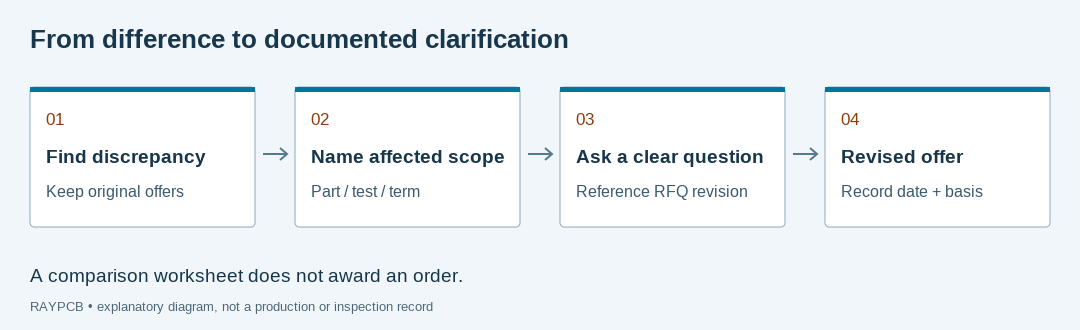
A useful clarification request names the RFQ revision, quote reference, affected line and desired confirmation. For example: “For the 100-board Rev B offer, please confirm whether functional-test execution is included, and price fixture development separately if it is not.” This gives the supplier a concrete question to answer and produces an auditable update.
Keep a comparison version and the date of each response. Do not silently edit one supplier's offer to make it look comparable. Document the normalized scope alongside the originals, and ask for a revised written offer when the difference affects price or delivery. A clean comparison supports a purchasing decision; it does not replace the organization's authorized approval process.
Common quote-comparison questions
Can I compare different currencies in this worksheet?
No. It intentionally withholds the price comparison. Agree a dated conversion basis outside the tool, including any fees or currency risk, and document the normalized values before using a common-currency comparison.
What if one quote excludes a test I do not need?
Confirm that the exclusion is appropriate for your product and align both offers to that same requirement. A lower price can reflect a legitimate narrower scope, but the decision should be explicit.
Is this an online quotation request?
No. It prepares a comparison brief on your device. You can contact RAYPCB directly with files and quantity options, with or without the worksheet. Downloaded information is not transferred to the form automatically.
Bring the open questions to RAYPCB
Send the project reference, available files, quantity options and the decisions you need help with. If you used the worksheet, review its assumptions and attach the downloaded brief yourself. Opening Contact does not send the worksheet or place an order.
Technical references and scope
These official references explain data, standards or handling concepts. Use the applicable controlled documents and project agreement for acceptance. Links do not certify RAYPCB, qualify a product or replace engineering approval.