
RAYPCB · ENGINEERING REFERENCE
Moisture-Sensitive Device Handling: MSL, Floor Life & Traceability
Reconcile component labels, exposure records and approved handling conditions. Track declared exposure without inventing a bake recipe or resetting floor life.
Original engineering guidance · References checked September 29, 2026
Preserve the handling record with the component
Moisture-sensitive device handling controls the exposure and storage history of components before the relevant thermal assembly operation. Moisture sensitivity level, or MSL, is part of a package classification and handling system; it is not a general shelf-life grade or an automatic instruction to bake every component. The actual package label, supplier information and approved procedure establish what conditions and records apply.
The practical challenge is continuity. A reel can move through receiving, stores, kitting, line setup, a production pause and return to storage. Its handling history must remain understandable through those movements. A timer is useful only when the material identity, conditions and starting state are known. An unknown interval cannot be made compliant by entering zero, and putting material into a cabinet does not by itself prove a floor-life reset.
This guide focuses on component traceability and decision records. It does not provide a universal baking table, override supplier instructions or treat bare-board moisture management as the same task. Use the worksheet to add declared exposure hours under an approved allowance. When history or conditions are uncertain, the result should support a hold and review, not an invented assurance that the material is safe to use.
Keep the key records distinct
| Record | Purpose | What it does not prove by itself |
|---|---|---|
| Component and package identity | Determines which documentation applies | That another package of the same device has identical limits |
| MSL and label instructions | Communicates the relevant handling classification and conditions | Unlimited shelf life or permission for any heating process |
| Moisture-barrier packaging | Supports the specified storage and shipping condition | That a damaged or unverified package preserved the condition |
| Indicator and desiccant evidence | Forms part of packaging review | A complete history of all previous exposure |
| Exposure log | Records cumulative known time and conditions | Recovery from unknown intervals |
| Authorized disposition | Defines the next permitted action | A universal bake or reset rule for all materials |
The TI product shelf-life guidance explains that post-delivery shelf life depends on packaging, material and storage factors. Do not confuse shelf life in controlled packaging with allowable floor exposure before assembly. Both may matter to a lot, but they answer different questions and need their own applicable evidence.
Inspect the package before releasing it to stores
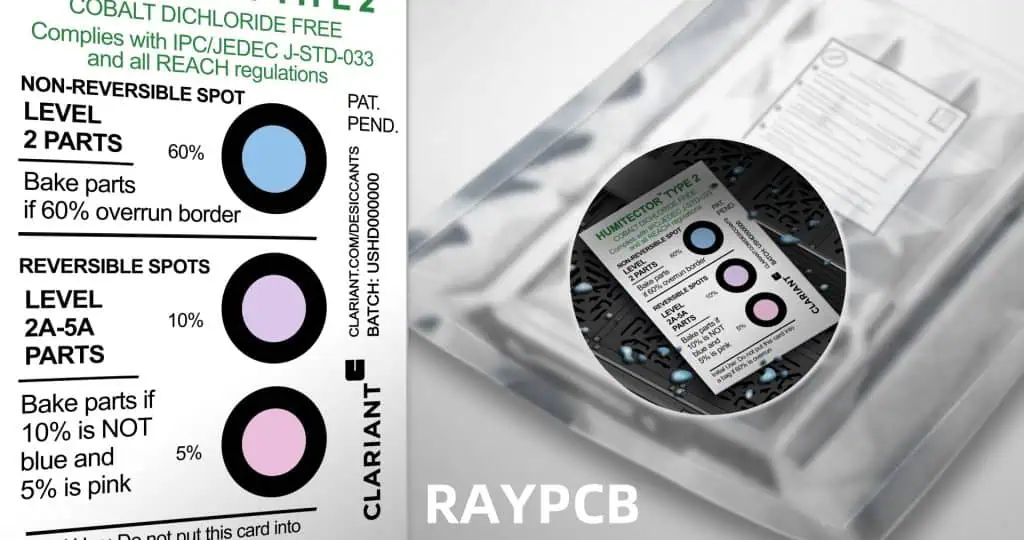
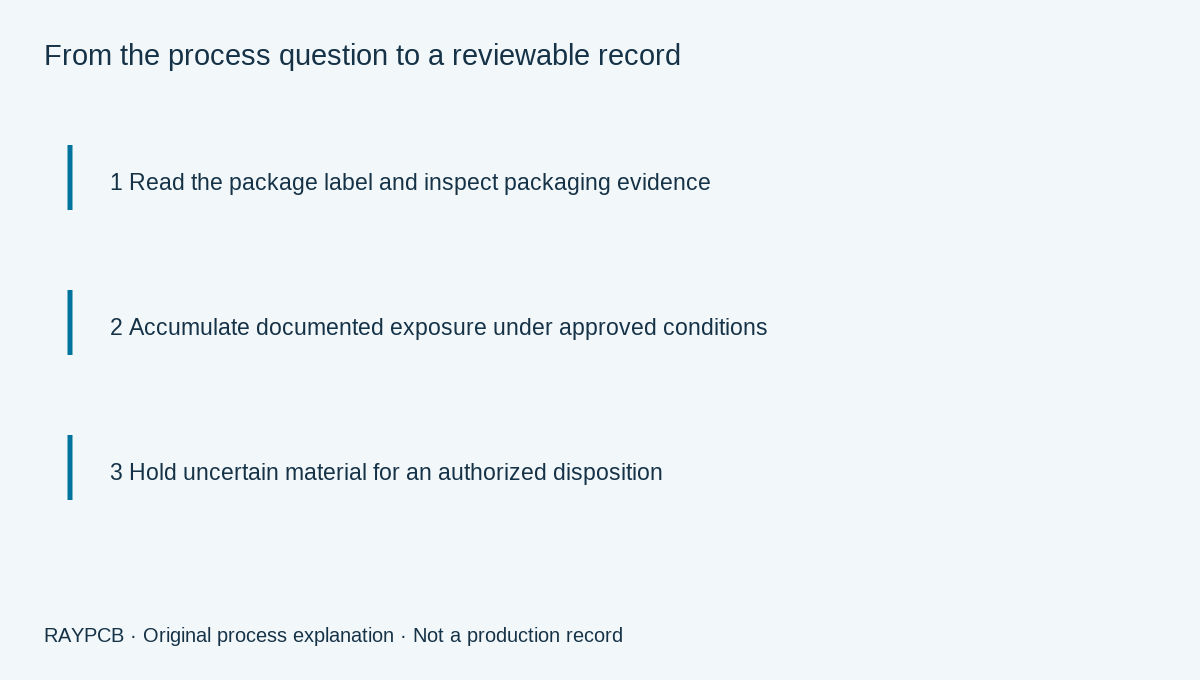
At receipt, identify the part, package, lot and supplier documentation. Review the condition and labeling of the moisture-barrier packaging where applicable. Record damage, uncertain seals or missing information before the material enters general stock. A receiving record should let the next person understand whether the package was accepted under a defined procedure or remains on hold for clarification.
Inspect humidity indicators and desiccant according to the applicable instructions. Do not reinterpret a card using a rule from a different material or packaging system. The meaning of an indication and the required response should come from the approved procedure. Photographs can support the record, but an image without the material identity and time is not a complete disposition.
The Renesas package handling guide highlights packaging integrity and the need to follow the identified handling conditions. Its component context should remain explicit. When handling material from another supplier, use that supplier's product and packaging information rather than assuming every table or example applies unchanged.
Start an exposure record with a known identity
When a package is opened, record the affected material quantity, time and applicable conditions. Identify the container or reel that will carry the record through production. If material is split into several containers, maintain the relationship to the original lot and history. A label attached only to the empty original bag is not enough to control the portions now on different lines.
Decide how exposure intervals are recorded and reconciled. The method can be electronic or controlled paper, but the units, responsibility and event definitions must be clear. Avoid mixing elapsed clock time, shift time and working time without explanation. If the approved allowance depends on environmental conditions, preserve evidence of those conditions rather than treating the timer as independent of the factory environment.
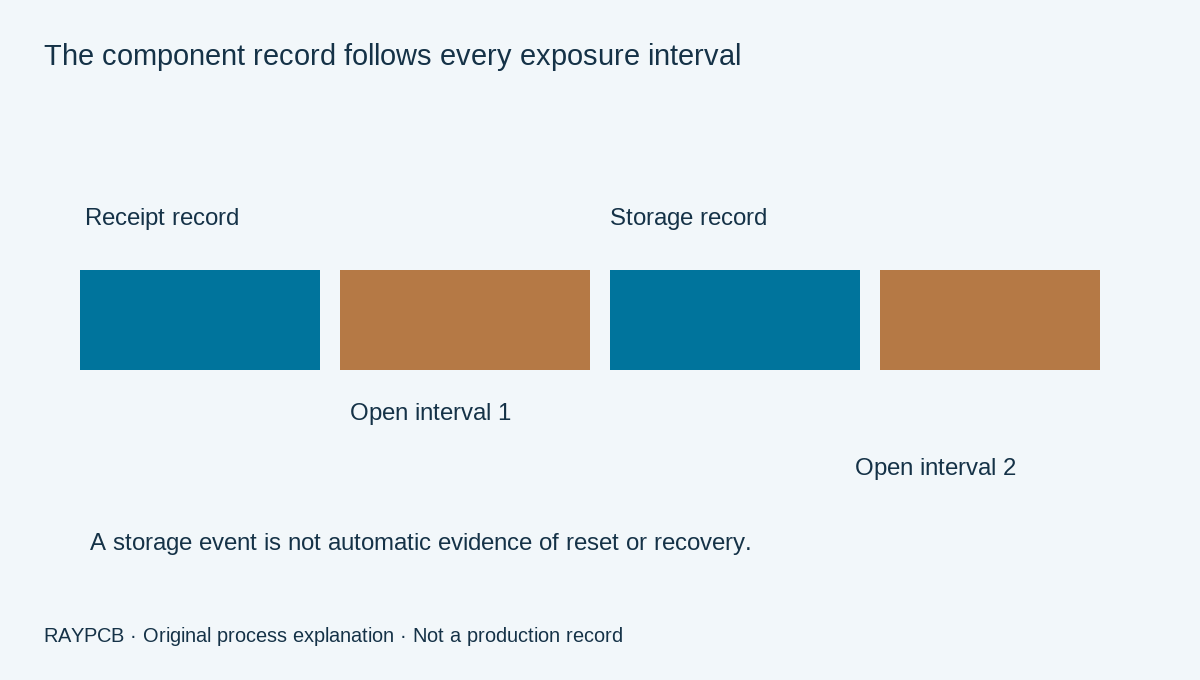
For an engineering review, a concise log might identify the initial state, each documented open interval, each storage event and the unresolved gaps. The point is to make the history reviewable, not to create a visually impressive dashboard. A simple record with clear ownership is more useful than an automatic countdown fed by uncertain timestamps.
A storage event needs a qualified meaning
Dry storage can form part of an approved handling system, but its effect depends on the specified conditions, material and procedure. Do not assume that any cabinet pauses every clock or restores every component. Record the storage equipment, relevant condition evidence and entry and exit events. The authorized procedure should define how those events affect the material's disposition.
If packaging is resealed, identify what packaging materials, method and documentation apply. A visually closed bag is not the same as verified moisture-barrier packaging prepared under an approved process. Likewise, replacing a label should not erase the previous exposure history. Keep the chain of records intact so a later review can distinguish valid controlled storage from an undocumented interruption.
Environmental excursions deserve a separate record. If temperature or humidity conditions are unknown or outside the approved basis, a simple subtraction of hours may no longer represent a usable allowance. The worksheet therefore retains arithmetic but marks the case for review. That distinction prevents a precise-looking number from concealing uncertainty about the conditions under which it was calculated.
Add declared exposure without inventing a reset
Enter the approved floor-life allowance in hours, earlier recorded exposure, the current interval and planned additional exposure. Then state whether the environmental conditions, full history and packaging evidence are documented. The result shows consumed time, arithmetic remaining time and the balance after the planned interval. Negative balances remain visible rather than being clamped to a reassuring zero.
RAYPCB ENGINEERING
Assembly SolderingDeclared floor-life exposure worksheet
Loading Declared floor-life exposure worksheet…
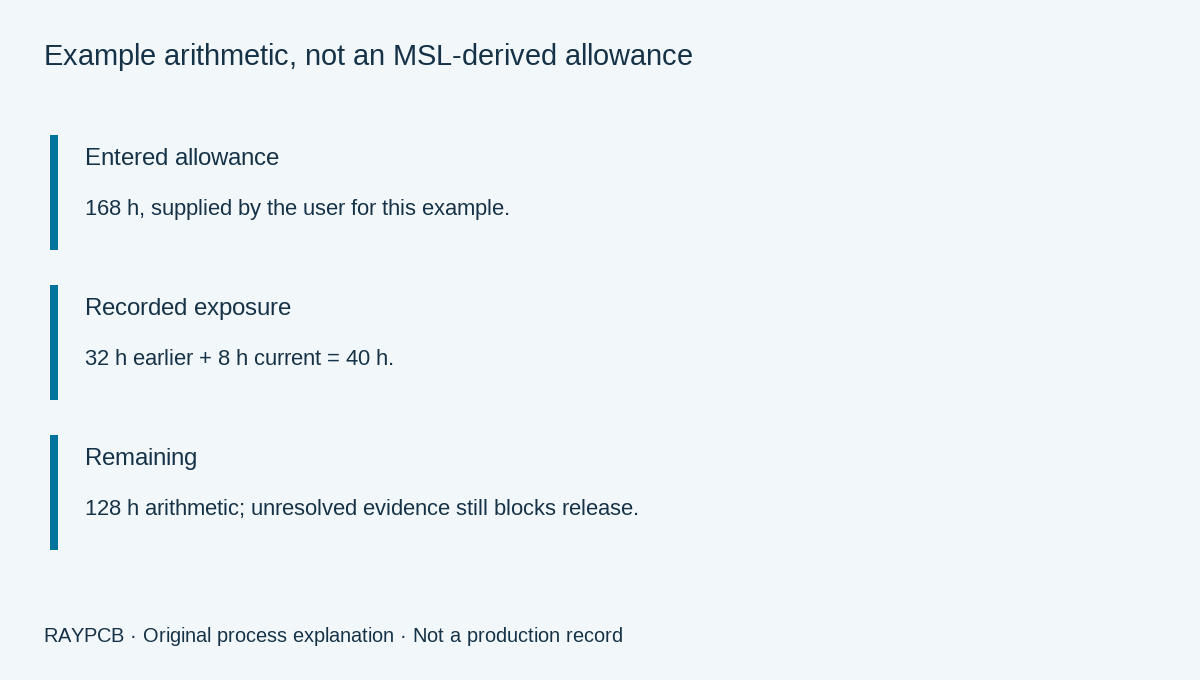
The example uses an entered allowance of 168 hours, with 32 earlier hours and eight current hours. That produces 40 hours consumed and 128 hours remaining arithmetically. It is not a universal MSL assignment. The tool does not map a classification to a generic table, apply dry-cabinet credits, calculate a bake or reset a clock. Any unresolved record prevents the arithmetic from being presented as a release permission.
Keep the underlying log with the downloaded brief. The brief records your declared values, not independently verified facts. Project mode begins empty, and editing invalidates the previous result. No material record is uploaded or transmitted by the worksheet. If you want an engineering review, manually attach the relevant labels and log to the inquiry through the approved contact route.
Plan for pauses, returns and split quantities
Production rarely proceeds exactly as the initial schedule suggests. A feeder issue, missing component or priority change can leave opened material waiting between operations. Define who updates the record and who decides whether material can continue. The handling system should cover the transition from the production line back to stores, rather than assuming that every opened quantity is consumed immediately.
For split lots, keep each portion's subsequent exposure identifiable. Two portions may share the same starting history but experience different line conditions afterward. Merging them without preserving that distinction can remove the evidence needed for a valid disposition. If the system cannot distinguish the histories, record that limitation and request an authorized decision instead of selecting the more favorable timer.
Repeated assembly passes also require attention to the complete component and product history. Moisture handling, permitted thermal exposure and cumulative reflow passes are related records, but one does not automatically replace another. Check the actual package guidance for the intended route. Do not assume that a completed first pass makes subsequent handling irrelevant or authorizes an unlimited number of additional heating operations.

Unknown history requires a controlled decision
When an allowance is exceeded or the history is incomplete, identify and contain the affected material while its disposition is determined. Record the reason for the hold and the evidence available. Avoid treating an arbitrary bake as an administrative way to clear the record. Drying conditions can depend on package characteristics, prior exposure, carrier limits and the applicable supplier and standards guidance.
The TI handling and process application note provides a component-manufacturer discussion of moisture-sensitive handling and drying. Use the exact product information and authorized procedure for the material concerned. This page intentionally does not reproduce a temperature-and-time table or choose a drying cycle from MSL alone.
The disposition record should state the action, responsible authority, material identity and evidence that permits the next step. If a supplier must clarify an uncertain lot history or packaging condition, retain that correspondence with the record. An instruction to proceed should be understandable at the point of use and should not depend on an undocumented verbal assurance from a previous shift.
Bring component handling into the assembly file package
For a consigned-material assembly, tell the assembler which components are customer supplied and what handling evidence accompanies them. Include supplier labels, lot identities and any known open-package history. Identify unresolved conditions before shipment. A quote based only on a BOM cannot account for every handling issue in material that arrives without a usable record.
Use the PCBA file and material preparation guide to align the material handoff with the assembly release. For broader procurement and production scope, the PCB assembly service page remains the commercial entry. This handling guide supports that decision without creating a competing turnkey-service page.
Specify which party owns incoming review, storage, exposure logging and exceptional disposition. If special records or customer-approved handling procedures are required, include them in the scope before the build. That makes responsibilities clearer and allows process-development or material-review effort to be discussed honestly. No calculator can replace agreement about who controls the material and its evidence.
Moisture-sensitive handling questions
Does MSL describe the unopened shelf life?
Not by itself. Review the supplier's packaging and storage information as well as the floor-exposure requirements. These are distinct decisions with different conditions.
Can the worksheet reset floor life after dry storage?
No. It only adds declared exposure and subtracts it from an entered allowance. Qualified storage and recovery procedures require their own evidence and authorized interpretation.
What if I do not know the earlier exposure?
Record the gap and hold the material for review. Entering zero would hide the uncertainty and could make a numerical result misleading.
Follow the applicable controlled documents
Use the IPC revision table to identify relevant joint IPC/JEDEC handling and classification documents, then use the authorized revision specified for the project. The distinction between classification, storage history and actual production disposition remains essential. This guide and worksheet do not certify component condition or approve a shipment.
Bring the assembly and process evidence together
Send the board revision, construction, quantity and the assembly process question you need reviewed. Identify unresolved requirements so the response can address them.
Send requirements for reviewOptional: attach the downloaded worksheet manually. This guidance does not certify a design, approve a shipment or replace the applicable authorized standards.