
RAYPCB · ENGINEERING REFERENCE
Kapton PCB: Film Grades, Expansion & Flex Design
Distinguish Kapton film from a finished flexible circuit. Match the film role, bonding route and thermal conditions to the drawing.
Original engineering guidance · References checked September 27, 2026
What does “Kapton PCB” actually identify?
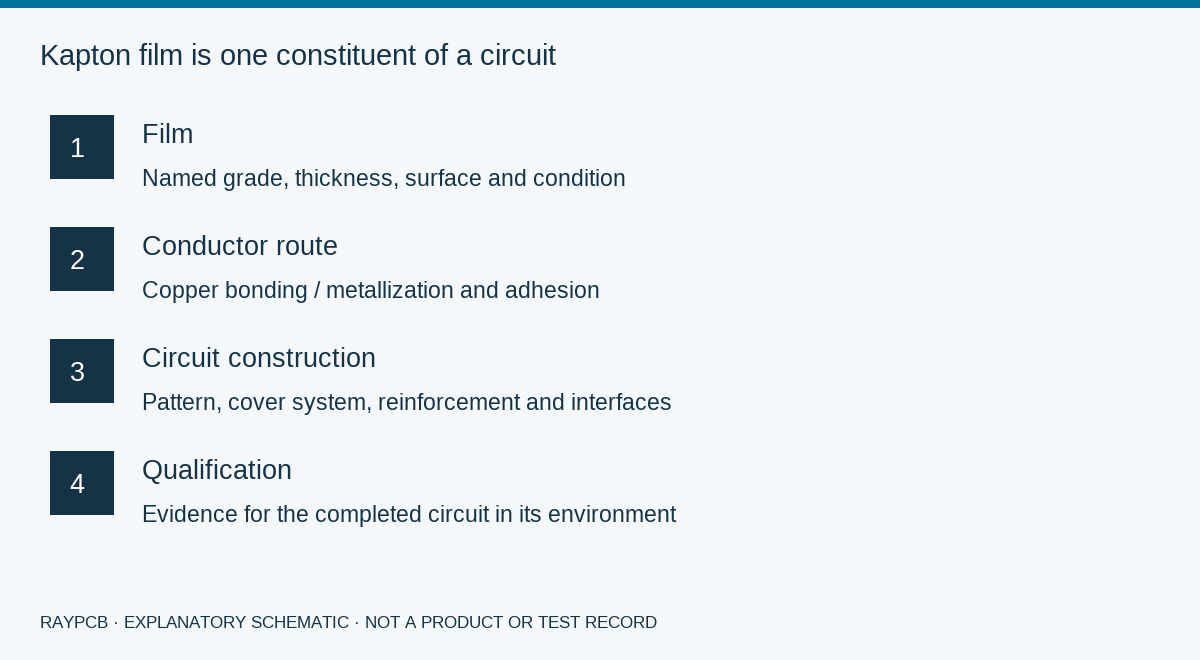
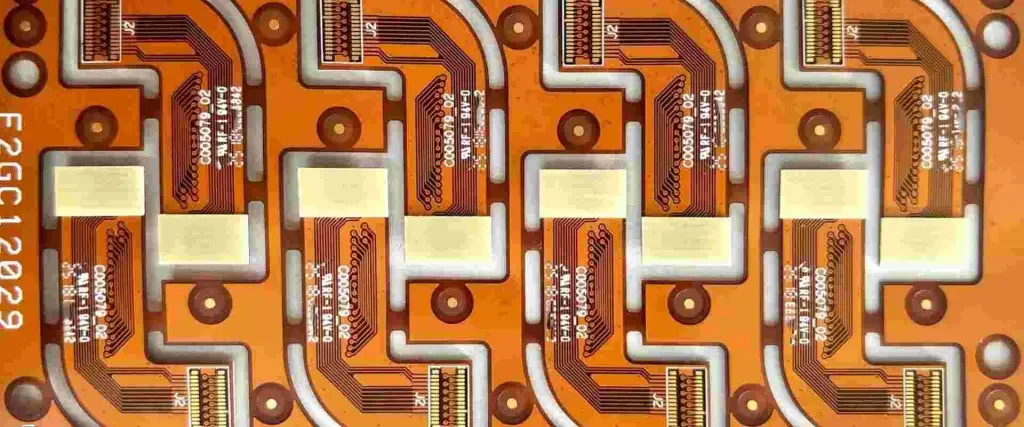
A Kapton PCB is a circuit whose construction specifies a Kapton polyimide film for a defined role. Kapton identifies a branded film family, not a complete finished-board specification. Copper, the bonding or metallization route, protective layers, local reinforcement and assembly materials still need their own definitions. A generic flexible PCB is not automatically a Kapton construction merely because it contains polyimide.
This distinction matters when a designer searches for temperature resistance, a purchasing team requests a particular brand, or an existing drawing needs a new manufacturing source. Those requests have different evidence requirements. The polyimide PCB overview addresses the wider material category; this page concentrates on film identity, dimensional behavior and the interfaces required to turn that film into a circuit.
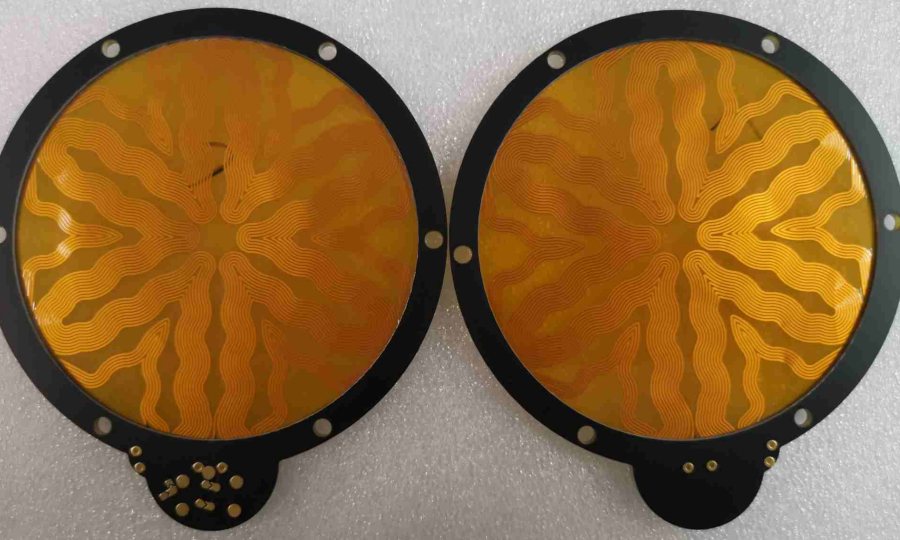
Current film information is available from Qnity, although historical drawings often say DuPont Kapton. Keep the film grade and its approved source document in the material record. A change of name in a web search must not become an uncontrolled change to the bill of materials. Conversely, a circuit photo cannot establish the branded film identity without traceable supporting records.
Choose the film role before comparing property numbers
The manufacturer's polyimide-film directory distinguishes several grades. HN is a general-purpose film; FPC addresses flexible printed circuitry; EN supports dimensional demands associated with fine circuitry; HPP-ST combines surface treatment with dimensional considerations; FN includes an FEP coating for a different bonding and heat-sealing role. These short descriptions are navigation aids, not an equivalence table or an approved substitution list.
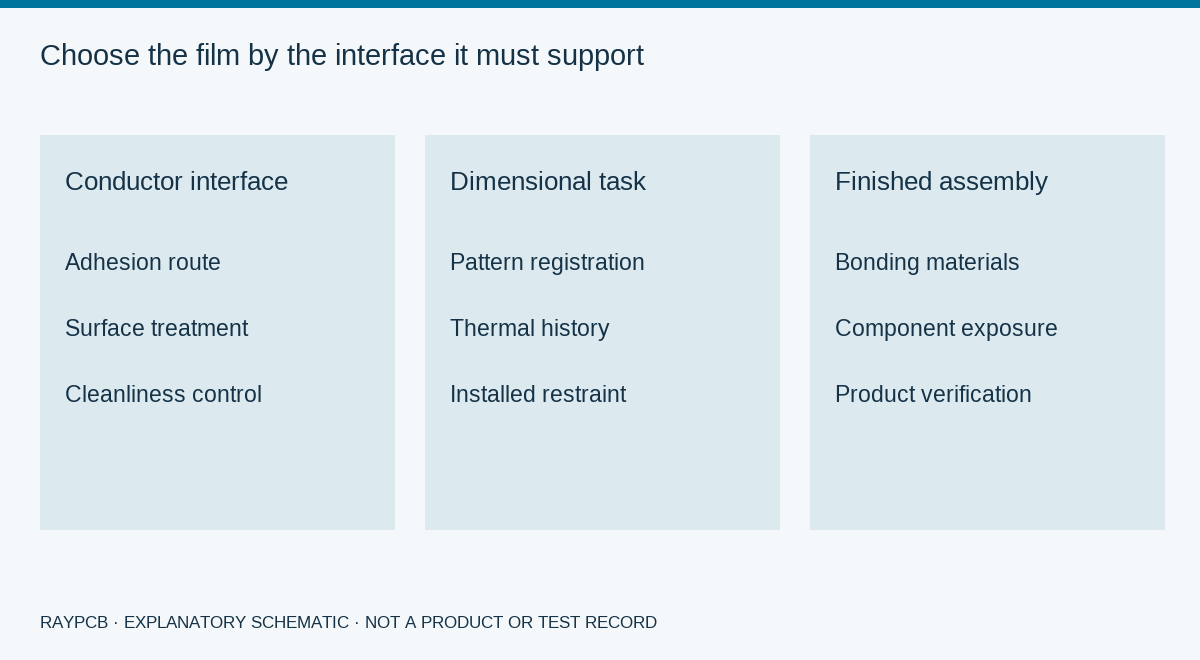
For a circuit drawing, use a decision table based on the interface and the evidence needed. It prevents a broad temperature claim from dominating a selection that actually depends on adhesion, pattern registration or a specific manufacturing route.
| Design question | What to specify | What the family name cannot settle |
|---|---|---|
| Film identity | Grade, thickness, surface and approved document | Finished-board material traceability |
| Copper interface | Bonding or metallization route and adhesion requirement | Peel performance after the chosen process |
| Fine pattern registration | Thermal history, dimensional target and measurement state | Compensation needed for your panel |
| Heat-sealed interface | Exact coating, mating material and process requirement | Suitability as a conventional circuit coverlay |
| Assembled product | Full construction and operating envelope | Service temperature or product lifetime |
Do not select a film solely because a nominal property is larger or smaller than another grade's value. Compare specimen conditions, test method and direction where relevant. The correct selection may depend more on the approved fabrication process and interfaces than on one isolated material number.
Film temperature data is not a PCB operating-temperature rating
A polyimide film can survive a laboratory exposure that a completed assembly cannot. The assembly also contains conductors, interfaces, adhesives, surface finishes, solder joints, components and mechanical restraints. Each has its own behavior under sustained heat and repeated cycling. A film test temperature therefore cannot be copied into a product description as a continuous operating rating for every Kapton PCB.
Separate three questions: what happens during processing, what happens during a short qualification exposure, and what happens during service. Record duration, atmosphere, moisture history, mechanical loading and the required electrical condition. A component attached to a circuit may impose a lower limit or a different failure mechanism than the film itself. Qualification must address the assembled product and its intended use.
If the requirement is a high-temperature interconnect, supply the actual duty cycle and acceptance criteria. If it is dimensional stability during manufacturing, identify the step that drives registration. If it is a thermal barrier, state the heat-flow geometry and interface conditions. These are different engineering tasks; one generic “heat resistant” label does not answer them.
Estimate free expansion within one documented HN interval
RAYPCB ENGINEERING
Pyralux MaterialsKapton HN Conditioned-Film Expansion
Loading Kapton HN Conditioned-Film Expansion…
The worksheet deliberately uses a narrow reference: thermally exposed 25 µm Kapton HN film, within 30–100°C, using 17 ppm/°C from Table 4 of QE-10206, March 2026. Both temperatures must lie inside that interval. The result estimates unconstrained length change; it excludes first-heating residual shrinkage and does not represent a bonded copper-clad structure.
The arithmetic is length change = starting length × CTE × temperature change. For a 100 mm free reference length heated from 30°C to 90°C, the estimated change is 100 × 17 × 10⁻⁶ × 60 = 0.102 mm. Cooling across the same interval gives a negative change. Enter the length at the stated starting temperature and keep the thermal history beside the result.
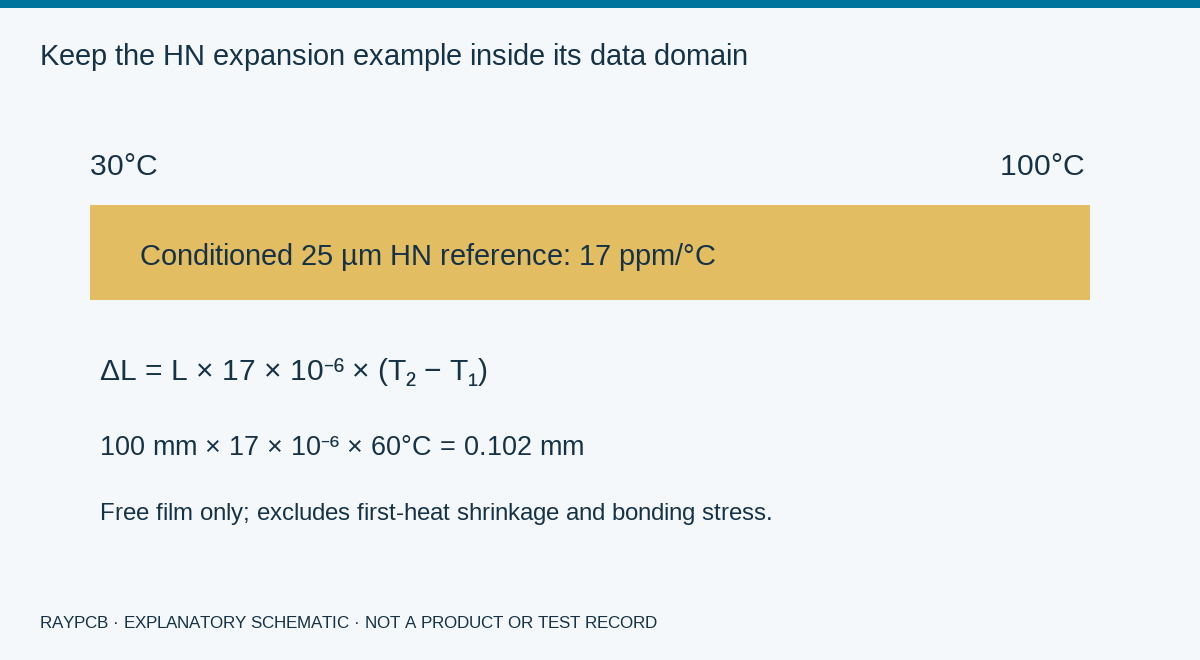
This example is useful for understanding scale, not for generating artwork compensation. A bonded structure can be constrained by copper and other layers, while first exposure and process history can introduce additional dimensional effects. For a production registration correction, obtain measured data for the actual material, panel, process and direction. The worksheet rejects temperatures outside the reference interval instead of silently extending a constant beyond its documented scope.
From insulating film to a manufacturable circuit
Start by defining how the conductor is attached and patterned. A film specification does not by itself describe copper foil type, metallization adhesion, finished conductor thickness or feature tolerances. The manufacturing release should identify the electrical layers and the insulating system that separates them, including any bonding material that influences spacing or mechanical response.
Then define the protective system. Coverlay openings must expose the intended pads while preserving the required insulation and local web. A film coating intended for heat sealing should not be substituted for an approved circuit bonding system without review. The Pyralux material overview helps connect film-related decisions to complete flexible-laminate and bonding constructions.
Local reinforcement needs an equally explicit definition. A connector tab can include a support layer that is absent from the moving span. Stiffener adhesive, coverage boundary and termination geometry affect both thickness and assembly handling. Identify the measurement region and relevant dimensions rather than specifying one overall thickness for a circuit whose construction changes along its length.
For a documented adhesiveless copper-clad route, review Pyralux AP construction selection. This does not mean every Kapton film grade is the dielectric used in every AP product. The film and laminate must retain their own supplier identity; combining related brand names without evidence is not a specification.
Translate the application into an engineering question
In an instrument interconnect, the main concerns may be compact routing, repeatable connector insertion and thermal drift near a sensor. The useful enquiry identifies the installed geometry and measurement requirements. A free-film expansion estimate can frame the dimensional question, but the supported, copper-patterned interconnect needs its own evidence if alignment is critical.
In a moving cable replacement, the useful information is the bending mission: stroke, restraint, cycle count, attached mass and operating temperatures. Conductor arrangement and local transitions deserve as much attention as the film label. A thin film does not guarantee long bending life in an assembly with sharp support transitions or unexpected twisting during installation.
In a compact electronics module, the flexible region may only be formed once to connect rigid sections. The priorities may instead be assembly access, local coverlay openings, connector fit and resistance to the specified assembly process. State which regions bend and which carry components. The flexible PCB design guide provides the broader layout context without making a particular film grade a universal answer.
Build a record that can survive a supplier change
Keep film grade, thickness, source revision, conductor route and bonding materials together. Separate required features from alternatives that may be proposed for review. When a supplier offers a substitute, request the comparison that matters to the project: dimensional behavior, adhesion after exposure, insulation, mechanical response or traceability. Matching nominal thickness alone is not sufficient evidence of equivalence.
Material receiving, process qualification and finished-circuit acceptance answer different questions. Incoming records establish what was supplied. Process evidence shows how the defined construction responds to the manufacturing route. Final checks evaluate the delivered circuit against agreed requirements. Plan those records before the prototype build if the results will be needed to qualify a later production source.
Budget for the complete film-to-circuit route
RAYPCB ENGINEERING
Pyralux MaterialsKapton PCB Documented Build Budget
Loading Kapton PCB Documented Build Budget…
The cost of a Kapton PCB depends on the completed construction and process, not a universal film-brand surcharge. Important inputs include available material format, circuit nesting, conductor processing, coverlay, reinforcement and the evidence required for the project. A quoted film price per area cannot be treated as the finished circuit price without accounting for these operations and their usable yield.
The budget tool uses your documented panel allowance, extra amount per ordered circuit and setup cost. Its illustrative values are not current market prices. If a panel allowance already includes coverlay or testing, do not enter the same operation again in the per-circuit field. Record currency and inclusions with the source so another reviewer can understand what has been counted.
For an actual response, send the drawing and material requirement with quantity, intended use, thermal conditions and any approved alternative policy. If you are still selecting a route, identify the unresolved interface or dimensional issue. The optional downloaded brief supports that conversation; it does not automatically attach files to Contact or approve the selected construction.
Questions about specifying Kapton PCB material
Does every polyimide flexible circuit use Kapton?
No. Polyimide is a material category, while Kapton is a branded film family. Use the supplier record and approved construction to establish identity rather than color or flexibility.
Can this worksheet predict expansion of a finished PCB?
No. It is restricted to the stated free-film HN reference. Copper, bonding, restraint and process history change the problem and require a suitable composite model or measured data.
Does a film exposure temperature establish continuous board service temperature?
No. Processing exposure, laboratory qualification and continuous service are different conditions. The complete circuit and assembly need requirements and evidence appropriate to their intended environment.
Which information makes a Kapton PCB enquiry useful?
Include the exact film role and grade if mandatory, the conductor and cover system, local dimensions, thermal and mechanical mission, quantities and drawing revision. Name the unresolved decision rather than requesting an unspecified high-temperature board.
Bring the requirement and the drawing together
Send the board revision, construction, quantity and the standard or engineering question you need reviewed. Identify unresolved requirements so the response can address them.
Send requirements for reviewOptional: attach the downloaded worksheet manually. This guidance does not certify a design, approve a shipment or replace the applicable authorized standards.