
RAYPCB / RF MATERIALS & FABRICATION
Taconic PCB Materials Directory
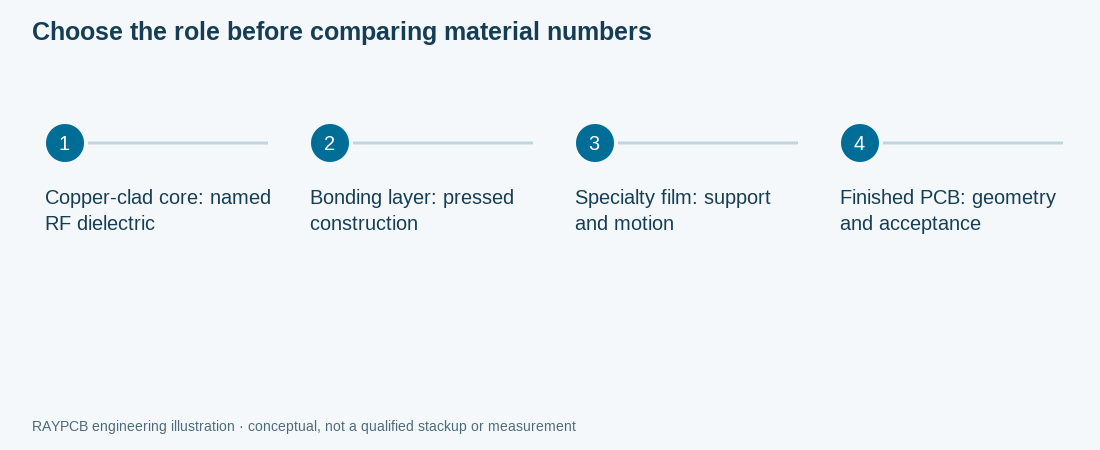
Find the exact laminate or bonding designation, then open its material or manufacturing guide. Current supplier references and archived names are identified separately.
Request a Taconic PCB quote
How to use the material directory
Choose a full code, not only a brand or family. The reference values below retain their original measurement context on the destination page. A blank or unresolved property needs supplier data, not a guessed value. An archived document does not prove that a grade is discontinued or available.
For fabrication scope and a project quote, use Taconic PCB manufacturing. This directory answers material-identification questions and provides the detailed branch entries.
Search material names and applications
RAYPCB ENGINEERING
Materials and StackupTaconic Material Selector
Loading Taconic Material Selector…
All material and manufacturing guides
| Material guide | Page task | Why open it? | Data context |
|---|---|---|---|
| RF-35 | Incoming inspection | Commercial RF fabrication with a documented original grade | Archived / identity review |
| CER-10 | Material & design | Legacy high-Dk resonator and miniaturization designs | Archived / identity review |
| EZ-IO-F | Material & design | Review a spread-weave material designation and its RF stackup | Archived / identity review |
| fastFilm FF-27 | Material & design | Distinguish an RF dielectric film from a bonding prepreg | Archived / identity review |
| fastRise 27 | Material & design | Choose an actual bonding construction and pressed thickness | Current supplier reference |
| HF300F / HF340 / HF341 | Material & design | Resolve historical hydrocarbon material codes and design records | Archived / identity review |
| HyRelex TF-260 / TF-290 | Material & design | Flexible RF interconnect construction and motion requirements | Archived / identity review |
| NF-30 | Material & design | Ceramic-filled PTFE without woven glass reinforcement | Current supplier reference |
| NF-30L | Manufacturing release | Confirm a legacy NF-30L construction and processing specification | Archived / identity review |
| FEP / HT-1.5 / TPN / TacBond | Material & design | Specify the bonding chemistry for multilayer PTFE boards | Archived / identity review |
| RF-10 | Material & design | High-Dk resonators and compact microwave structures | Current supplier reference |
| RF-10 | Manufacturing release | High-Dk resonators and compact microwave structures | Current supplier reference |
| RF-30 | Material & design | Maintain a legacy RF-30 design and source specification | Archived / identity review |
| RF-30 | Manufacturing release | Maintain a legacy RF-30 design and source specification | Archived / identity review |
| RF-30A | Material & design | Antenna material with an exact A suffix | Current supplier reference |
| RF-30A2 | Material & design | Validate a historical A2 drawing before procurement | Archived / identity review |
| RF-35 | Material & design | Commercial RF fabrication with a documented original grade | Archived / identity review |
| RF-35A2 | Material & design | Low-loss RF design with method-specific reference values | Archived / identity review |
| RF-35A2 | Manufacturing release | Low-loss RF design with method-specific reference values | Archived / identity review |
| RF-35HTC | Material & design | RF power paths that need thermally conductive ceramic/PTFE | Current supplier reference |
| RF-35P | Material & design | Thin reinforced cores for dense RF multilayers | Archived / identity review |
| RF-35TC | Material & design | Combine dielectric loss planning with a defined heat path | Current supplier reference |
| RF-35TC | Manufacturing release | Combine dielectric loss planning with a defined heat path | Current supplier reference |
| RF-41 / RF-43 / RF-45 | Material & design | Resolve exact RF-4x grade before copying an RF layout | Archived / identity review |
| RF-60A | Material & design | High-Dk RF layout and controlled substitution | Archived / identity review |
| RF-60TC | Material & design | Compact RF structures with a higher-Dk thermal material | Current supplier reference |
| RF-35 | Manufacturing release | Commercial RF fabrication with a documented original grade | Archived / identity review |
| TacLam TLG-29 / TLG-30 | Material & design | Identify the thin-core laminate and its place in an RF multilayer | Archived / identity review |
| TacLamplus | Material & design | Non-reinforced dielectric concepts for MMIC and compact microwave structures | Archived / identity review |
| TLA-6 | Material & design | RF dielectrics in constructions that may include a metal backing | Archived / identity review |
| TLC-32 | Material & design | PTFE/glass material selection for moderate-Dk RF layouts | Current supplier reference |
| TLE-95 | Material & design | Thin dielectric constructions and tightly coupled RF structures | Current supplier reference |
| TLF-34 / TLF-35 | Material & design | Compare historical TLF grade identity and routing geometry | Archived / identity review |
| TLF-35A | Material & design | PA-board sourcing and laminate-process review | Current supplier reference |
| TLP-5 | Material & design | Source a legacy low-Dk PTFE/glass construction | Archived / identity review |
| TLX-8 | Material & design | Reinforced RF cores for antennas and passive networks | Current supplier reference |
| TLY-3 | Material & design | A low-Dk option between TLY-5 and the TLX family | Current supplier reference |
| TLY-5 | Material & design | Low-Dk transmission lines and antenna feed networks | Current supplier reference |
| TPG-30 / TPG-35 | Material & design | Plan a thermoset bonding layer with grade-specific dielectric data | Archived / identity review |
| TRF-43 / TRF-45 | Material & design | Compare thermally stable historical TRF constructions | Archived / identity review |
| TRF-43 / TRF-45 | Manufacturing release | Compare thermally stable historical TRF constructions | Archived / identity review |
| TSM-26 / TSM-29 / TSM-30 | Material & design | Keep historical TSM grade names separate from the DS3 family | Archived / identity review |
| TSM-DS3 | Material & design | RF multilayers with dimension and thermal-expansion constraints | Current supplier reference |
| TSM-DS3 | Manufacturing release | RF multilayers with dimension and thermal-expansion constraints | Current supplier reference |
| TSM-DS3b | Material & design | DS3-family procurement with the b designation | Current supplier reference |
| TSM-DS3M | Material & design | DS3M routing and phase planning at nominal Dk 2.94 | Current supplier reference |
Read Dk and Df without mixing methods
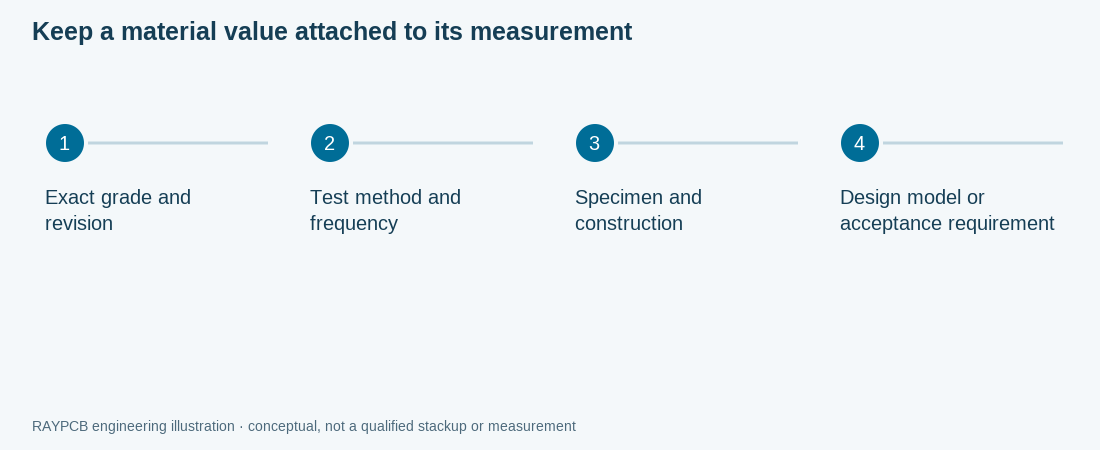
A number without a test method can be misleading. RF-35’s archived 1.9 GHz data is not a direct 10 GHz loss reference. TLX-8’s current TDS specifies Dk at 1 MHz, while its loss value is at 10 GHz. RF-35TC, RF-35HTC and older TC variants require their own data-sheet context.
Historical provenance: the archived Taconic Laminate Material Guide used for this table. The historical values and stated test conditions are retained for identification; they are not current purchase limits. Verify the ordered grade against its original datasheet and certificate. For current product families and supplier document requests, consult the AGC Multi Material official solutions guide. That current guide does not independently verify every historical value above.
Ready to obtain a board quote?
The Taconic PCB quotation brief collects the build scope. Material selection and price depend on the approved construction; a searchable directory is not an inventory list.
Request a Taconic PCB quoteComparing a specific substitution? Read RF-35 versus RO4350B before treating process Dk as equivalence.
Directory questions
Why does a material have two article links?
Some established URLs now answer different tasks: one explains material data and design, another prepares fabrication or acceptance. Existing addresses are preserved.
Does the lowest Df mean the best board?
Not necessarily. Copper loss, route length, transitions, thermal behavior, tolerances and sourcing all influence the result.
Can I use a family-average Dk?
Use a full-grade or construction-specific value with the relevant method. Family ranges are useful for navigation, not final RF geometry.