
RAYPCB · ENGINEERING & PROCUREMENT
PCB Material Cost vs Reliability: Choose Requirements Before a Laminate
PCB material cost versus reliability is a requirements decision, not a contest between a cheap laminate and a premium label. Electrical behavior, thermal exposure, dimensional stability, moisture, construction and manufacturing compatibility all matter. This guide helps engineers compare candidate materials on a consistent basis and helps buyers understand what must be confirmed before accepting a lower-cost substitution.
Your task: Define service and process exposure. Use the material comparison evidence planner to record the next decision.
Open material comparison evidence planner · Discuss the project
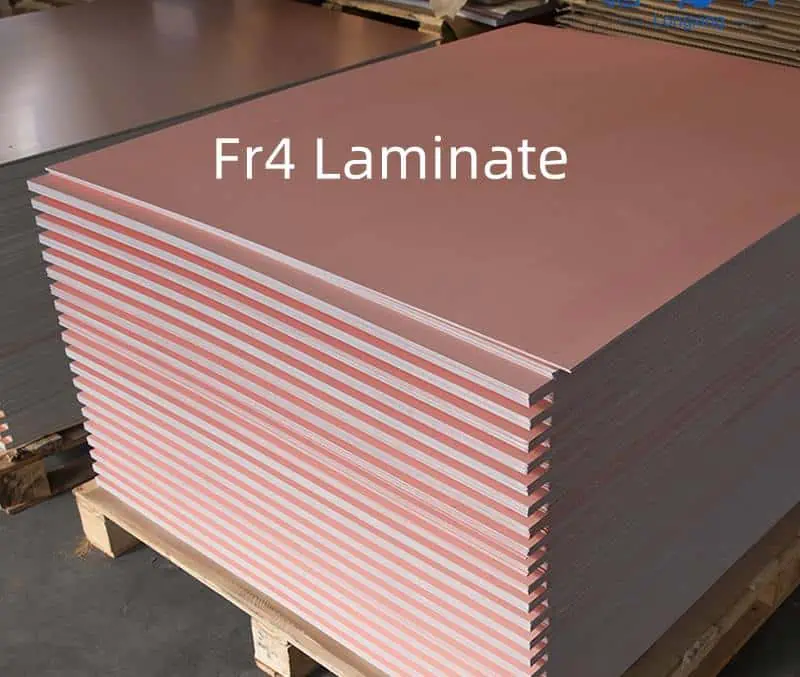
Describe the service and assembly conditions
Separate continuous service conditions from short manufacturing exposures such as soldering. State expected temperatures, cycling, humidity, mechanical strain and electrical demands. Include the number and nature of relevant assembly or rework exposures when they are part of the qualification plan.
Tg is a glass-transition property, not a universal maximum operating temperature. Other properties and the completed construction affect reliability. A higher Tg number alone does not establish suitability for every environment or guarantee longer life.
For RF or high-speed circuits, define frequency-dependent requirements and the modeling basis. A material datasheet value measured by one method may not be interchangeable with a design value used for a different structure. Record method, frequency and construction when comparing data.
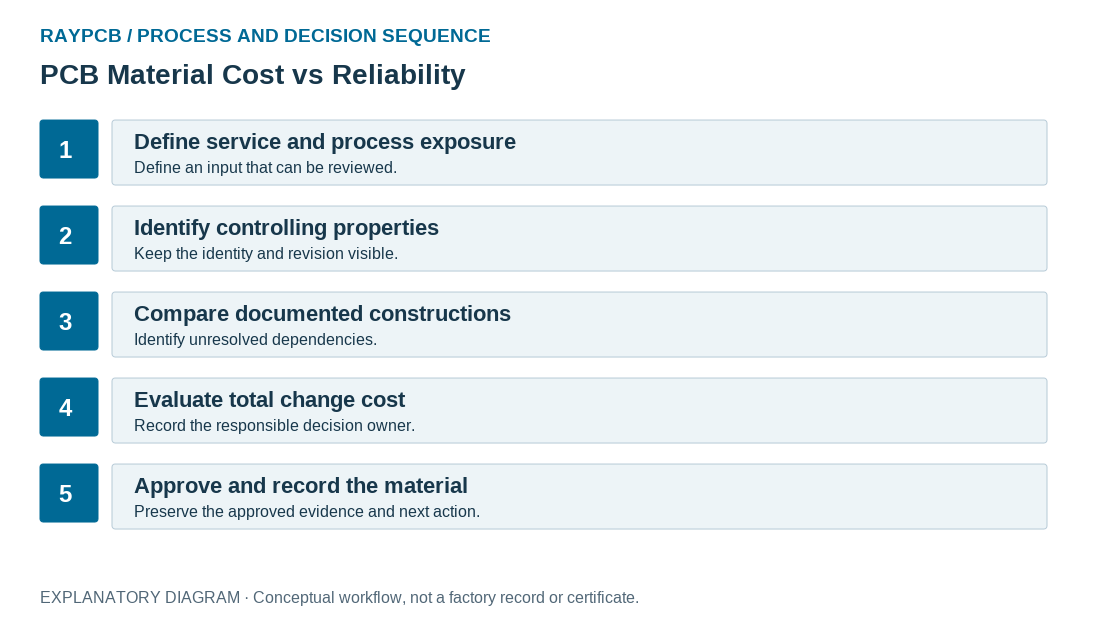
Compare a construction, not an isolated material name
A finished PCB includes resin, reinforcement, copper and a manufacturing history. Prepreg style, resin content, cured thickness and foil can influence the resulting structure. A family name is not a complete stackup specification.
Ask whether the candidate material is available in the construction the design needs. A technically attractive datasheet does not establish local stock, suitable thicknesses or an approved fabrication route. Confirm the proposed build with the manufacturer.
Use the PCB material directory for material families and brands. This page owns the decision method and cost tradeoff; it does not duplicate the full catalogue or declare different grades interchangeable.
Identify which properties control the risk
For thermally demanding designs, review the relevant expansion and decomposition behavior, construction, holes and qualification evidence. For RF designs, consider dielectric behavior, loss and conductor characteristics under comparable conditions. For flex, bending construction and copper type may be central.
Select properties because they relate to a failure mechanism or performance requirement. A long table of unconnected numbers can distract from the one characteristic that constrains the design.
Document the source and test method for each comparison. If data is missing or measured differently, mark it as an evidence gap rather than ranking materials numerically. The worksheet keeps those questions visible and does not generate an automatic material approval.
Material comparison evidence planner
Material comparison evidence planner
How to use and interpret this worksheet
Choose a narrow review boundary before filling in the worksheet. Use one product revision, one proposed build or one supplier decision. If several configurations differ, keep separate records or explain precisely which evidence applies to each. A short reference is enough; the tool does not need drawings, customer names, confidential part lists or passwords.
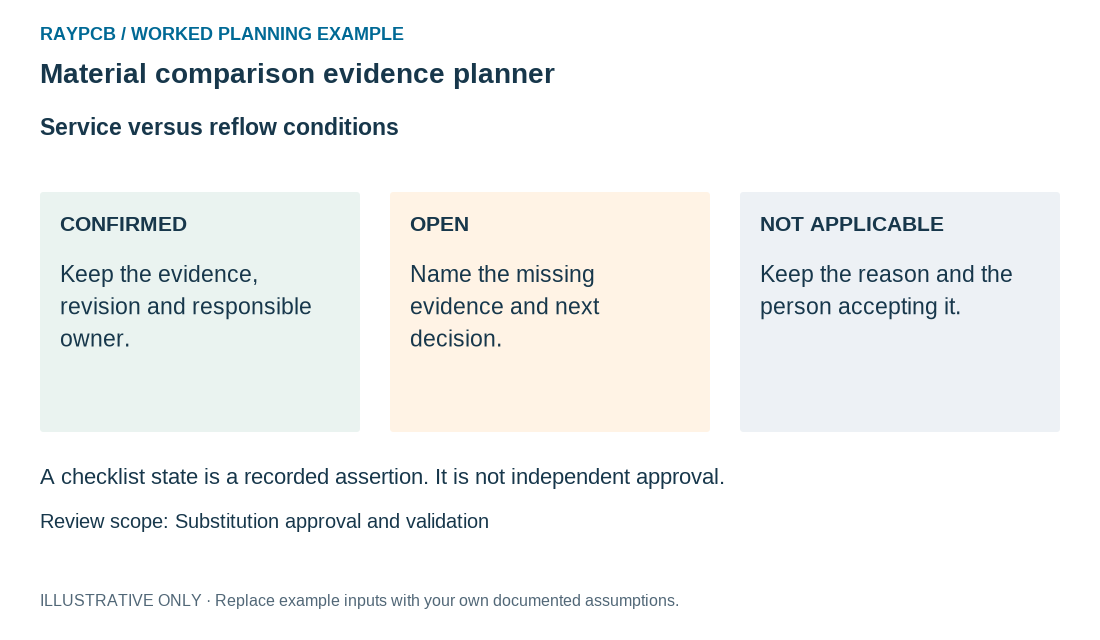
For every item, distinguish confirmed evidence from an unresolved assumption. Confirmed means that the responsible person has reviewed the relevant information, not merely that a document exists somewhere. Open means the decision or evidence is still missing. Not applicable requires a rationale because it is an applicability decision, not a shortcut to completion.
Record a concrete next action with an owner and a target decision point. For example, replace ask engineering with obtain the approved revision from the design owner before material release. The useful output is an actionable handoff, not a readiness percentage. No weighted score is used, because the consequence of one mandatory gap may exceed that of several completed items.
Load example only to learn the controls. Example mode remains clearly labeled even if you edit its values. Clear the form before entering your own review. Changing an input invalidates the old result and disables its download until you generate a new record. Download the current text if it helps your discussion; it is not automatically added to an enquiry.
Keep supporting approvals and measured results in the controlled project system. This worksheet stores nothing between visits and does not verify files, supplier statements or legal applicability. A completed record can support a review meeting, but the authorized team remains responsible for the release decision.
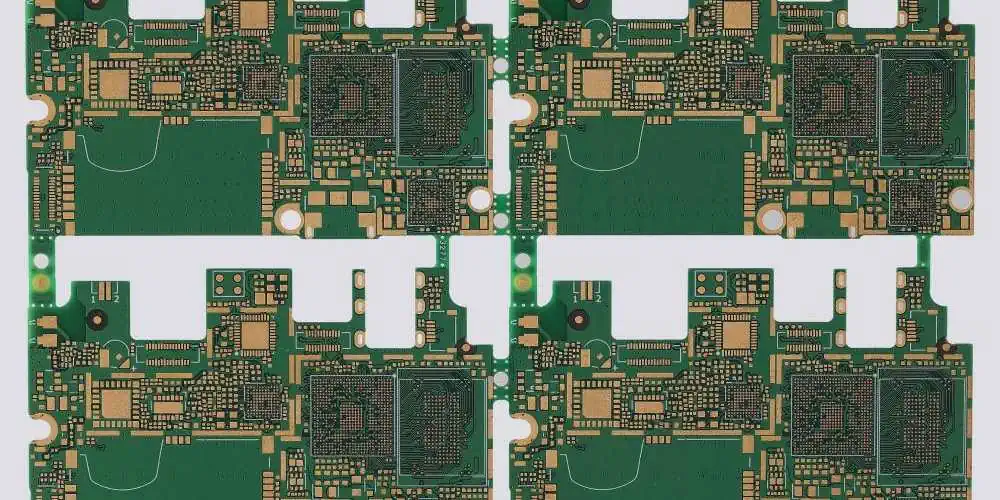
Look beyond laminate purchase price
Material can affect processing, availability, yield, tooling, qualification and redesign. Compare the total quoted construction and the cost of validating a change. A lower laminate price may not reduce the finished-board price if other operations become more demanding.
Likewise, an expensive material may be unnecessary when it does not address an actual requirement. Ask for technically feasible alternatives with explicit differences, then assess their effect on electrical and mechanical behavior.
For a hypothetical mixed-signal board, a proposed change might alter dielectric thickness or Dk enough to require impedance geometry review. The saving should be considered together with the engineering work and verification needed, not only the purchase price of raw laminate.
Keep a decision record with the review
Use this record to connect the discussion to supporting information. Record the source, revision and reviewer for each item. Confirmed means the responsible person has reviewed the evidence; it does not mean this website has verified it. Keep confidential documents in your approved project system.
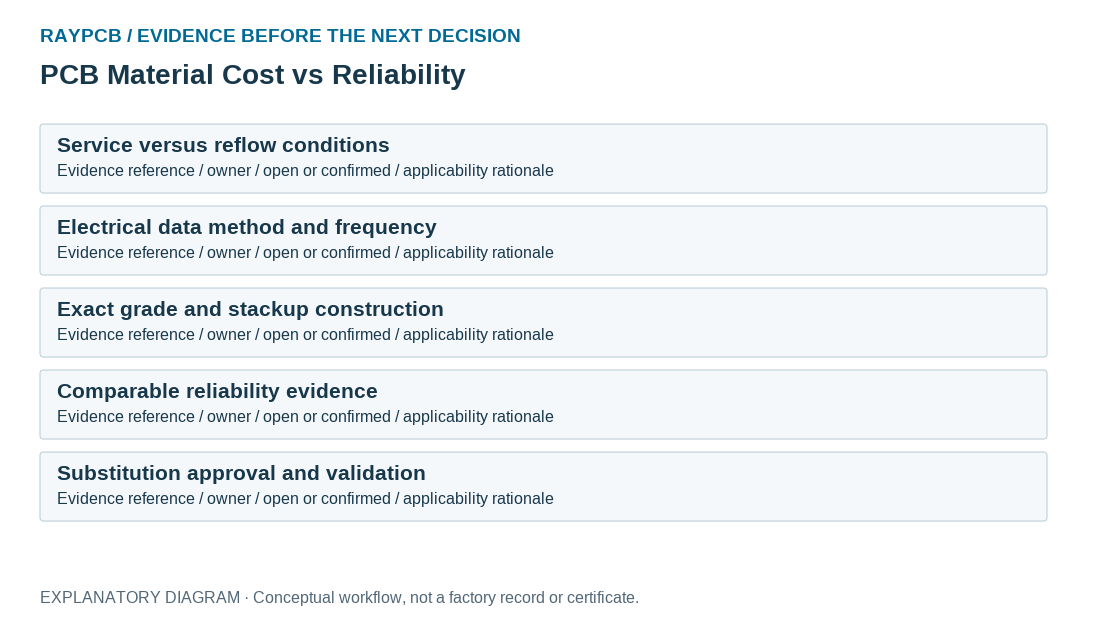
| Review topic | Record to retain | When it remains open |
|---|---|---|
| Service versus reflow conditions | Identify the controlled scope and the person authorized to approve it. Keep the current reference together with the intended decision. | Clarify the boundary before treating the review as a release instruction. |
| Electrical data method and frequency | Reference the actual file, data source or agreed requirement, including its revision or date and the person who reviewed it. | Request the missing evidence and identify which downstream decision depends on it. |
| Exact grade and stackup construction | Record the conditions and assumptions that make the evidence applicable. Separate a proposed value from an approved requirement. | Keep the assumption visible and define whether the next activity may proceed under a bounded exception. |
| Comparable reliability evidence | Identify responsibility for the next operation and the evidence expected afterward. Distinguish preparation from a completed result. | Assign a named role and an agreed decision point; do not turn an unanswered question into an approval. |
| Substitution approval and validation | Record the final disposition, affected quantity or revision and the authority accepting it. Preserve the reason for any exception. | Retain the item in the action list and review its consequence before committing work or materials. |
Review the record again when the product, supplier proposal or supporting data changes. A result from an earlier revision is historical evidence, not automatic approval for the current one. If an item is not applicable, retain the reason and the person who made that decision.
Control substitutions with a defined acceptance path
State whether the drawing requires an exact grade or allows an approved equivalent. If alternatives are permitted, define who evaluates them and what evidence is needed. Matching Tg or a broad FR-4 description is not sufficient for every application.
Compare the actual affected requirements, manufacturing construction and qualification implications. Record the approved alternative and the revision or lot to which it applies. Do not let a one-time availability decision silently become a permanent option.
Where a substitute changes the simulation basis, update and review the model. Where it changes the mechanical or thermal construction, consider the relevant validation. The required work depends on the product and cannot be reduced to a universal substitution checklist.
Use supplier documentation in context
Review official grade datasheets and processing guidance. Rogers' advanced electronics materials resources and Isola's product information are useful primary sources for their respective products. Verify the exact current grade and document rather than borrowing a number from a reseller table.
Material recognition or a test result has a defined scope. It does not automatically certify the complete PCB or end product. Discuss applicable acceptance and product requirements with the responsible engineering and quality teams.
Avoid placing incomparable typical values into a weighted score. Typical values may not be guaranteed limits, and different test methods may produce different results. The comparison should preserve those distinctions.
Write a quote request that preserves design intent
Provide the proposed stackup, finished thickness, copper, impedance requirements, thermal or environmental requirements and any mandatory grade. Identify whether a supplier proposal is welcome. Include quantities and required timing so availability can be evaluated alongside technical fit.
Ask the quotation to identify the assumed construction and any departures from the request. If the manufacturer proposes a different material, review it before release. A price comparison is meaningful only when the underlying requirements are visible.
For construction review use PCB manufacturing. If the issue is a broader cost reduction, low-cost PCB manufacturing covers geometry, process and quantity as well as material.
Questions about cost and reliability
Is high Tg always more reliable? No single property establishes overall reliability. Match the material and construction to the actual exposure and failure mechanisms.
Can I compare Dk numbers directly? Only after checking method, frequency, construction and whether the value is intended for design. Preserve uncertainty where the conditions differ.
What can the worksheet decide? It organizes requirements, evidence and open questions. It cannot predict service life, approve substitutions or issue a price. Send the resulting brief with your drawing for a project-specific discussion if useful.