
RAYPCB · ENGINEERING & PROCUREMENT
Low Cost PCB Manufacturing: Reduce Cost Without Losing Required Performance
Low cost PCB manufacturing begins with a specification that fits the application and a quote that includes the required work. Board size, panel use, construction, material, holes, finish, tolerances, inspection and quantity interact. The lowest advertised starting price rarely describes a complete project. This guide helps engineers identify changes worth quoting and helps buyers compare equal scopes using their own cost inputs.
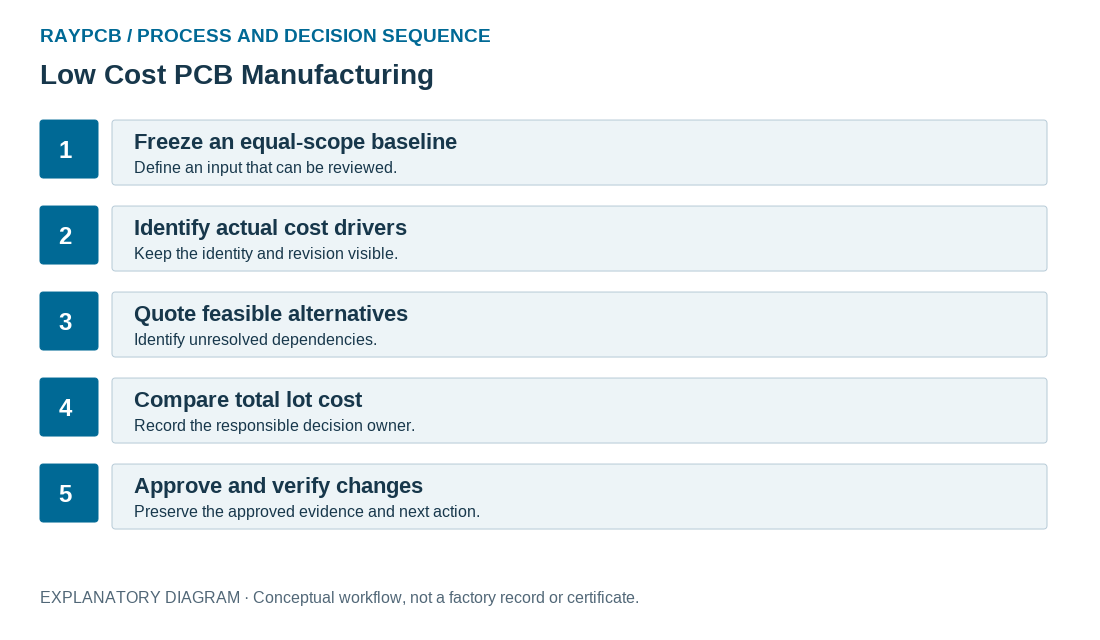
Your task: Freeze an equal-scope baseline. Use the pcb lot cost comparison to record the next decision.
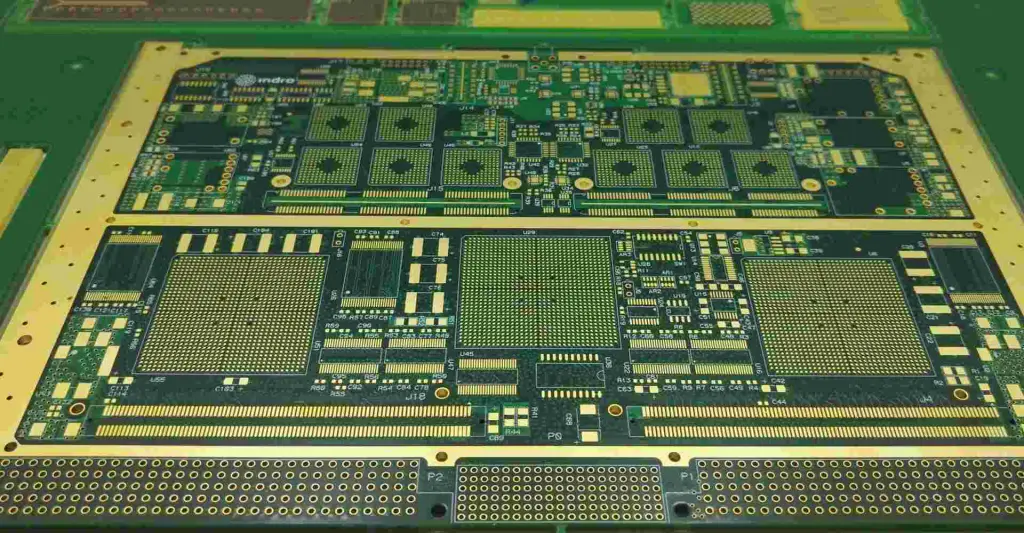
Start with an equal-scope comparison
Write a baseline specification before comparing suppliers or design alternatives. Include board dimensions, layer count, finished thickness, material requirements, copper, surface finish, holes, special processes, acceptance and quantity. Add delivery destination and commercial assumptions where they affect the total.
If one quote includes electrical testing and another does not state it, clarify the scope before comparing totals. If one assumes a different laminate or excludes a report, the difference is not necessarily a saving. Record deviations in a comparison table.
Do not equate low cost with minimum requirements. A requirement that protects an actual function should remain. The useful question is whether a costly feature is necessary, over-specified, poorly explained or avoidable through a reviewed design change.
Understand the geometric cost drivers
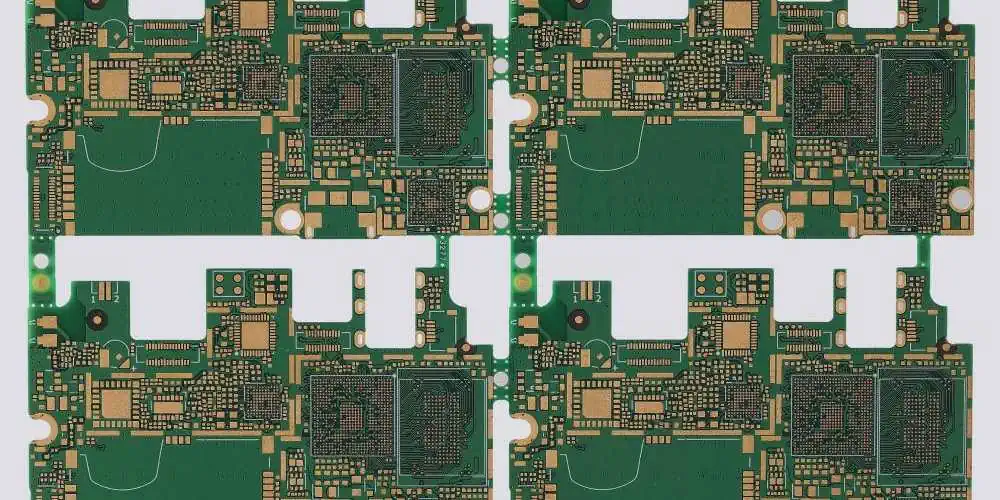
Board outline and panel arrangement affect material utilization, but smaller individual dimensions do not always translate directly into lower panel cost. Rails, spacing, routing, coupons and assembly handling can change the usable arrangement. Ask for a panel review before changing an outline solely for price.
Small holes, fine features, tight registration and specialized structures can require additional process control or constrain yield. Use them where the design needs them, and distinguish local critical features from unnecessarily tight global rules.
Layer count also interacts with routing, reference planes and signal integrity. Removing layers can create longer routes, poor return paths or another design iteration. Compare complete workable constructions through PCB manufacturing, rather than selecting the smallest layer number in isolation.
Material and finish are functional choices
Select material against electrical, thermal, mechanical and reliability requirements using the relevant methods and construction. A higher Tg label alone does not define continuous operating temperature or every aspect of reliability. Similarly, a low-loss material may be important for one signal path and unnecessary for another product.
A finish should suit assembly, contact, storage and other specified needs. Do not choose it from a universal cheapest-to-best ranking. Fine-pitch assembly, wire bonding or repeated contact can require different considerations.
Use material cost and reliability selection for the decision process. Ask the fabricator to quote a technically reviewed alternative separately; never treat a proposed substitute as approved because it is cheaper.
Separate setup from recurring cost
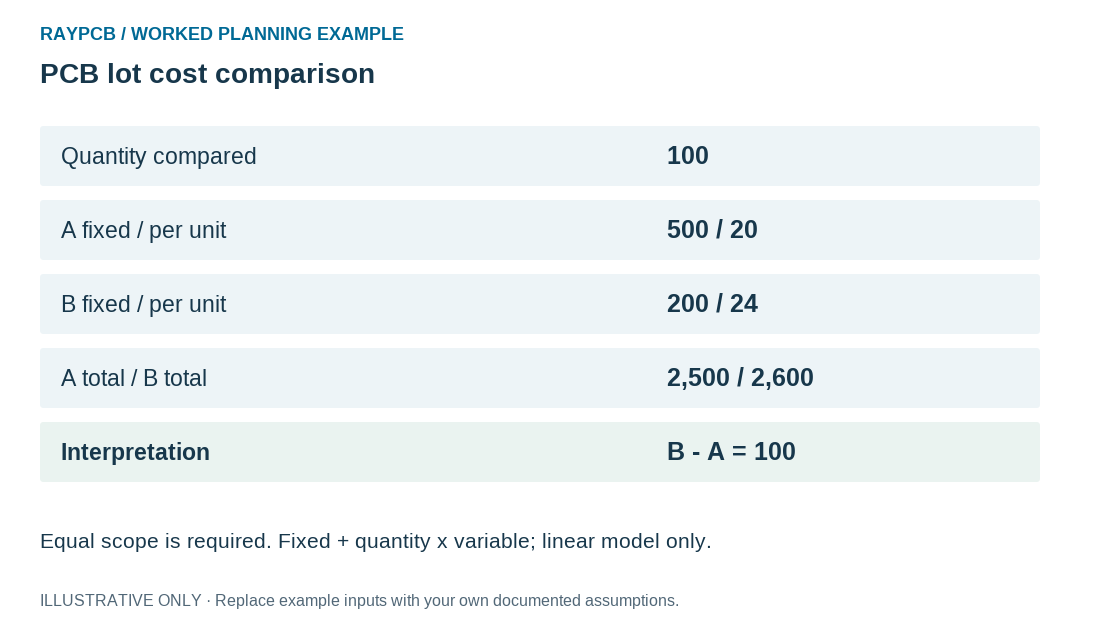
The worksheet compares two lot scenarios using fixed charges and per-board costs that you supply. It reports total and effective cost per ordered board, with exclusions stated. It does not contain calibrated RAYPCB rates or fetch live market prices.
PCB lot cost comparison
PCB lot cost comparison
How to use and interpret this worksheet
Define the common quantity and the same technical deliverable for both scenarios. Enter each scenario's fixed charges and recurring cost per board in one currency. The calculation uses only these values; it contains no current supplier price list or automatic complexity multiplier.
For each scenario, total lot cost equals fixed charges plus quantity multiplied by unit cost. Effective cost per ordered board is that total divided by quantity. The displayed difference is scenario B minus scenario A, so a negative number means B is lower within the entered scope.
Before interpreting the difference, compare material, construction, tolerance, testing, documentation, lead time and commercial terms. A missing operation can make a scenario look cheaper without making it equivalent. Add excluded logistics or other charges consistently if they are part of your decision.
The model assumes linear recurring cost at the entered quantity. Real price breaks and minimum charges may require a new set of inputs. It does not model yield loss or future inventory use. Do not treat a calculated effective unit value as a standing offer for another quantity.
Load the labeled example to explore the controls, then clear it for your own assumptions. Edits invalidate previous output. Download the current comparison and retain the source quotations beside it. Nothing is sent to a supplier or the contact form, and the calculation does not select a technically acceptable construction.
Use the same currency and scope for both scenarios. Include tooling or special reporting only once if it is truly a one-time charge. Do not divide by an anticipated good quantity unless the source quote is based on that same definition.
The result is arithmetic, not a purchase recommendation. A lower total can coexist with higher technical risk, longer lead time or missing work. Keep the specification comparison beside the cost output.
Keep a decision record with the review
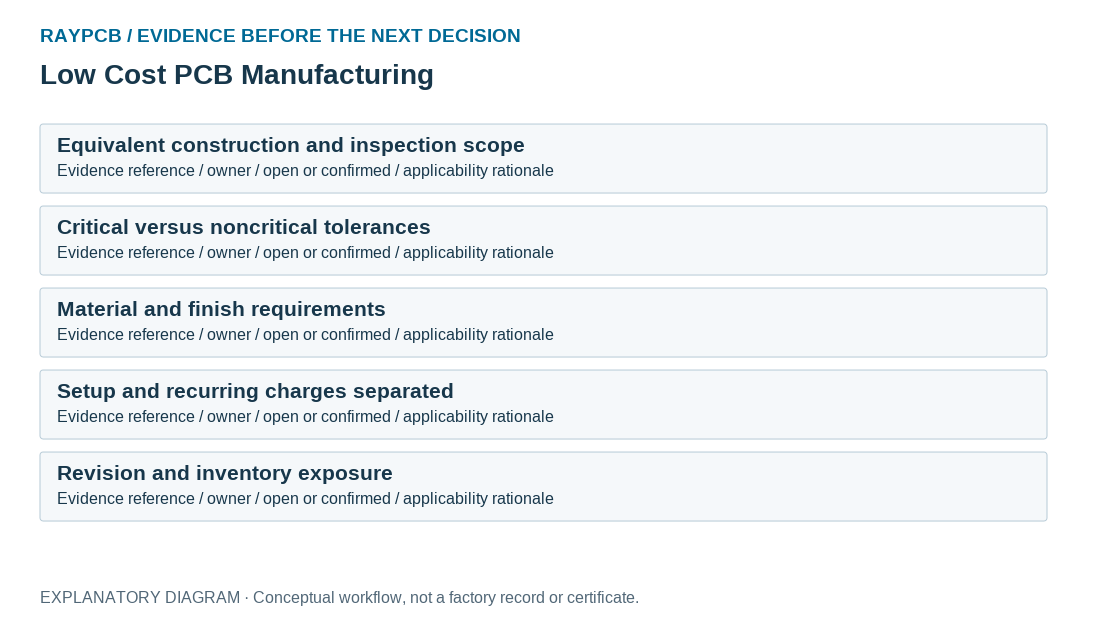
Use this record to connect the discussion to supporting information. Record the source, revision and reviewer for each item. Confirmed means the responsible person has reviewed the evidence; it does not mean this website has verified it. Keep confidential documents in your approved project system.
| Review topic | Record to retain | When it remains open |
|---|---|---|
| Equivalent construction and inspection scope | Identify the controlled scope and the person authorized to approve it. Keep the current reference together with the intended decision. | Clarify the boundary before treating the review as a release instruction. |
| Critical versus noncritical tolerances | Reference the actual file, data source or agreed requirement, including its revision or date and the person who reviewed it. | Request the missing evidence and identify which downstream decision depends on it. |
| Material and finish requirements | Record the conditions and assumptions that make the evidence applicable. Separate a proposed value from an approved requirement. | Keep the assumption visible and define whether the next activity may proceed under a bounded exception. |
| Setup and recurring charges separated | Identify responsibility for the next operation and the evidence expected afterward. Distinguish preparation from a completed result. | Assign a named role and an agreed decision point; do not turn an unanswered question into an approval. |
| Revision and inventory exposure | Record the final disposition, affected quantity or revision and the authority accepting it. Preserve the reason for any exception. | Retain the item in the action list and review its consequence before committing work or materials. |
Review the record again when the product, supplier proposal or supporting data changes. A result from an earlier revision is historical evidence, not automatic approval for the current one. If an item is not applicable, retain the reason and the person who made that decision.
Review tolerances and tests by consequence
Tight dimensional or electrical limits can be justified by a connector, enclosure or signal requirement. Explain which feature matters and how it will be measured. Applying the tightest tolerance everywhere can add review and process burden without a corresponding benefit.
Testing should address the required defect mechanisms. Bare-board electrical testing does not prove the assembled product will function, and visual acceptability does not replace electrical checks. Reducing coverage simply to make quotes match can conceal a material difference in risk.
For a hypothetical interface board, a mating edge may need close control while unrelated outline regions permit ordinary manufacturing tolerances. A drawing that distinguishes those areas gives the supplier a clearer basis for a costed proposal. It is an illustration, not a universal tolerance recommendation.
Avoid false economies in urgency and inventory
Expedited work may carry additional cost, but schedule problems often originate in incomplete data or late decisions. Close construction and material questions early. Do not pay for a shorter production interval while an unapproved stackup still prevents release.
Larger quantities can reduce setup allocation but increase cash tied up in stock. Consider revision probability, storage requirements and expected consumption. A price break is not a saving if much of the lot becomes obsolete.
For uncertain designs, request a preliminary PCB quote with explicit assumptions. Replace it with a reviewed quotation when the release package is ready. Keep budget figures separate from purchase authorization.
Turn a cost-reduction proposal into an engineering decision
Describe the original requirement, proposed change, expected cost mechanism and validation needed. Examples include relaxing a noncritical tolerance, changing a panel arrangement or evaluating a more available material. Obtain engineering approval before changing production data.
Request separate quotations for alternatives so that cost differences remain traceable. If several features change at once, the total difference does not reveal the contribution of each one. Decide whether that distinction matters to the project.
Altium's PCB cost-driver discussion provides background on how design choices affect fabrication and assembly. Use it to frame questions; your supplier's reviewed quotation establishes project pricing. No fixed savings percentage is assumed here.
Questions before requesting a lower-cost build
Is the cheapest material always the best starting point? Start from required performance and available constructions. A material that causes a redesign or fails a qualification is not a useful saving.
Should I combine prototype and production quantities? Show them separately, especially when the prototype can change the released design. Discuss purchasing commitments explicitly.
What should I send? Provide the baseline package, quantities and the features you are willing to reconsider. PCB supplier evaluation helps compare capability and evidence alongside price. A direct contact request is available without using the calculator.