
RAYPCB · ENGINEERING REFERENCE
PCB Cleaning After Soldering: Process Selection & Verification
Plan a repeatable post-solder cleaning process around the actual residue, assembly and verification requirement.
Original engineering guidance · References checked September 29, 2026
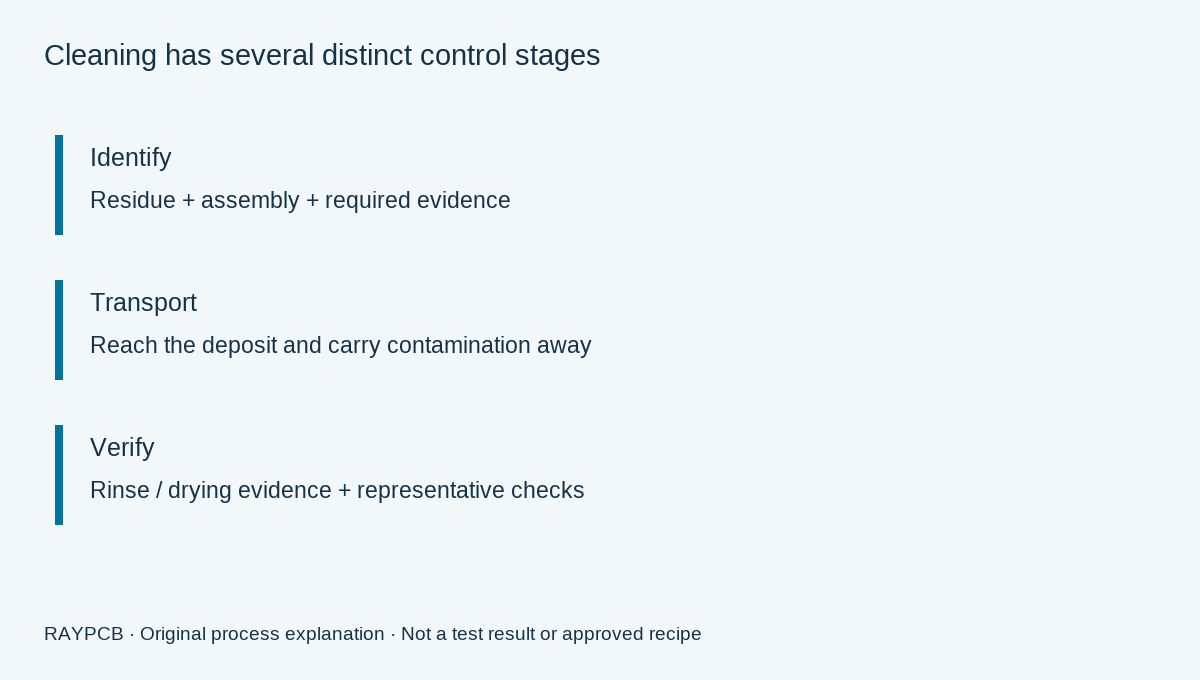
PCB cleaning after soldering is a controlled manufacturing process
PCB cleaning after soldering removes specified residues and contamination from an assembled board using a process compatible with the materials, components and intended product. A useful process definition includes more than the cleaner: it covers access to the deposit, removal or transport, rinsing where required, drying, verification and change control. A board that looks clean at its edges has not necessarily been cleaned beneath a low-clearance component.
Start by deciding why cleaning is required. The reason might be the flux supplier's instructions, an assembly specification, a sensitive electrical function, a downstream coating or an observed process problem. These reasons can lead to different verification needs. Avoid choosing equipment or a solvent before identifying the residue and the surfaces that will be exposed.
This page owns the batch and production process. For a small repair region, use the separate localized flux-removal guide. For an unidentified deposit, begin with residue observation and investigation before changing the specimen. Both tasks feed into the wider PCB assembly process.
Define the assembly and the residue before choosing a route
| Input | What to identify | Why it changes the process |
|---|---|---|
| Soldering materials | Exact paste, wire-core flux and added flux | Residues may respond differently after their actual thermal history |
| Assembly features | Low standoffs, cavities, connectors and sensitive components | Fluid access, trapping and compatibility can limit a route |
| Surface materials | Mask, labels, coatings, adhesives and markings | Cleaning can alter more than the unwanted deposit |
| Next operation | Coating, bonding, testing or packaging | Each interface can impose a different evidence requirement |
| Acceptance basis | Applicable contract, method and process evidence | A visual finish is not a complete cleanliness decision |
Keep the technical data sheet and safety data sheet distinct. The TDS describes intended technical use and process information; the applicable SDS addresses handling and hazards for the supplied product. Neither document alone qualifies a complete assembly. Obtain current documents for the actual formulation and region rather than copying instructions from a similarly named product.
For example, the official ZESTRON VIGON A 200 technical information describes a particular water-based defluxing product and its intended equipment context. It is evidence for that product's stated use, not a recommendation that every populated PCB should be washed with that material or with one fixed set of conditions.
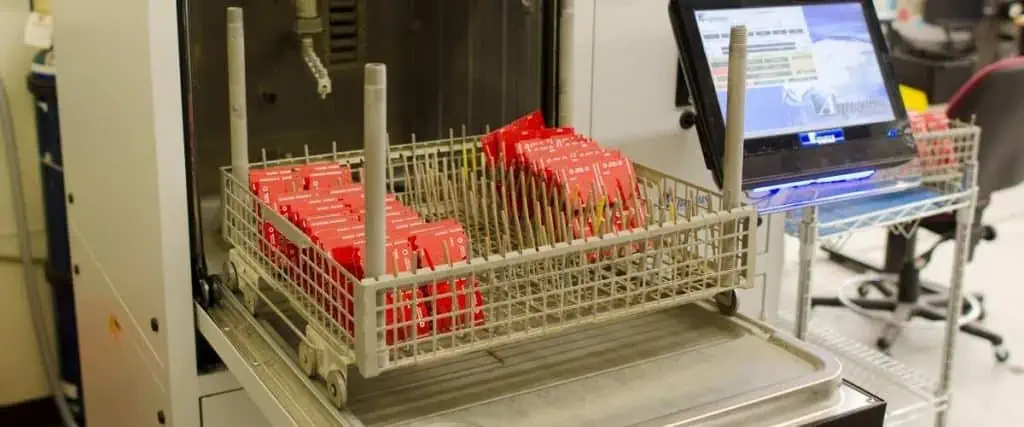
Select a route around access and compatibility
A batch or inline wash can offer repeatable transport and monitoring, but it must reach the locations that matter. A manual process can suit a defined local task, but operator technique and contamination collection require control. A cleaning method should be chosen with both the deposit and the populated assembly in view, not only the bare laminate's resistance to a liquid.
Do not assume that ultrasonic agitation is compatible with every component. The exact device instructions take precedence for sensors, cavities and mechanically sensitive structures. Analog Devices discusses the issue for MEMS devices in its aqueous-washing and ultrasonic-cleaning guidance. A successful trial on an unrelated board does not establish compatibility with a newly introduced sensor.
Compare the complete route when evaluating no-clean and water-soluble flux systems. A flux is a soldering material, not the wash chemistry. A water-soluble residue still needs an effective removal process, while a no-clean material still needs evidence that its actual residue is suitable for the intended assembly and downstream operations.
Follow the contaminant from its original location to its exit
Cleaning requires more than wetting the visible surface. The process must reach the deposit, mobilize or detach it as intended and carry it away. If removed material remains trapped or is redistributed beneath another component, a cleaner-looking top surface can hide an unresolved process problem. Define the exit and collection route alongside the delivery method.
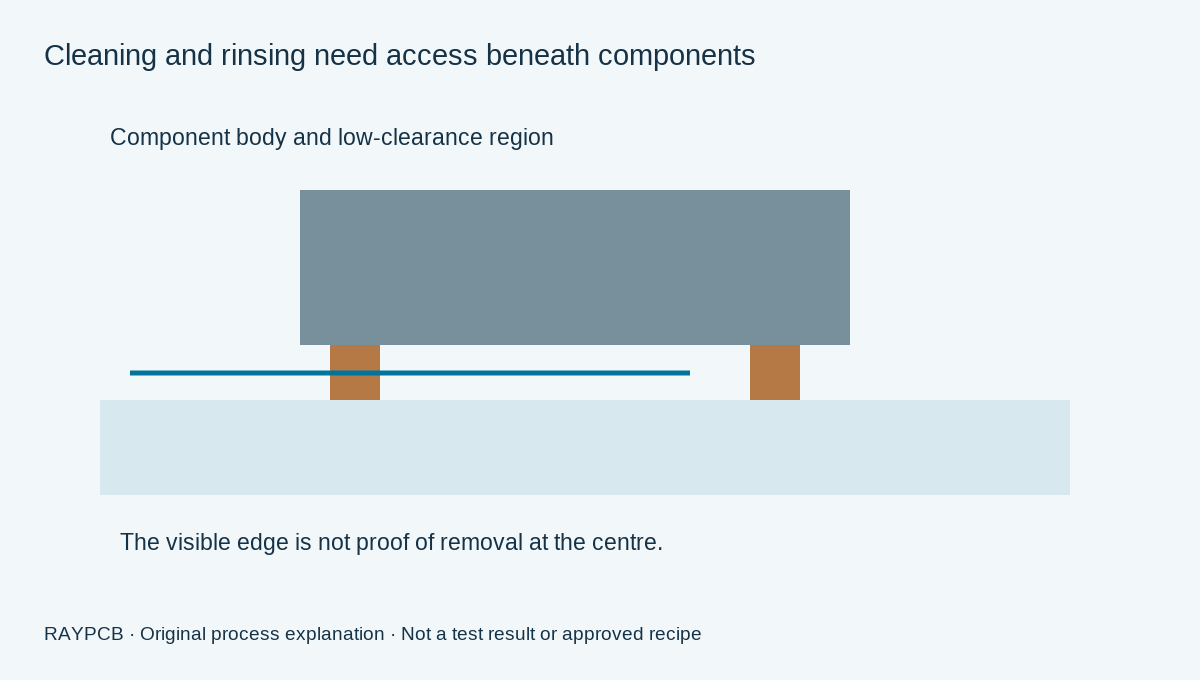
Low-clearance packages are a useful challenge location for process trials. Their edges can be accessible while the centre remains difficult to evaluate. Representative coupons or sacrificial assemblies may be needed when the required evidence cannot be collected non-destructively. Indium's discussion of cleaning no-clean solder-paste residues highlights the importance of evaluating residue beneath bottom-terminated components.
Board orientation, loading and fixture contact can also affect access. Record how assemblies are held in the equipment and which surfaces are shadowed or obstructed. A laboratory trial with an exposed single board should not automatically qualify a densely loaded production rack. The proposed production arrangement belongs in the verification plan.
Build a process-review brief
The planner asks for residue identity, the candidate route, access conditions and the status of material documents, compatibility, drying and verification. It returns the unresolved engineering actions and a control sequence. It does not select a chemical or prescribe concentration, temperature or exposure time from a generic board category.
RAYPCB ENGINEERING
Assembly CleaningPost-solder cleaning process planner
Loading Post-solder cleaning process planner…
Use a documented state only when the relevant record exists. An unknown deposit or unresolved access condition remains visible in the result. A localized manual trial is identified as a different scope from production qualification, so a convenient bench result is not silently promoted into a batch-process approval.
The example is illustrative and begins with open items. Start project mode to enter your own information. Changes invalidate the previous result and download. The resulting TXT remains local until you manually attach it to an enquiry; the page does not upload confidential drawings or automatically transfer the brief to Contact.
Rinse, drainage and drying need their own evidence
Where the selected chemistry requires rinsing, define what the rinse must remove and how its condition is monitored. Cleaner carryover, dissolved contamination and water quality can affect the result. Do not infer rinse completion merely because a set time has elapsed. Use the process supplier's instructions and the assembly-specific validation evidence to establish the control window.
Drying must address the actual retention locations, including connectors, shields or narrow gaps. A visibly dry exterior is not proof that every cavity is dry. At the same time, a generic high-temperature bake can be incompatible with components, labels or coatings. The drying method and allowable exposure must be reviewed as part of the complete assembly route.
Keep handling after cleaning in view. Tools, fixtures, gloves, packaging and the interval before coating or test can reintroduce contamination. Identify the point at which the verified state is established and the controls that preserve it through the next operation. Otherwise, a successful cleaning trial may be followed by an uncontrolled transfer that defeats its purpose.
Match the test to the question
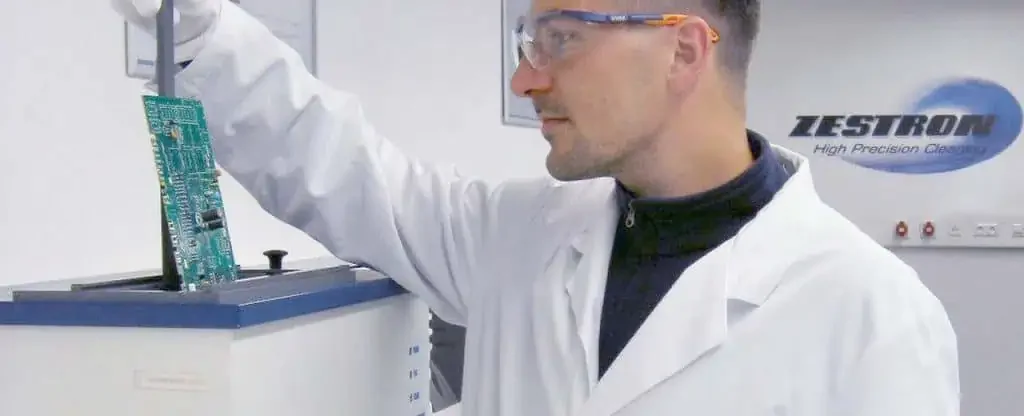
Visual examination can reveal visible deposits, particles or process variation, but it does not identify all ionic species or demonstrate electrical behaviour under humidity and bias. An extraction method, chemical identification technique and electrical reliability experiment answer different questions. Select the method by the evidence needed rather than by the availability of a familiar numerical result.
The ionic contamination testing guide explains the different roles and limitations of ROSE, ion chromatography and SIR-oriented evidence. This process page does not impose a universal sodium-chloride-equivalent threshold. Use the applicable requirements and representative process evidence, with the sampling and extraction limitations stated in the record.
Where IPC documents form part of the contract, record the applicable revision and requirements rather than claiming that one cleaning step makes the assembly IPC compliant. The IPC assembly standards guide connects standards to the release and evidence discussion. A cleaning record supports that discussion without replacing the rest of the assembly acceptance plan.
Design a trial that can explain the result
Suppose deposits appear after a solder-paste change. Preserve the original and revised material identities, thermal profiles, cleaning settings and representative samples. Compare the candidate process against a known reference where available. Changing chemistry, rack loading, rinse and drying simultaneously may produce a different appearance without explaining which change mattered.
Agree the observations and decision before running the trial. They may include a specific hidden location, compatibility with a component marking, an extraction result or a downstream interface check. Record unsuccessful trials too: a result that exposes poor access or an incompatible material is useful evidence when choosing the next controlled change.
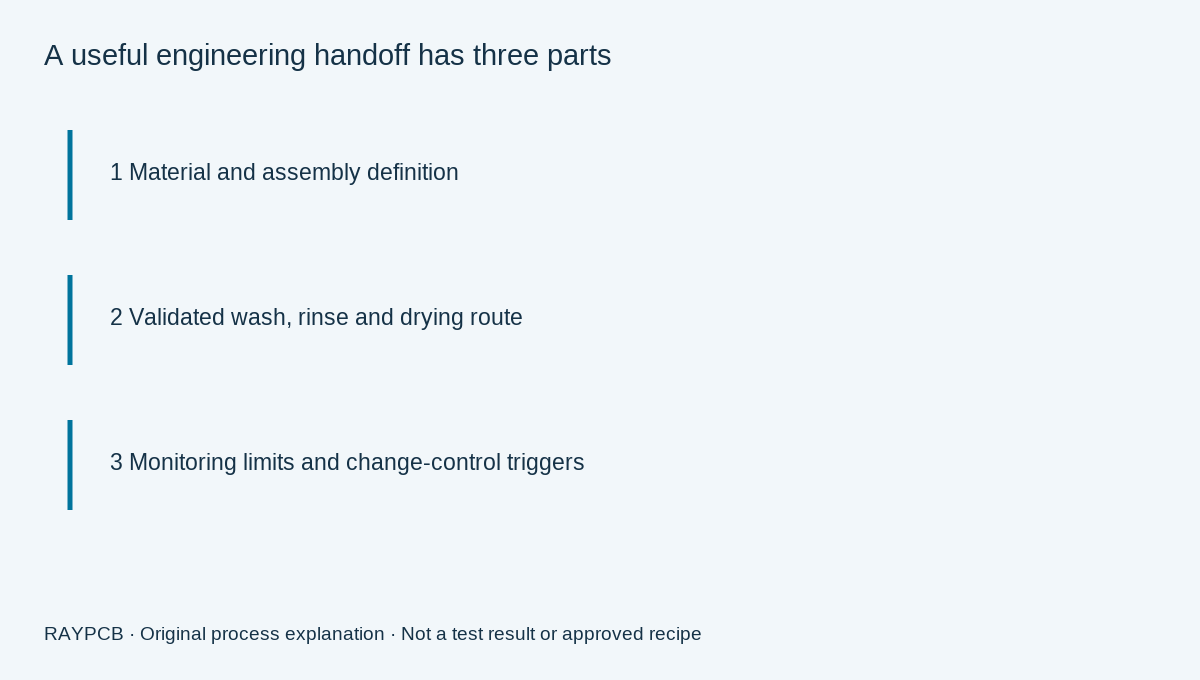
Once the route is established, define the changes that trigger review. A new flux formulation, component, coating, board geometry or equipment arrangement can change the validated conditions. Monitoring should detect drift in the relevant process variables, while change control addresses cases that fall outside the original evidence.
Make cleaning requirements part of the assembly quotation
For PCB assembly, identify the board revision, BOM, soldering materials, required cleaning outcome and any sensitive or non-washable components. State whether a cleaning process is already approved or whether the project needs a development trial. Include coating, test and packaging requirements that depend on the cleaned state.
Cleaning cost can include equipment time, chemistry, rinse, drying, monitoring, verification and handling. A low consumable price does not describe the complete route. Ask for a defined scope rather than treating cleaning as an unexplained line item. The project contact page remains available without completing the planner.
Questions before production cleaning
Must every PCB be cleaned after soldering?
No single rule covers every material and application. Follow the exact soldering-material instructions, assembly requirements and evidence for the intended product. A no-clean route can still require review for sensitive circuitry or downstream surfaces; a cleaning-required route needs demonstrated removal, not just a wash label.
Is an accessible surface enough to validate a low-standoff package?
No. The locations relevant to the requirement must be represented in the evidence. Hidden regions can behave differently from visible edges. Plan access, specimen selection and the appropriate inspection or analytical method before declaring a production route established.
Can the planner recommend a universal wash temperature?
No. Temperature, concentration, time and equipment action depend on the actual chemistry and assembly. The tool organizes the documents and questions needed for a material-specific process; it does not replace the supplier's instructions or a representative trial.
Bring the assembly and process requirements together
Send the board revision, construction, quantity and the cleaning or residue question you need reviewed. Identify unresolved requirements so the response can address them.
Send requirements for reviewOptional: attach the downloaded worksheet manually. This guidance does not certify a design, approve a shipment or replace the applicable authorized standards.