RAYPCB · ENGINEERING GUIDE
Does Your PCBA Need Conformal Coating? A Product Decision Guide
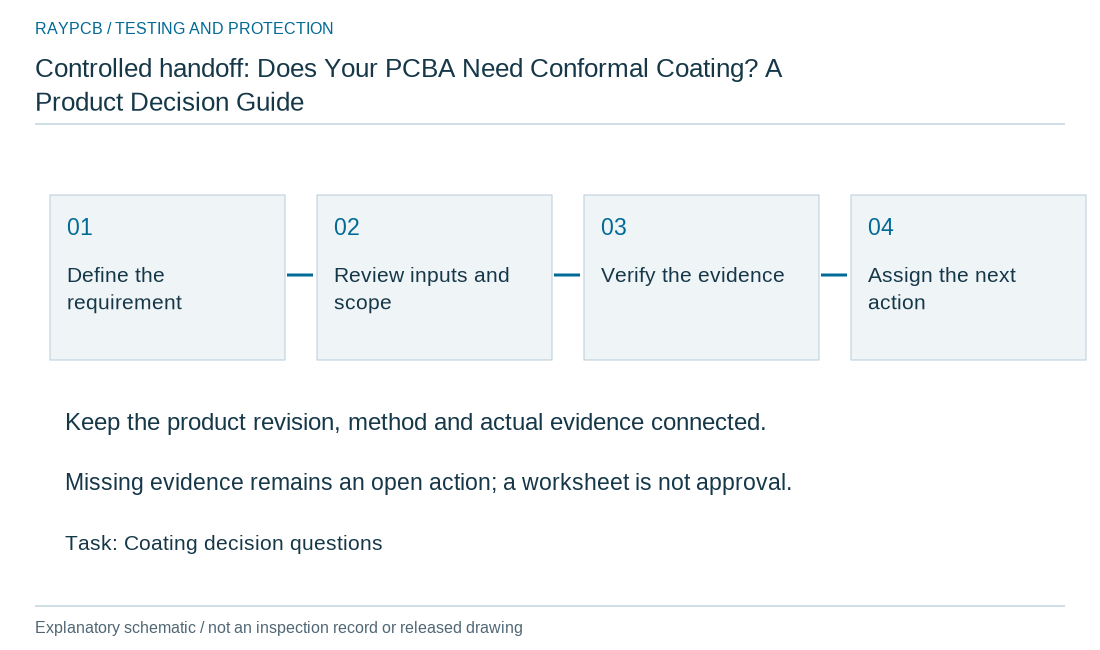
Conformal coating deserves consideration when the assembly's exposure creates a risk that a qualified film can meaningfully reduce. The decision should account for the enclosure, contamination, condensation, electrical sensitivity and service access. Coating is not automatically necessary for every board and is not a substitute for sound product design.
This page helps define the decision before specifying a resin or production process. The interactive brief maps entered exposure and access concerns to review questions; it does not approve an uncoated or coated design.

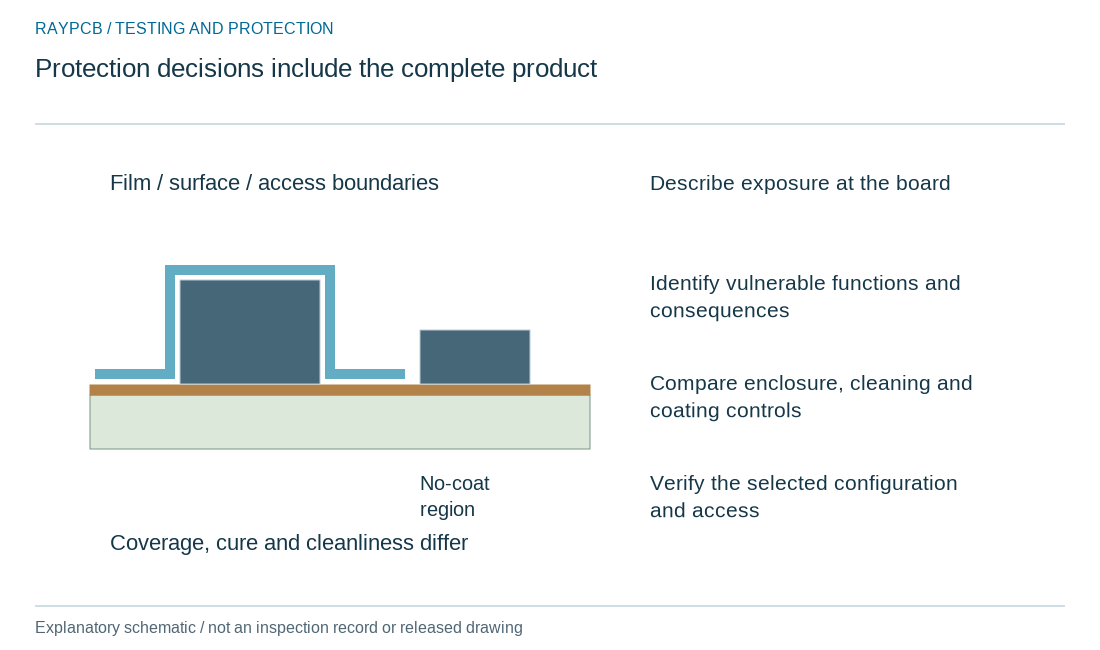
Describe the exposure at the board
Outdoor use does not tell the whole story. An enclosure may limit some exposure while creating condensation during temperature changes. Dust, salt, process chemicals and conductive contamination have different implications. Record the expected conditions at the assembly itself.
Separate normal service, transport, storage and maintenance. Identify how the environment changes over the product's life. A controlled office device and a controller near a washdown process should not receive the same decision solely because their PCBs look similar.
Identify the vulnerable functions
High-impedance analog circuits, closely spaced conductors and exposed interfaces may respond differently to moisture and contamination. Name the functions and failure consequences that matter. Coating coverage should be designed around those risks rather than treated as a uniform cosmetic finish.
Use the PCB reliability guide to connect the exposure to a plausible mechanism. The decision needs a reason that can later be verified through a suitable assembly-level test.
| Review item | What to establish |
|---|---|
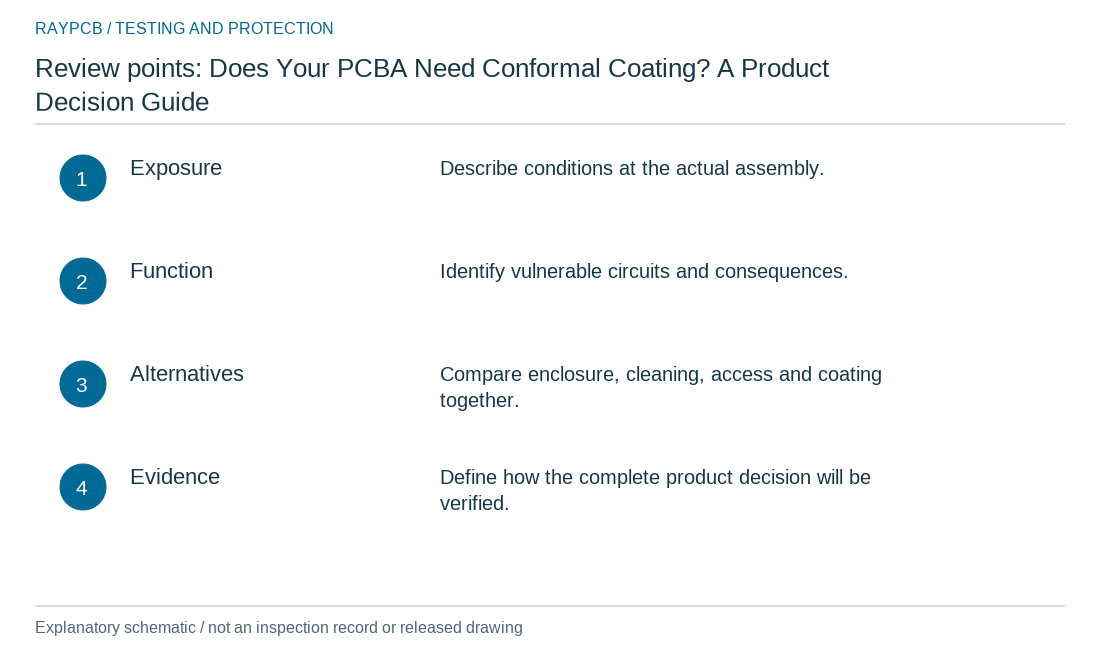
| Exposure | Describe conditions at the actual assembly. |
| Function | Identify vulnerable circuits and consequences. |
| Alternatives | Compare enclosure, cleaning, access and coating together. |
| Evidence | Define how the complete product decision will be verified. |
Compare protection options together
Enclosure sealing, ventilation strategy, connector selection, spacing, cleaning and coating can complement each other. A film cannot repair an unsuitable connector interface or guarantee hermetic protection. Consider how water or contaminants can reach uncoated regions and edges.
The right comparison is between complete product configurations. Do not compare a coating data sheet with an uncoated bare board and infer finished-product performance without testing the actual assembly conditions.
Account for manufacturing and repair consequences
Coating adds drawing requirements, masking, handling, cure, inspection and possible repair complexity. Test points and connectors may need to remain accessible. These are engineering decisions that should be made before the production sequence is released.
If coating is selected, use the PCBA conformal coating process to define the work. If a specific silicone product is being considered, the material guide addresses its compatibility and process questions.
Coating decision questions
Coating decision questions
Use the current inputs and keep the assumptions
Choose the engineering question before entering numbers. Fields begin blank. Load example fills teaching values so you can understand the model; those values are not recommended dimensions, process settings or market prices. The example label remains visible after edits. Reset before preparing a record based entirely on your own project data.
Use the displayed units and keep a reference for each input. Counts must describe the same scope, and measurements must share the declared conditions. A threshold entered by you remains your supplied review condition. The website does not turn it into an IPC limit or an approved product requirement. If the necessary value is unknown, obtain the evidence rather than replacing it with an attractive assumption.
Read the result and its limitations together. An access fraction is not fault coverage, a cost allowance is not a quotation, and a completed evidence checklist is not a safety or quality approval. Negative margins remain visible where the model permits them. They identify a conflict in the entered scenario rather than silently adjusting the result.
Changing an input invalidates the result and disables its download until you run the tool again. The text record contains the inputs, result and limitations. Processing stays in your browser; no CAD files, instruments or certificates are read. No data is automatically transferred to the enquiry form. Download and attach the record manually if useful, or contact RAYPCB directly without completing the tool.
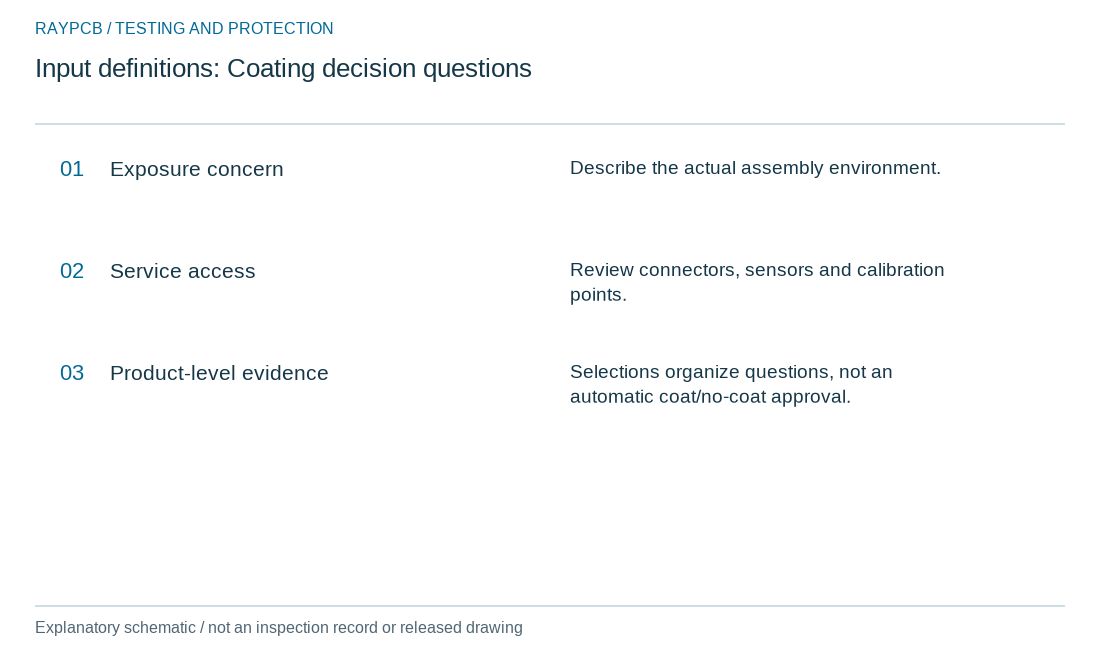
| Input | What to establish before using it |
|---|---|
| Review reference | Use a nonconfidential revision or scope reference. |
| Exposure concern | Describe the actual assembly environment. |
| Service access | Review connectors, sensors and calibration points. |
| Product-level evidence | Selections organize questions, not an automatic coat/no-coat approval. |
Define evidence for the decision
Plan representative samples and relevant exposure tests, monitored functions and acceptance criteria. Keep the proposed mechanism and test conditions connected. An attractive coated sample does not establish electrical performance after service exposure.
Record why a no-coating decision is acceptable too. Evidence may support protection through other product controls, but the basis should be explicit and reviewed when the environment or design changes.
Example: access conflicts with protection
An illustrative product needs periodic calibration through exposed contacts. Coating the contacts defeats the maintenance task, while leaving them exposed may retain an environmental risk. The solution requires coordinated contact design, enclosure access and protection, not a blanket instruction to coat or not coat.
Mark the conflict early and verify the selected product arrangement. The interactive brief keeps such unresolved items visible for the engineering discussion.
Make the enquiry about the decision you need
Provide the environment, assembly files, critical functions, enclosure information, service access and existing test evidence. State whether you need a coating feasibility review, material comparison or a quotation for an already released process.
RAYPCB's PCB assembly route can connect the chosen scope to manufacture and testing. The tool does not send project data or infer a product certification; contact the team directly when the question needs a file-based review.
Questions to resolve before the next build
Can conformal coating make an assembly waterproof? A coating decision should not be described as a hermetic or waterproof guarantee without the appropriate complete-product design and evidence. Interfaces, edges, connectors and damage can remain relevant. Define the expected exposure and verify the actual product configuration rather than relying on the appearance of a coated sample.
When should a no-coating decision be revisited? Review changes in environment, enclosure, contamination sources, sensitive circuitry, spacing, cleaning or service access. A decision supported for one configuration may not apply after those conditions change. Keep the original rationale and the new evidence so that the review is an engineering comparison rather than a preference for always coating or never coating.
Carry the protection decision through manufacturing
Treat protection as a complete assembly process. The relevant chain begins with the product environment and continues through material selection, surface condition, application, cure, inspection and service. A strong result at one step cannot compensate automatically for an unresolved interface or an unsuitable surface at another.
Use a controlled drawing to connect design intent to manufacturing. Mark coated regions, no-coat zones, connectors, sensors, mating faces and future test access. Define how edges and difficult geometry are handled. Include the assembly variant and sequence so that an operator does not have to infer whether a component is fitted before or after protection is applied.
Record the exact materials in contact with the process. Coating product, flux residue, cleaning chemistry, labels, adhesives and component surfaces can all matter. Keep technical and safety documentation available for the selected products. A resin-family name or a general compatibility table is a starting point for review, not proof that the complete combination is suitable.
Use representative trials to resolve uncertain geometry and process behavior. Include difficult access, tall components, shadowed regions and relevant no-coat boundaries. A flat coupon may help characterize some aspects, but it may not reproduce the populated assembly's flow, cure or service-access problems. State what each specimen represents.
Define verification in terms of the actual property. Coverage, thickness, cure, adhesion and electrical behavior are distinct. A fluorescent appearance can help show where a suitable material is present, but it should not be used as an unqualified substitute for every other requirement. Match the observation and method to the decision being made.
Consider the life of the product after shipment. Repairs, connector access, calibration and mechanical maintenance may disturb protection. Establish an approved route for any required removal and restoration, and keep the material identity traceable. If a change makes maintenance impractical, resolve the product tradeoff rather than leaving the service team an undocumented problem.
For purchasing, include preparation, masking, material handling, application, cure, inspection and repair assumptions in the scope. Material price alone rarely describes the complete operation. Ask which trials and records are included, and keep environmental qualification separate from routine production checks. A useful enquiry allows the manufacturing team to review the real assembly and explain the proposed route with its limits.
Standards, source context and limits
Use each reference for its stated scope. Equipment and material documentation applies to the identified product and conditions. A published study describes its own specimens and methods; its settings are not universal production limits. Public standard summaries and revision tables do not replace the controlled normative document.
Agree the applicable standards, revisions, product class where relevant, measurement methods and exceptions before production. Distinguish printed-board requirements, assembly workmanship, laboratory competence and finished-product certification. A method name or photograph does not establish that a supplier holds an accreditation or that a particular test is included in an order.
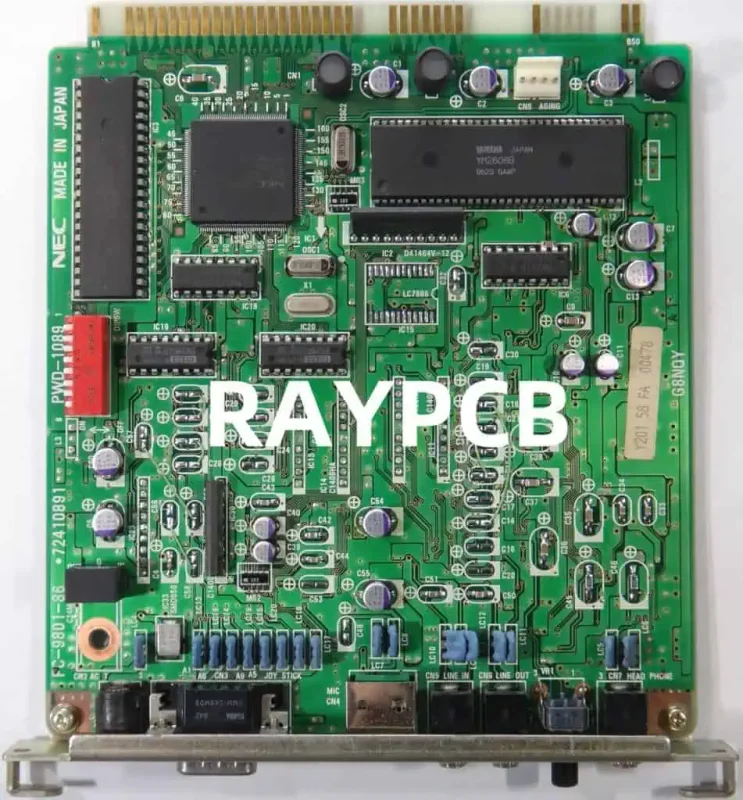
Archive photographs illustrate relevant boards, equipment or operations from the existing RAYPCB website. They are not evidence of current equipment ownership or results from your project. Original diagrams explain concepts and measurement boundaries; they are not inspection records or released manufacturing drawings. Confirm the actual service and reporting scope in the project review.