
RAYPCB · ENGINEERING REFERENCE
Pyralux LF: Adhesive Layers & Flex Thickness
Read LF construction codes with copper, acrylic and film counted separately. Compare base thickness and plan the complete flexible region.
Original engineering guidance · References checked September 27, 2026
What is Pyralux LF used for?
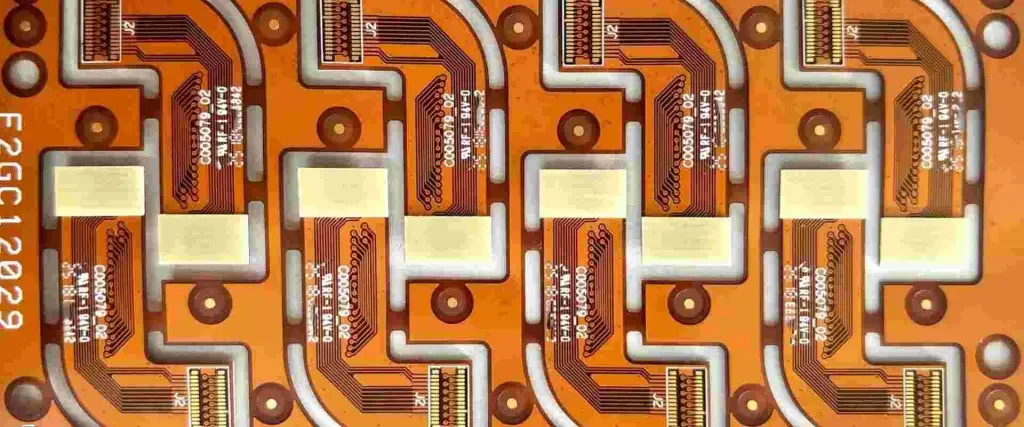
Pyralux LF is an acrylic-based flexible-circuit material family. Its copper-clad laminate uses polyimide film, acrylic bonding material and copper foil. The family name also appears on products serving other roles in a flexible construction. A purchase request must identify whether it calls for copper-clad base, coverlay, bond ply or adhesive sheet; these are not interchangeable forms of one finished PCB.
For a designer, the immediate task is to understand which layers already exist in the purchased material and which are added during circuit fabrication. This page concentrates on that distinction, the thickness consequences and the records needed for a useful enquiry. The Pyralux manufacturing overview covers the broader service route. Current manufacturer information is published by Qnity, while existing drawings may retain DuPont naming.
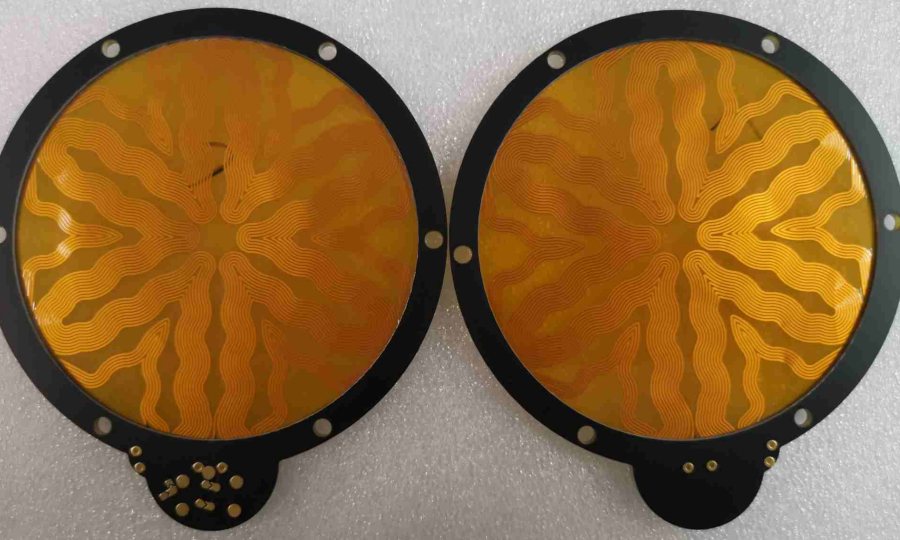
An adhesive-based construction is not automatically unsuitable for a demanding application. The decision depends on the actual circuit, environmental exposures, qualification and available process route. Equally, a familiar family name is not evidence that a previous design can be reproduced with an unspecified replacement. Preserve the complete construction code and approved specification, not just the yellow appearance of a sample circuit.
Decode the physical layers before comparing thickness
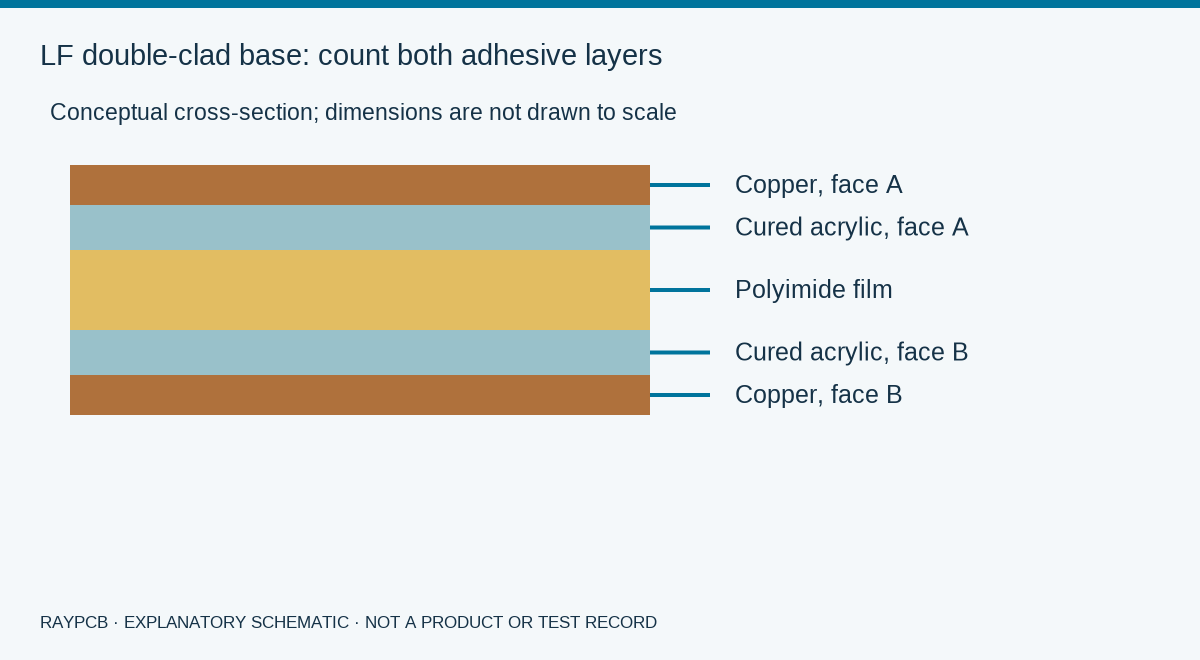
The examples below use the dated LF copper-clad laminate data sheet, EI-10117. They are a six-record reference subset rather than an availability list. Source-rounded micrometre values are retained. In a double-clad material, the listed copper and adhesive contributions occur on both faces of the central film.
| Reference | Copper faces | Copper per face, µm | Base adhesive per face, µm | Film, µm | Calculated base, µm |
|---|---|---|---|---|---|
| LF7012R | 1 | 18 | 13 | 13 | 44 |
| LF9110R | 1 | 35 | 25 | 25 | 85 |
| LF9120R | 1 | 35 | 25 | 51 | 111 |
| LF7022R | 2 | 18 | 13 | 13 | 75 |
| LF9111R | 2 | 35 | 25 | 25 | 145 |
| LF9121R | 2 | 35 | 25 | 51 | 171 |
Some entries on the supplier product webpage differ from the dated PDF. Use the linked document as the basis for these examples, and obtain confirmation of the construction actually being purchased. Do not combine one source's copper value with another source's film value and present the resulting sum as a certified specification.
Check single- and double-clad layer accounting
RAYPCB ENGINEERING
Pyralux MaterialsPyralux LF Layer Accounting
Loading Pyralux LF Layer Accounting…
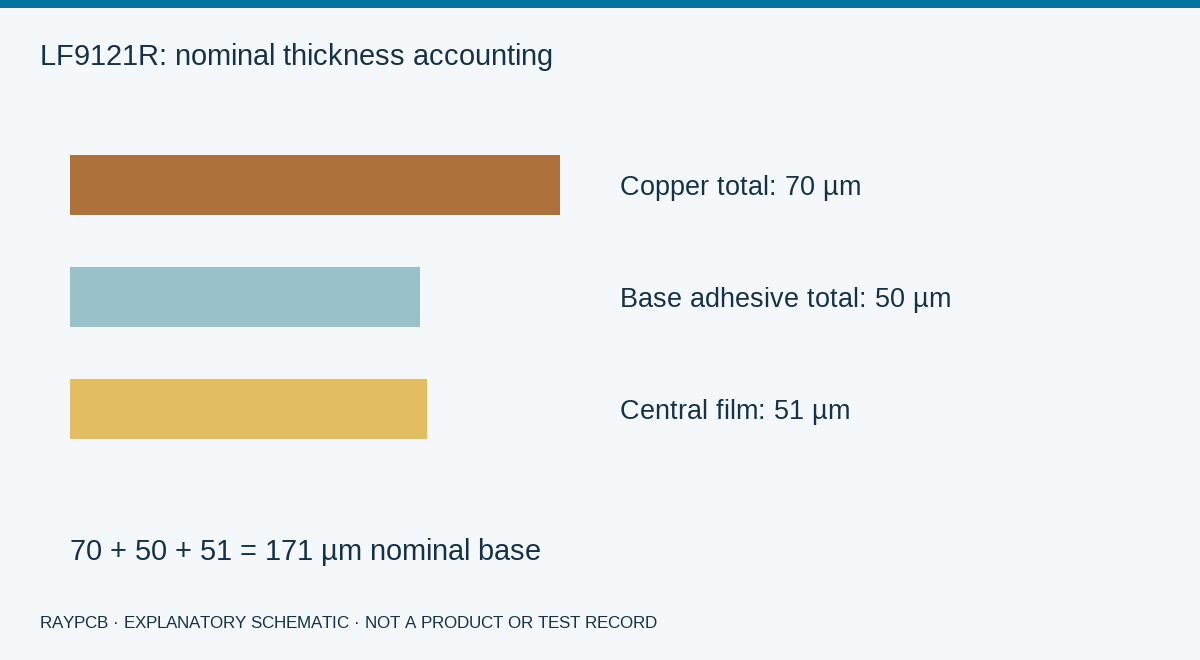
For a documented construction, the worksheet calculates base thickness = film + number of copper faces × (copper + base adhesive). LF9121R therefore gives 51 + 2 × (35 + 25) = 171 µm. The adhesive contribution is 50 µm, not 25 µm. Forgetting the second bonding layer understates the starting material before any coverlay or fabrication addition is considered.
The displayed adhesive percentage is simply adhesive thickness divided by the base sum. It is not resin content by weight, a dielectric-loss estimate, a strength prediction or a ranking of material quality. The visual bars help locate a thickness contribution; they do not model stress, thermal conduction or electrical fields. For constructions absent from the list, use the actual supplier specification rather than choosing the nearest-looking code.
Keep cured base adhesive separate from later bonding materials
The laminate arrives with its base bonding system already incorporated. A separate coverlay contributes film and adhesive over selected circuitry. Bond ply supports a different joining task between layers, while an unsupported adhesive sheet provides bonding without the same central film contribution. The manufacturer's laminate directory distinguishes these product roles; confirm the exact ordering item before specifying its thickness.
A practical stack ledger should include a column for delivered state and another for the contribution after the intended process. If the supplier quotes an uncured adhesive thickness, ask how the cured local thickness will be established. Resin flow around copper features makes the local condition important. A nominal sheet value is not necessarily the final spacing between adjacent conductors at every position on the board.
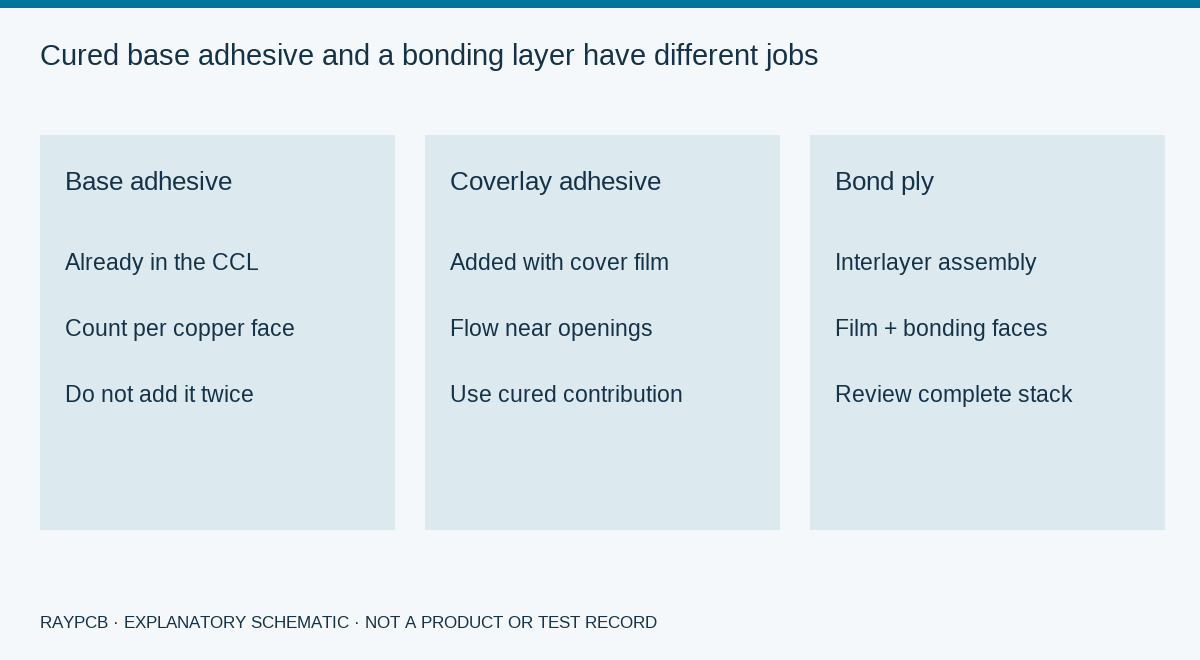
Avoid a common bookkeeping error: adding a complete copper-clad base to the stack, then adding its internal acrylic layer a second time. The reverse mistake is assuming a base material also includes the protective coverlay required by the drawing. Mark each physical boundary and identify the component that supplies it. That simple review can prevent a thickness mismatch from surviving into connector selection or prototype procurement.
Make the local measurement location explicit
Draw sections through the unsupported flex span, component area and insertion tab. Show copper that remains at the measurement point, coverlay openings and any local reinforcement. If the fabricator measures a solid witness area while the customer measures over a routed feature, an apparent disagreement may be a location-definition problem rather than a material error.
An illustrative LF9121R base is 171 µm. Adding two approved cover systems, each contributing 25 µm after processing, produces a nominal 221 µm covered section before other additions. Adding a 100 µm local support system at a connector creates a different nominal 321 µm section there. These assumed additions are an arithmetic example, not recommended coverlay or stiffener specifications. They show why one thickness label should not be copied across the entire outline.
Use the flex stackup planning page to organize the whole construction. The flex thickness guide helps distinguish a material nominal from the finished local dimension. Establish the allowed range and measurement method with the drawing; summing nominal values cannot generate valid manufacturing tolerances.
Consider bending, registration and conductor geometry together
For an installation bend, describe the formed shape and how the circuit is held. For repeated movement, also define the stroke, number of cycles, temperature range and attached mass. A supplier coupon test cannot be directly translated into the life of an assembled interconnect with plated conductors, cut edges and local support. The mechanical mission belongs in the design review before thickness is minimized.
Pay particular attention to the start and end of stiffeners, changes in coverlay coverage, and conductors near moving boundaries. An assembly fixture can introduce twisting that was absent from the flat CAD model. Show installation steps when they control the bend. A fabrication drawing should identify controlled dimensions without relying on a photograph to explain which region is meant to flex.
For electrical design, the field distribution depends on the complete conductor and dielectric arrangement. An acrylic layer adjacent to a trace is not equivalent to the central polyimide film. Do not assign one generic dielectric value to every layer in a controlled-impedance model. Name the line structure and actual materials, then use the PCB impedance reference to frame the geometry and verification discussion.
When AP or FR enters the discussion
An AP adhesiveless base removes the separate acrylic layers from that base construction. It does not remove every possible adhesive elsewhere in a finished circuit. Comparing AP with LF therefore starts with complete cross-sections, not a universal statement that one family always has lower cost, better bending life or superior electrical performance.
Pyralux FR addresses a different material-system requirement. Do not infer finished-board flame classification from similarity of construction or substitute LF for FR without the necessary approval. If a procurement request names a recognition or acceptance requirement, connect it to the actual finished construction and required records. A marketing description is not the acceptance document.
Before approving any alternative, compare foil type, adhesive system, film, local thickness, dimensional response and the qualification scope that matters to the product. Record the proposed difference explicitly. The most useful supplier response is often a marked construction comparison and a list of evidence still required, rather than a blanket statement of equivalence.
Estimate from the actual manufacturing scope
RAYPCB ENGINEERING
Pyralux MaterialsPyralux LF Documented Build Budget
Loading Pyralux LF Documented Build Budget…
LF circuit cost includes more than the purchased base. Panel utilization, outline complexity, opening preparation, local supports, inspection and lot size can change the allowance. The worksheet accepts an actual quoted or internal panel amount, a separate amount per ordered circuit and one-time setup. It does not carry current market rates or assume that every LF construction has the same process cost.
At 100 requested circuits, 12 geometric positions per panel and 90% expected usable output, the example requires ten panels. A panel allowance of 80, additional circuit allowance of 2 and setup of 150 give a total of 1,150 in the chosen currency. Check whether coverlay, tooling and testing are already included in the panel amount before entering additional costs. Changing currency does not perform an exchange-rate conversion.
Use the flex PCB cost estimator for a broader cost discussion. For a project response, send the exact LF role and code, drawing revision, quantities, coverlay data, local thickness requirements and expected motion. A direct RAYPCB enquiry is available without completing this worksheet; a manually attached brief can clarify unresolved assumptions.
LF questions that affect the release
Is LF9121R thickness the same as a completed circuit thickness?
No. The reference sum describes the starting copper-clad material. Include actual fabrication additions and local cover or reinforcement, then agree the finished measurement range and location.
Can the adhesive thickness percentage predict dielectric loss?
No. It is a geometric accounting result. Electrical behavior requires the properties and field distribution of the complete structure under the relevant conditions.
Does the LF name identify coverlay as well as copper-clad material?
The family includes different material roles. State the exact product form and ordering specification so procurement does not treat a coverlay or bonding item as the starting copper-clad base.
Is an unlisted construction unavailable?
The worksheet only includes six documented examples. Ask for the current ordering and supply information for your exact requirement. Absence from this teaching subset is not a discontinuation or stock statement.
Bring the requirement and the drawing together
Send the board revision, construction, quantity and the standard or engineering question you need reviewed. Identify unresolved requirements so the response can address them.
Send requirements for reviewOptional: attach the downloaded worksheet manually. This guidance does not certify a design, approve a shipment or replace the applicable authorized standards.