
RAYPCB · ENGINEERING & PROCUREMENT
PCB Manufacturing Lead-Time Risks: Find the Dependency That Controls Delivery
PCB manufacturing lead-time risks often appear before a board reaches production. Incomplete data, unapproved construction, unavailable materials, unresolved component choices and unfinished test preparation can all hold a build. A useful schedule distinguishes those prerequisites from fabrication, assembly and shipment. This guide helps buyers and engineers identify the controlling dependency and communicate a realistic release basis instead of relying on an unqualified number of days.
Your task: Define the start and finish. Use the build dependency and schedule planner to record the next decision.
Open build dependency and schedule planner · Discuss the project

Define when the clock starts
A quoted production interval may start after data approval, payment, material readiness or another stated condition. Ask for the exact start point and whether the interval uses working or calendar days. Do not compare two offers until those definitions match.
Separate quote response time, engineering review, material procurement, production, inspection release and transit. A promise about one interval is not a promise about the complete order-to-delivery path. State the destination and required arrival date separately from the requested ship date.
Keep date assumptions visible. Holidays, transport services and destination clearance are not automatically represented by a simple duration calculator. The supplier should confirm its own production commitment against the released scope.
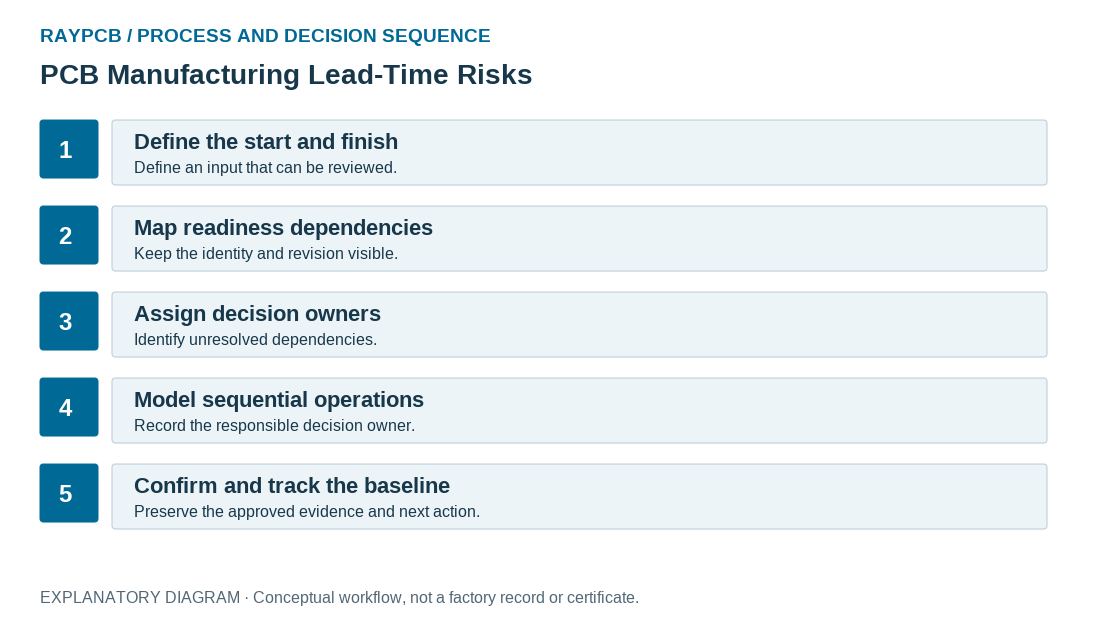
Map parallel prerequisites before adding durations
Approved files, materials and tooling may be prepared in parallel. The next operation can begin only after every required prerequisite is ready. Adding all parallel durations overstates one kind of schedule; ignoring the slowest prerequisite understates it.
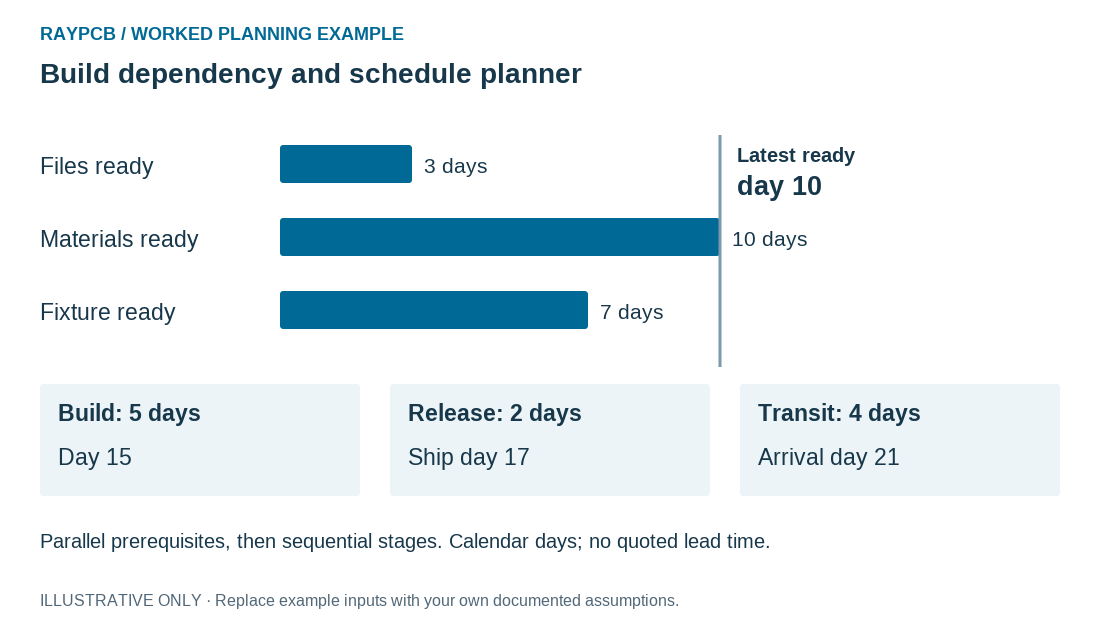
The worksheet uses a deliberately simple model: the latest of three readiness paths, followed by sequential build, release and transit durations. Enter all values on the same calendar-day basis. It does not model partial overlaps, factory capacity or complex project networks.
Build dependency and schedule planner
Build dependency and schedule planner
How to use and interpret this worksheet
Use calendar days measured from the same planning start for all three readiness paths: released files, accepted material and prepared fixtures or tests. Enter the remaining durations, not dates mixed with elapsed time. The worksheet does not include holiday calendars or convert working days automatically.
The model takes the maximum of those readiness durations because all three are prerequisites. It then adds sequential build, release and transit durations. Tied readiness paths are all reported as controlling. This simple model assumes the later operations do not overlap and that their stated inputs are available.
Complex projects may have partial builds, multiple suppliers or overlapping operations. Represent those in a more detailed schedule rather than forcing them into this model. Queue, customs, capacity, transport availability and customer approvals are not predicted; include only justified assumptions and confirm them with the responsible parties.
Use the output to identify the next decision that can actually affect arrival. Shortening a noncontrolling prerequisite may leave the total unchanged. That is useful information, not an error. Changing the route or release scope requires technical and commercial review.
The example is illustrative. Clear it before entering project durations, then download the current assumptions with the result. Edits invalidate previous output. No production slot is reserved and no delivery commitment is created. Confirm the final dates directly against the approved files, material status and supplier schedule.
Treat the output as a discussion schedule. If your operation can start partially before all materials arrive, document that as a separate route with its risks and acceptance conditions rather than hiding it inside a shorter number.
Close engineering questions with an owner and deadline
An engineering query can concern stackup, drill definition, impedance, dimensions, BOM identity or contradictory files. Record the specific decision required and who can make it. Forwarding the question to several people is not the same as assigning responsibility.
Give each open item a latest useful response date tied to the build. When a proposed answer changes design intent, obtain approval from the responsible engineer. Procurement should not approve a technical substitution solely to preserve the original date.
After resolution, update the authoritative package or controlled instruction. If the answer remains only in a message, a repeat order may recreate the same delay. The PCB assembly order checklist covers the release record after quotation.

Treat material availability as an evidenced condition
Distinguish stock advertised online, material reserved for an order and material received and accepted. Component availability can change between quotation and purchase. Laminate, special foil or unusual construction may also require procurement planning.
Record which items are long-lead or noncancelable and who authorizes commitment. For alternatives, separate commercial sourcing from engineering approval. A shorter lead time does not establish interchangeability.
If only part of the BOM is ready, discuss whether a partial build creates extra handling, inspection or rework. In some cases waiting is more efficient; in others a controlled split serves the project. The decision must reflect the actual assembly route and delivery objective.
Keep a decision record with the review
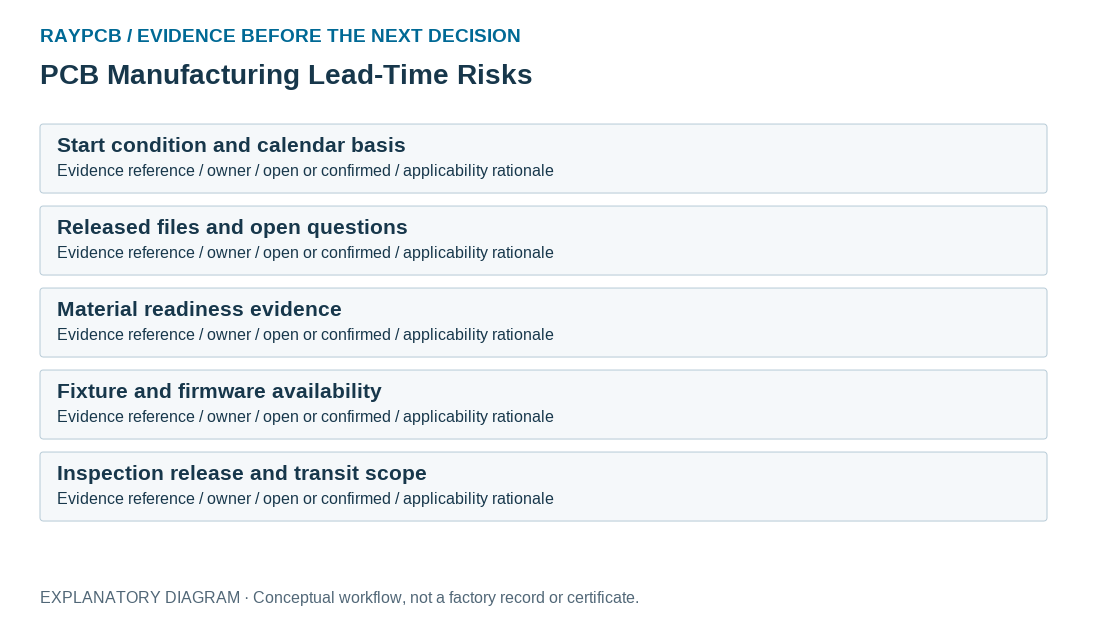
Use this record to connect the discussion to supporting information. Record the source, revision and reviewer for each item. Confirmed means the responsible person has reviewed the evidence; it does not mean this website has verified it. Keep confidential documents in your approved project system.
| Review topic | Record to retain | When it remains open |
|---|---|---|
| Start condition and calendar basis | Identify the controlled scope and the person authorized to approve it. Keep the current reference together with the intended decision. | Clarify the boundary before treating the review as a release instruction. |
| Released files and open questions | Reference the actual file, data source or agreed requirement, including its revision or date and the person who reviewed it. | Request the missing evidence and identify which downstream decision depends on it. |
| Material readiness evidence | Record the conditions and assumptions that make the evidence applicable. Separate a proposed value from an approved requirement. | Keep the assumption visible and define whether the next activity may proceed under a bounded exception. |
| Fixture and firmware availability | Identify responsibility for the next operation and the evidence expected afterward. Distinguish preparation from a completed result. | Assign a named role and an agreed decision point; do not turn an unanswered question into an approval. |
| Inspection release and transit scope | Record the final disposition, affected quantity or revision and the authority accepting it. Preserve the reason for any exception. | Retain the item in the action list and review its consequence before committing work or materials. |
Review the record again when the product, supplier proposal or supporting data changes. A result from an earlier revision is historical evidence, not automatic approval for the current one. If an item is not applicable, retain the reason and the person who made that decision.
Prepare tests and fixtures before boards arrive
A completed assembly can wait for firmware, programming access, a fixture or acceptance limits. These are production dependencies when they are required for release. Include their owners and readiness dates in the schedule from the start.
Confirm whether test development is part of the supplier quotation or retained by the customer. A request for functional testing needs a defined method, inputs, expected outputs and disposition of failures. A generic statement that every board should work is not an executable instruction.
For a hypothetical controller build, a six-day component delay may have no additional effect if the fixture already needs ten days. Once the fixture is ready, however, the same component can become the critical dependency. Schedule priorities should follow the actual paths, not the loudest individual delay.
Assess acceleration by what it changes
An expedite may shorten a queued operation, but cannot remove an unresolved design decision. Ask which interval changes, what assumptions apply and whether the revised plan affects cost, inspection or transport.
Avoid solving schedule pressure by silently removing tests or accepting unapproved substitutions. If a reduced scope is proposed, the responsible owner must review the consequences and document the release conditions.
The preliminary quote guide helps when the design is not frozen. It is better to issue a clear provisional schedule than a firm-looking date based on hidden assumptions.
Use status reports that show the next decision
A useful update identifies what is complete, what is waiting, the next event, the responsible owner and the effect on the target. Percent complete can be misleading when the unfinished item blocks every subsequent step.
Keep the original baseline and the revised forecast distinct. Record why dates changed so repeated problems can be addressed. A later delivery should not erase the evidence that led to the revised commitment.
For general process-improvement resources, the NIST Manufacturing Extension Partnership is an authoritative starting point. Project dates still require direct confirmation. This planning guide does not claim a measured RAYPCB on-time-delivery rate or reserve manufacturing capacity.
Questions before asking for a faster delivery
Should durations be working days? Use the basis specified by each responsible party, then convert consistently before comparing. The worksheet requires calendar-day inputs and does not contain holiday calendars.
Can a material substitution save the date? Sometimes, but only after technical review, availability confirmation and any required revalidation.
What should RAYPCB receive? Provide required arrival date, available files, known shortages, approvals and test responsibilities. Use PCB manufacturing or PCB assembly for the actual build request. Downloaded planning output can be attached manually; no schedule is booked by the tool.